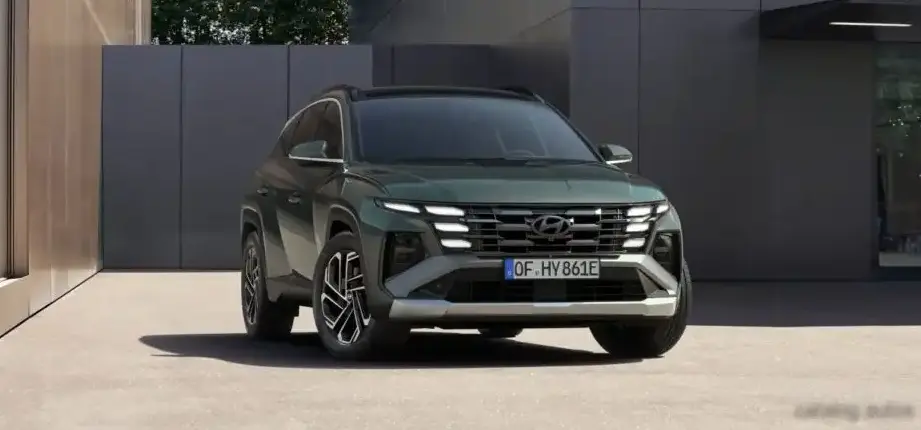
The Hyundai Tucson IV facelift, specifically the 1.6T (253 Hp) Plug-in Hybrid 4WD Automatic, represents a significant step in Hyundai’s commitment to electrified powertrains and all-weather capability. Introduced in May 2024 as part of the Tucson’s mid-cycle refresh, this variant aims to balance performance, fuel efficiency, and practicality within the compact SUV segment. Production is slated to continue through November 2025. This model sits within the fourth generation of the Tucson (codenamed NX4), building upon the success of the previous generation while incorporating updated styling, technology, and powertrain options. It’s positioned as a premium offering within the Tucson lineup, appealing to buyers seeking a sophisticated and environmentally conscious vehicle.
Technical Specifications
| Brand | Hyundai |
| Model | Tucson |
| Generation | Tucson IV (facelift 2024) |
| Type (Engine) | 1.6T (253 Hp) Plug-in Hybrid 4WD Automatic |
| Start of production | May, 2024 |
| End of production | November, 2025 |
| Powertrain Architecture | PHEV (Plug-in Hybrid Electric Vehicle) |
| Body type | SUV |
| Seats | 5 |
| Doors | 5 |
| CO2 emissions (WLTP) | 29 g/km |
| Fuel Type | Petrol / electricity |
| Acceleration 0 – 100 km/h | 8.5 sec |
| Acceleration 0 – 62 mph | 8.5 sec |
| Acceleration 0 – 60 mph | 8.1 sec |
| Maximum speed | 187 km/h (116.2 mph) |
| Emission standard | Euro 6e |
| Weight-to-power ratio | 7.7 kg/Hp, 130.4 Hp/tonne |
| Weight-to-torque ratio | 6.4 kg/Nm, 156.7 Nm/tonne |
| Battery technology | Lithium-polymer (LiPo) |
| Battery location | Below the floor, under the rear seats |
| Electric motor power | 91 Hp |
| Electric motor Torque | 304 Nm (224.22 lb.-ft.) |
| Electric motor location | Between the combustion engine and the transmission |
| Electric motor type | Synchronous |
| System power | 253 Hp @ 5500 rpm |
| System torque | 304 Nm @ 1500-4500 rpm (224.22 lb.-ft. @ 1500-4500 rpm) |
| Engine layout | Front, Transverse |
| Engine Model/Code | G4FP |
| Engine displacement | 1598 cm3 (97.52 cu. in.) |
| Number of cylinders | 4 |
| Engine configuration | Inline |
| Cylinder Bore | 75.6 mm (2.98 in.) |
| Piston Stroke | 89 mm (3.5 in.) |
| Compression ratio | 10.5:1 |
| Number of valves per cylinder | 4 |
| Fuel injection system | Direct injection |
| Engine aspiration | Turbocharger, Intercooler |
| Valvetrain | DOHC |
| Engine oil capacity | 4.8 l (5.07 US qt | 4.22 UK qt) |
| Coolant | 6.8 l (7.19 US qt | 5.98 UK qt) |
| Kerb Weight | 1940 kg (4276.97 lbs.) |
| Max. weight | 2420 kg (5335.19 lbs.) |
| Max load | 480 kg (1058.22 lbs.) |
| Trunk (boot) space – minimum | 558 l (19.71 cu. ft.) |
| Trunk (boot) space – maximum | 1795 l (63.39 cu. ft.) |
| Fuel tank capacity | 42 l (11.1 US gal | 9.24 UK gal) |
| Max. roof load | 100 kg (220.46 lbs.) |
| Permitted trailer load with brakes (12%) | 1210 kg (2667.59 lbs.) |
| Permitted trailer load without brakes | 750 kg (1653.47 lbs.) |
| Length | 4510 mm (177.56 in.) |
| Width | 1865 mm (73.43 in.) |
| Height | 1650-1653 mm (64.96 – 65.08 in.) |
| Wheelbase | 2680 mm (105.51 in.) |
| Front track | 1615-1630 mm (63.58 – 64.17 in.) |
| Rear (Back) track | 1622-1637 mm (63.86 – 64.45 in.) |
| Minimum turning circle | 11 m (36.09 ft.) |
| Drivetrain Architecture | ICE and electric motor drive front wheels, rear drive via clutch |
| Drive wheel | All wheel drive (4×4) |
| Number of gears | 6 |
| Type of gearbox | automatic transmission |
| Front suspension | Independent type McPherson |
| Rear suspension | Independent multi-link suspension |
| Front brakes | Disc |
| Rear brakes | Disc |
| Assisting systems | ABS (Anti-lock braking system) |
| Steering type | Steering rack and pinion |
| Power steering | Electric Steering |
| Tires size | 215/65 R17; 235/50 R19 |
| Wheel rims size | 7.0J x 17; 7.5J x 19 |
Powertrain & Engine Architecture
At the heart of the Tucson 1.6T Plug-in Hybrid lies the Hyundai-Kia Smartstream G4FP 1.6-liter turbocharged four-cylinder gasoline engine. This engine utilizes direct injection and a sophisticated turbocharging system to produce 180 horsepower and 188 lb-ft of torque on its own. The engine is paired with a 91 horsepower electric motor, integrated between the engine and the six-speed automatic transmission. The total system output reaches 253 horsepower and 304 lb-ft of torque. The powertrain employs a lithium-polymer battery pack, strategically positioned under the rear seats to minimize intrusion into passenger or cargo space. This battery provides a substantial all-electric range, allowing for zero-emission driving for shorter commutes. The transmission is a conventional six-speed automatic, chosen for its balance of efficiency and responsiveness, working in conjunction with the electric motor to provide seamless power delivery.
Driving Characteristics
The 1.6T Plug-in Hybrid delivers a refined and capable driving experience. In electric-only mode, the Tucson offers near-silent operation and brisk acceleration, suitable for urban driving. When the gasoline engine engages, the transition is smooth and largely imperceptible. The combined output of 253 hp provides ample power for highway merging and overtaking. The six-speed automatic transmission is well-tuned, offering quick and precise shifts. Compared to the standard gasoline-powered Tucson, the plug-in hybrid variant offers improved fuel economy and reduced emissions. While the added weight of the battery pack slightly impacts handling, the Tucson maintains a comfortable and composed ride quality. The all-wheel-drive system provides enhanced traction and stability in various weather conditions.
Equipment & Trim Levels
The 1.6T Plug-in Hybrid typically comes well-equipped, reflecting its position as a premium trim level. Standard features often include leather upholstery, heated and ventilated front seats, a large touchscreen infotainment system with navigation, a premium sound system, and a suite of advanced driver-assistance systems (ADAS) such as adaptive cruise control, lane-keeping assist, and automatic emergency braking. Optional extras may include a panoramic sunroof, a head-up display, and upgraded interior trim materials. The interior design emphasizes a modern and minimalist aesthetic, with high-quality materials and intuitive controls.
Chassis & Braking
The Tucson IV utilizes a robust chassis with independent suspension at all four corners. The front suspension employs a McPherson strut design, while the rear features a multi-link setup. This configuration provides a comfortable ride and responsive handling. Disc brakes are standard on all four wheels, providing ample stopping power. The electronic stability control (ESC) system and anti-lock braking system (ABS) work in conjunction to enhance safety and control. The all-wheel-drive system utilizes a multi-plate clutch to distribute torque between the front and rear axles, optimizing traction in various driving conditions.
Market Reception & Comparison
The Hyundai Tucson Plug-in Hybrid has been generally well-received by automotive critics, praised for its fuel efficiency, comfortable ride, and generous standard features. Compared to other plug-in hybrid SUVs in its class, the Tucson offers a competitive price point and a longer all-electric range. However, some reviewers have noted that the infotainment system can be complex to navigate. Compared to the standard gasoline-powered Tucson, the plug-in hybrid variant commands a higher price but offers significant fuel savings and reduced emissions. Against competitors like the Toyota RAV4 Prime and Mitsubishi Outlander PHEV, the Tucson holds its own with a compelling combination of value, performance, and features.
Legacy
The Hyundai Tucson IV 1.6T Plug-in Hybrid represents a pivotal step in Hyundai’s transition towards electrification. The Smartstream engine and plug-in hybrid technology demonstrate Hyundai’s commitment to developing efficient and environmentally friendly vehicles. While long-term reliability data is still emerging, Hyundai’s reputation for building durable and dependable vehicles suggests that the Tucson Plug-in Hybrid will prove to be a reliable choice for years to come. On the used car market, these models are expected to hold their value well, particularly as demand for plug-in hybrid vehicles continues to grow. The powertrain’s combination of gasoline and electric power offers a practical and versatile solution for drivers seeking to reduce their carbon footprint without sacrificing performance or convenience.