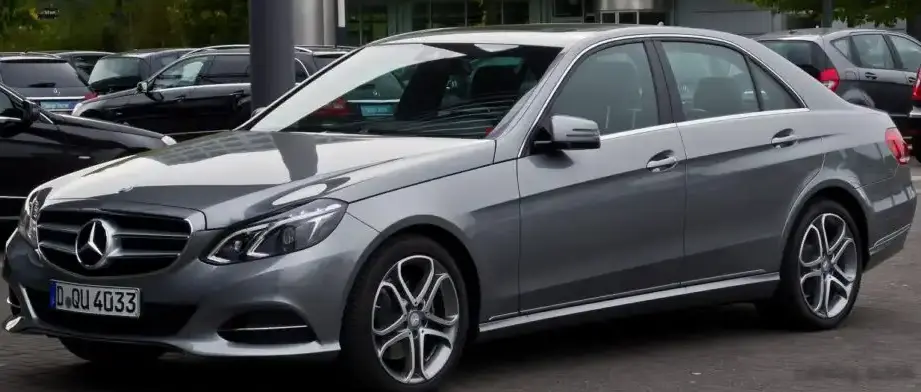
The Mercedes-Benz E 250 CDI, part of the W212 facelift generation produced from April 2013 to July 2014, represented a significant offering in the mid-size executive car segment. Positioned as a fuel-efficient and refined option within the E-Class lineup, it catered to buyers seeking a balance between performance, comfort, and economy. This variant utilized a 2.1-liter turbocharged diesel engine producing 204 horsepower, paired with a 6-speed manual transmission. It occupied a middle ground in the E-Class range, slotting below the more powerful E 350 models and above the entry-level E 200 CDI.
Technical Specifications
| Brand | Mercedes-Benz |
| Model | E-class |
| Generation | E-class (W212, facelift 2013) |
| Type (Engine) | E 250 CDI (204 Hp) |
| Start of production | April, 2013 |
| End of production | July, 2014 |
| Powertrain Architecture | Internal Combustion engine |
| Body type | Sedan |
| Seats | 5 |
| Doors | 4 |
| Fuel consumption (economy) – urban (NEDC) | 5.9-6.2 l/100 km (39.9 – 37.9 US mpg, 47.9 – 45.6 UK mpg, 16.9 – 16.1 km/l) |
| Fuel consumption (economy) – extra urban (NEDC) | 4.2-4.4 l/100 km (56 – 53.5 US mpg, 67.3 – 64.2 UK mpg, 23.8 – 22.7 km/l) |
| Fuel consumption (economy) – combined (NEDC) | 4.8-5.1 l/100 km (49 – 46.1 US mpg, 58.9 – 55.4 UK mpg, 20.8 – 19.6 km/l) |
| CO2 emissions (NEDC) | 126-132 g/km |
| Fuel Type | Diesel |
| Acceleration 0 – 100 km/h | 7.7 sec |
| Acceleration 0 – 62 mph | 7.7 sec |
| Acceleration 0 – 60 mph | 7.3 sec |
| Maximum speed | 240 km/h (149.13 mph) |
| Emission standard | Euro 5 |
| Weight-to-power ratio | 8.3 kg/Hp, 120.7 Hp/tonne |
| Weight-to-torque ratio | 3.4 kg/Nm, 295.9 Nm/tonne |
| Power | 204 Hp @ 3800 rpm |
| Power per litre | 95.2 Hp/l |
| Torque | 500 Nm @ 1600-1800 rpm (368.78 lb.-ft. @ 1600-1800 rpm) |
| Engine layout | Front, Longitudinal |
| Engine Model/Code | OM 651.924 |
| Engine displacement | 2143 cm3 (130.77 cu. in.) |
| Number of cylinders | 4 |
| Engine configuration | Inline |
| Cylinder Bore | 83 mm (3.27 in.) |
| Piston Stroke | 99 mm (3.9 in.) |
| Compression ratio | 16.2:1 |
| Number of valves per cylinder | 4 |
| Fuel injection system | Diesel Commonrail |
| Engine aspiration | BiTurbo, Intercooler |
| Valvetrain | DOHC |
| Engine oil capacity | 6.5 l (6.87 US qt | 5.72 UK qt) |
| Coolant | 10 l (10.57 US qt | 8.8 UK qt) |
| Kerb Weight | 1690 kg (3725.81 lbs.) |
| Max. weight | 2330 kg (5136.77 lbs.) |
| Max load | 640 kg (1410.96 lbs.) |
| Trunk (boot) space – minimum | 540 l (19.07 cu. ft.) |
| Fuel tank capacity | 59 l (15.59 US gal | 12.98 UK gal) |
| Max. roof load | 100 kg (220.46 lbs.) |
| Permitted trailer load with brakes (12%) | 1900 kg (4188.78 lbs.) |
| Permitted trailer load without brakes | 750 kg (1653.47 lbs.) |
| Permitted towbar download | 84 kg (185.19 lbs.) |
| Length | 4879 mm (192.09 in.) |
| Width | 1854 mm (72.99 in.) |
| Width including mirrors | 2071 mm (81.54 in.) |
| Height | 1474 mm (58.03 in.) |
| Wheelbase | 2874 mm (113.15 in.) |
| Front track | 1598 mm (62.91 in.) |
| Rear (Back) track | 1614 mm (63.54 in.) |
| Front overhang | 849 mm (33.43 in.) |
| Rear overhang | 1156 mm (45.51 in.) |
| Drag coefficient (Cd) | 0.25 |
| Minimum turning circle (turning diameter) | 11.28 m (37.01 ft.) |
| Drivetrain Architecture | The Internal combustion engine (ICE) drives the rear wheels of the vehicle. |
| Drive wheel | Rear wheel drive |
| Number of gears and type of gearbox | 6 gears, manual transmission |
Powertrain & Engine Architecture
The heart of the E 250 CDI is the OM 651.924 2.1-liter inline-four diesel engine. This engine is a highly refined unit, featuring common-rail direct injection and a sophisticated two-stage turbocharging system. The first turbocharger is a variable geometry turbo (VGT) that provides boost at low engine speeds, minimizing turbo lag and improving responsiveness. The second, smaller turbocharger kicks in at higher RPMs to maintain power output. This configuration delivers a broad torque curve, peaking at 500 Nm (368.78 lb-ft) between 1600 and 1800 rpm. The engine also incorporates an intercooler to further enhance performance by cooling the intake air. The 6-speed manual transmission offered with this variant provides precise gear changes and allows the driver to fully utilize the engine’s torque.
Driving Characteristics
The E 250 CDI with the manual transmission offered a balanced driving experience. While not as overtly sporty as the higher-powered E 350 models, it provided ample power for everyday driving and comfortable highway cruising. The 6-speed gearbox was well-matched to the engine’s characteristics, with relatively short ratios that kept the engine in its optimal torque band. Acceleration from 0 to 100 km/h (0-62 mph) took approximately 7.7 seconds. The manual transmission allowed for greater driver engagement compared to the optional 7G-TRONIC automatic, but required more effort in stop-and-go traffic. Fuel economy was a major strength, with combined cycle figures ranging from 4.8 to 5.1 liters per 100 kilometers (49-46.1 US mpg).
Equipment & Trim Levels
The E 250 CDI typically came standard with a generous array of features, including automatic climate control, a multi-function steering wheel, power-adjustable front seats, and a high-quality audio system. Interior upholstery was typically Artico leather, a synthetic leather alternative, although genuine leather was available as an option. Optional extras included a sunroof, navigation system, premium sound system, and various driver assistance features such as parking assist and lane keeping assist. Trim levels varied slightly depending on the market, but generally followed a progression from base ‘SE’ to more luxurious ‘Sport’ or ‘AMG Line’ specifications.
Chassis & Braking
The W212 E-Class featured a sophisticated chassis design. The front suspension utilized a multi-link setup with coil springs, while the rear suspension employed a multi-link independent suspension. This configuration provided a comfortable ride and good handling characteristics. The E 250 CDI typically came equipped with ventilated disc brakes at the front and solid disc brakes at the rear. Anti-lock braking system (ABS) and electronic stability control (ESC) were standard safety features. The steering was a rack-and-pinion system with electric power assistance.
Market Reception & Comparison
The E 250 CDI was generally well-received by automotive critics. It was praised for its fuel efficiency, refined engine, and comfortable ride. Compared to the E 350 models, the E 250 CDI offered a more economical option without sacrificing too much in terms of comfort or refinement. The manual transmission was appreciated by driving enthusiasts, but some reviewers noted that the automatic transmission provided a smoother and more convenient driving experience. Against competitors like the BMW 520d and Audi A6 2.0 TDI, the E 250 CDI held its own, offering a compelling combination of performance, economy, and luxury.
Legacy
The OM 651 engine family, including the 2.1-liter variant used in the E 250 CDI, has proven to be remarkably durable and reliable. These engines are known for their longevity and relatively low maintenance costs. On the used car market, the E 250 CDI remains a popular choice for buyers seeking a well-built and fuel-efficient executive car. However, potential buyers should be aware of the potential for diesel particulate filter (DPF) issues, particularly on vehicles that have primarily been used for short journeys. Overall, the E 250 CDI represents a solid and dependable option in the mid-size luxury segment.