
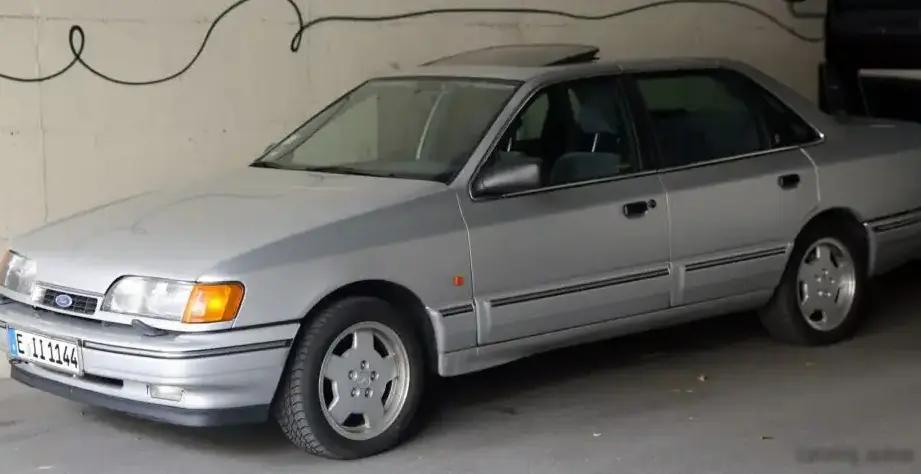
The Ford Scorpio I, produced between 1985 and 1992, represented a significant step forward for Ford of Europe’s executive car offerings. Replacing the Consul and Granada, the Scorpio (designated GAE and GGE) aimed to compete with vehicles like the Opel/Vauxhall Senator and Rover 800. The 2.0i variant, powered by the Ford NRA/NRI engine producing 115 horsepower, occupied a middle ground in the Scorpio lineup, offering a balance between performance and affordability. It was positioned as a more accessible option compared to the higher-specification 2.8i and 2.9i models, while still providing a comfortable and well-equipped driving experience.
Technical Specifications
| Brand | Ford |
| Model | Scorpio |
| Generation | Scorpio I (GAE, GGE) |
| Type (Engine) | 2.0i (115 Hp) |
| Start of production | 1985 |
| End of production | 1992 |
| Powertrain Architecture | Internal Combustion engine |
| Body type | Sedan |
| Seats | 4 |
| Doors | 4 |
| Fuel Type | Petrol (Gasoline) |
| Acceleration 0 – 100 km/h | 11.2 sec |
| Acceleration 0 – 62 mph | 11.2 sec |
| Acceleration 0 – 60 mph | 10.6 sec |
| Maximum speed | 192 km/h (119.3 mph) |
| Power | 115 Hp @ 5500 rpm |
| Power per litre | 57.7 Hp/l |
| Torque | 160 Nm @ 4000 rpm (118.01 lb.-ft. @ 4000 rpm) |
| Engine layout | Front, Longitudinal |
| Engine Model/Code | NRA, NRI |
| Engine displacement | 1993 cm3 (121.62 cu. in.) |
| Number of cylinders | 4 |
| Engine configuration | Inline |
| Cylinder Bore | 90.8 mm (3.57 in.) |
| Piston Stroke | 77 mm (3.03 in.) |
| Number of valves per cylinder | 4 |
| Fuel injection system | Multi-port manifold injection |
| Engine aspiration | Naturally aspirated engine |
| Valvetrain | DOHC |
| Engine oil capacity | 3.8 l (4.02 US qt | 3.34 UK qt) |
| Coolant | 8 l (8.45 US qt | 7.04 UK qt) |
| Max. weight | 1260 kg (2777.82 lbs.) |
| Fuel tank capacity | 70 l (18.49 US gal | 15.4 UK gal) |
| Length | 4744 mm (186.77 in.) |
| Width | 1766 mm (69.53 in.) |
| Height | 1450 mm (57.09 in.) |
| Wheelbase | 2761 mm (108.7 in.) |
| Minimum turning circle | 10.4 m (34.12 ft.) |
| Drivetrain Architecture | Rear wheel drive |
| Drive wheel | Rear wheel drive |
| Number of gears | 5 gears, manual transmission |
| Front brakes | Ventilated discs |
| Rear brakes | Disc |
| Steering type | Steering rack and pinion |
Powertrain & Engine Architecture
The heart of the Scorpio 2.0i was the Ford NRA or NRI engine, a 1.993-liter inline-four cylinder powerplant. This engine featured a double overhead camshaft (DOHC) valvetrain, operating four valves per cylinder. Fuel delivery was handled by a multi-port fuel injection system, contributing to improved efficiency and responsiveness compared to earlier carbureted designs. The engine’s longitudinal mounting within the front engine bay, coupled with rear-wheel drive, was a configuration common to many European executive cars of the era. The 5-speed manual transmission was the standard offering, providing a relatively direct connection between the engine and the rear wheels. The engine was known for its relatively smooth operation and decent mid-range torque, although it lacked the outright punch of the larger displacement engines available in the Scorpio range.
Driving Characteristics
The 2.0i Scorpio offered a comfortable, if not particularly sporty, driving experience. With 115 horsepower and 160 Nm (118 lb-ft) of torque, acceleration was adequate for everyday driving, but overtaking required careful planning. The five-speed manual transmission allowed drivers to keep the engine in its optimal power band, but the relatively long gearing emphasized fuel economy over outright performance. Compared to the 2.8i and 2.9i versions, the 2.0i felt noticeably less powerful, especially at higher speeds. However, the lighter weight of the 2.0i engine contributed to slightly improved handling balance. The rear-wheel-drive configuration provided a traditional driving feel, favored by many enthusiasts, but also demanded respect in adverse weather conditions.
Equipment & Trim Levels
The Scorpio 2.0i typically came equipped with a respectable level of standard features for its time. These included central locking, electric front windows, and a basic stereo system. Interior upholstery was generally cloth, with options for upgraded velour or leather available at extra cost. Dashboard design was functional and straightforward, with clear instrumentation. Optional extras included a sunroof, air conditioning, and upgraded sound systems. The trim level could vary depending on the market, but generally, the 2.0i was positioned as a mid-range offering, bridging the gap between the more basic models and the luxury-oriented higher-spec versions.
Chassis & Braking
The Scorpio I utilized a traditional body-on-frame construction, providing a robust and durable chassis. Suspension consisted of independent front suspension with MacPherson struts and a live axle rear suspension with coil springs. The 2.0i models typically featured ventilated disc brakes on the front wheels and disc brakes on the rear, providing adequate stopping power for the vehicle’s weight and performance. Stabilizer bars were fitted to both the front and rear axles to reduce body roll during cornering. The steering system employed a rack and pinion setup, offering precise and responsive steering feel.
Market Reception & Comparison
The Scorpio 2.0i was generally well-received by automotive critics as a practical and comfortable family car. It was praised for its spacious interior, comfortable ride, and relatively affordable price point. However, some critics noted that the 2.0i engine lacked the refinement and performance of its larger counterparts. Compared to the 2.8i and 2.9i models, the 2.0i offered better fuel economy, but at the expense of performance. The 2.0i also represented a more economical alternative to rivals like the Opel Senator and Rover 800, making it an attractive option for buyers seeking a well-equipped executive car without breaking the bank.
Legacy
The Ford Scorpio I, including the 2.0i variant, has developed a cult following among classic car enthusiasts. The NRA/NRI engine, while not known for being particularly high-performance, is generally considered to be reliable and relatively easy to maintain. Parts availability can be a challenge, but a dedicated network of Scorpio owners and specialists exists to support the preservation of these vehicles. Today, well-maintained Scorpio 2.0i models are increasingly sought after by collectors and enthusiasts who appreciate their classic styling, comfortable ride, and rear-wheel-drive character. The Scorpio I represents a significant chapter in Ford of Europe’s history, and the 2.0i variant remains a testament to the brand’s commitment to providing practical and affordable transportation.
