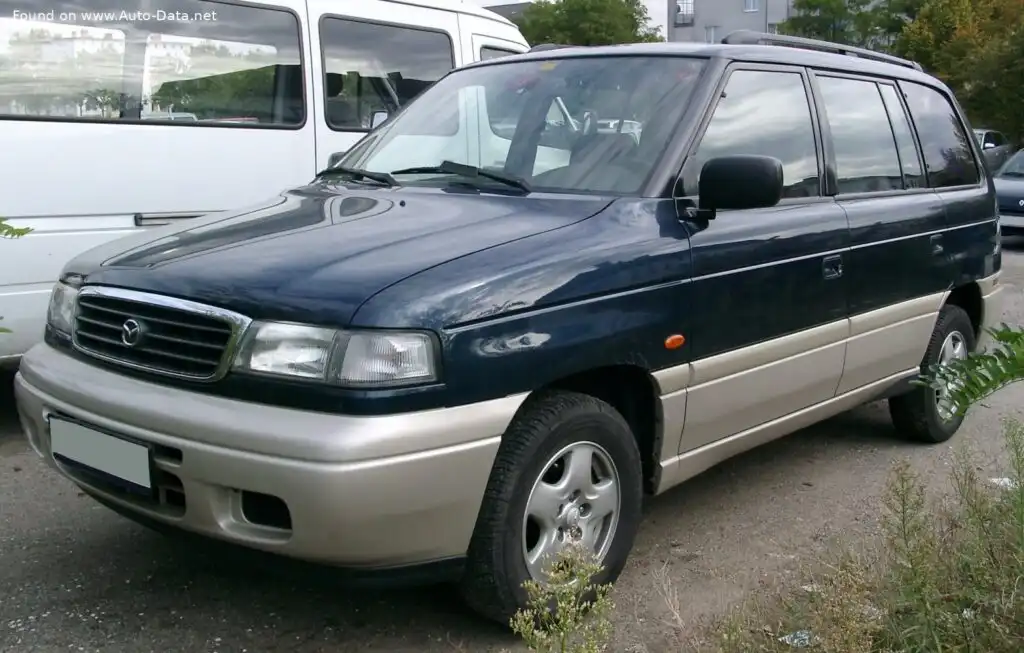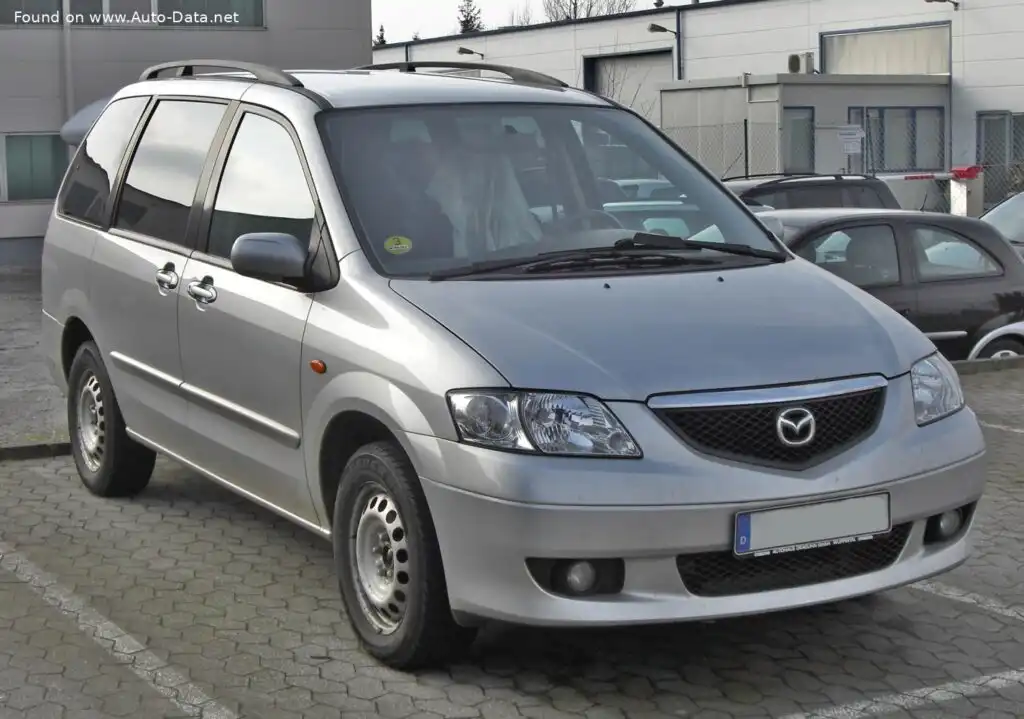
The Mazda MPV II (LW) 2.0, produced between 1999 and 2002, represented Mazda’s second-generation entry into the mid-size minivan segment. Positioned as a practical and family-oriented vehicle, the LW MPV aimed to compete with established players like the Honda Odyssey and Toyota Sienna, particularly in markets outside of North America where minivans maintained stronger popularity. This 2.0-liter variant, producing 122 horsepower, served as a more affordable and fuel-conscious option within the MPV II lineup, slotting below the more powerful V6 engine offerings. The LW generation MPV was built on Mazda’s GC platform, shared with other models like the Mazda Premacy/Familia Van.
Technical Specifications
| Brand | Mazda |
| Model | MPV |
| Generation | MPV II (LW) |
| Type (Engine) | 2.0 (122 Hp) |
| Start of production | 1999 |
| End of production | 2002 |
| Powertrain Architecture | Internal Combustion engine |
| Body type | Minivan |
| Seats | 7 |
| Doors | 5 |
| Fuel consumption (urban) | 12.6 l/100 km (18.7 US mpg) |
| Fuel consumption (extra urban) | 8.6 l/100 km (27.4 US mpg) |
| Fuel consumption (combined) | 10.1 l/100 km (23.3 US mpg) |
| Fuel Type | Petrol (Gasoline) |
| Acceleration 0 – 100 km/h | 14.2 sec |
| Acceleration 0 – 62 mph | 14.2 sec |
| Acceleration 0 – 60 mph | 13.5 sec |
| Maximum speed | 180 km/h (111.85 mph) |
| Weight-to-power ratio | 13.1 kg/Hp |
| Weight-to-torque ratio | 9.1 kg/Nm |
| Power | 122 Hp @ 5800 rpm |
| Torque | 175 Nm @ 3800 rpm (129.07 lb.-ft. @ 3800 rpm) |
| Engine layout | Front, Transverse |
| Engine displacement | 1991 cm3 (121.5 cu. in.) |
| Number of cylinders | 4 |
| Engine configuration | Inline |
| Cylinder Bore | 83 mm (3.27 in.) |
| Piston Stroke | 92 mm (3.62 in.) |
| Compression ratio | 9.7:1 |
| Number of valves per cylinder | 4 |
| Fuel injection system | Multi-port manifold injection |
| Engine aspiration | Naturally aspirated engine |
| Valvetrain | DOHC |
| Kerb Weight | 1600 kg (3527.4 lbs.) |
| Max. weight | 2230 kg (4916.31 lbs.) |
| Max load | 630 kg (1388.91 lbs.) |
| Trunk (boot) space – minimum | 294 l (10.38 cu. ft.) |
| Trunk (boot) space – maximum | 1600 l (56.5 cu. ft.) |
| Fuel tank capacity | 70 l (18.49 US gal) |
| Length | 4750 mm (187.01 in.) |
| Width | 1830 mm (72.05 in.) |
| Height | 1775 mm (69.88 in.) |
| Wheelbase | 2840 mm (111.81 in.) |
| Front track | 1545 mm (60.83 in.) |
| Rear track | 1545 mm (60.83 in.) |
| Drivetrain Architecture | Front wheel drive |
| Number of gears | 5 gears, manual transmission |
| Front suspension | Spring Strut |
| Rear suspension | Coil spring |
| Front brakes | Ventilated discs |
| Rear brakes | Drum |
| Assisting systems | ABS (Anti-lock braking system) |
| Steering type | Steering rack and pinion |
| Power steering | Hydraulic Steering |
| Tires size | 205/65 R15 |
| Wheel rims size | 15 |
Powertrain & Engine Architecture
The heart of this MPV variant is the Mazda-developed 1.991-liter (2.0L) inline-four cylinder engine, typically identified by engine codes like F8. This engine utilizes a naturally aspirated configuration with multi-port fuel injection and a double overhead camshaft (DOHC) valvetrain. The 9.7:1 compression ratio was a common figure for engines of this era, balancing performance and fuel efficiency. The engine’s 122 horsepower at 5800 rpm and 175 Nm (129 lb-ft) of torque at 3800 rpm were respectable for its displacement, but not particularly groundbreaking. The five-speed manual transmission was the standard offering, designed to maximize the engine’s limited power band. The transmission’s gear ratios were tuned for everyday drivability rather than outright acceleration.
Driving Characteristics
The 2.0-liter MPV II, with its manual transmission, offered a reasonably pleasant driving experience, though it wasn’t known for its sporty performance. Acceleration was adequate for merging onto highways and navigating city streets, but fully loaded with passengers and cargo, the engine could feel strained, especially when climbing hills. The five-speed manual allowed drivers to keep the engine in its optimal power range, but required more driver involvement than the automatic transmissions offered on other MPV trims. Compared to the available V6 engine, the 2.0L felt noticeably slower, with a 0-60 mph time around 13.5 seconds. The front-wheel-drive configuration provided predictable handling, but lacked the all-weather capability of an all-wheel-drive system.
Equipment & Trim Levels
The 2.0-liter MPV II typically represented the entry-level trim in many markets. Standard features generally included power windows and locks, air conditioning, and a basic audio system. Interior upholstery was typically cloth, and the dashboard featured a functional, if somewhat utilitarian, design. Optional extras could include alloy wheels, a sunroof, upgraded audio systems, and rear air conditioning. The focus of this trim level was on providing a practical and affordable family vehicle, prioritizing space and functionality over luxury features.
Chassis & Braking
The MPV II utilized a conventional front-wheel-drive chassis with a MacPherson strut suspension in the front and a coil spring suspension in the rear. The suspension was tuned for comfort, providing a relatively smooth ride over most road surfaces. Braking duties were handled by ventilated discs in the front and drum brakes in the rear. Anti-lock Braking System (ABS) was standard, enhancing safety during emergency braking situations. The relatively modest weight of the 2.0L variant, around 1600 kg (3527 lbs), helped to mitigate the limitations of the braking system.
Market Reception & Comparison
The Mazda MPV II 2.0 received mixed reviews. Critics generally praised its spacious interior, practical design, and relatively affordable price point. However, the 2.0-liter engine was often criticized for being underpowered, particularly when compared to the V6 options available. Fuel economy was considered reasonable for a vehicle of its size, averaging around 23.3 US mpg in combined driving. Compared to competitors like the Honda Odyssey and Toyota Sienna, the MPV II often lagged in terms of refinement and performance, but offered a compelling value proposition for budget-conscious buyers.
Legacy
The Mazda MPV II 2.0, while not the most powerful or technologically advanced minivan of its era, proved to be a reliable and durable vehicle. The F8 engine, when properly maintained, is known for its longevity. Today, these MPVs can be found in the used car market at very affordable prices. While they may not appeal to those seeking a modern minivan with advanced features, they remain a viable option for those needing a spacious and practical vehicle for family transportation, particularly for those who prioritize simplicity and affordability over performance and luxury. Parts availability is generally good, and the relatively straightforward mechanical design makes them relatively easy to maintain for DIY mechanics.