
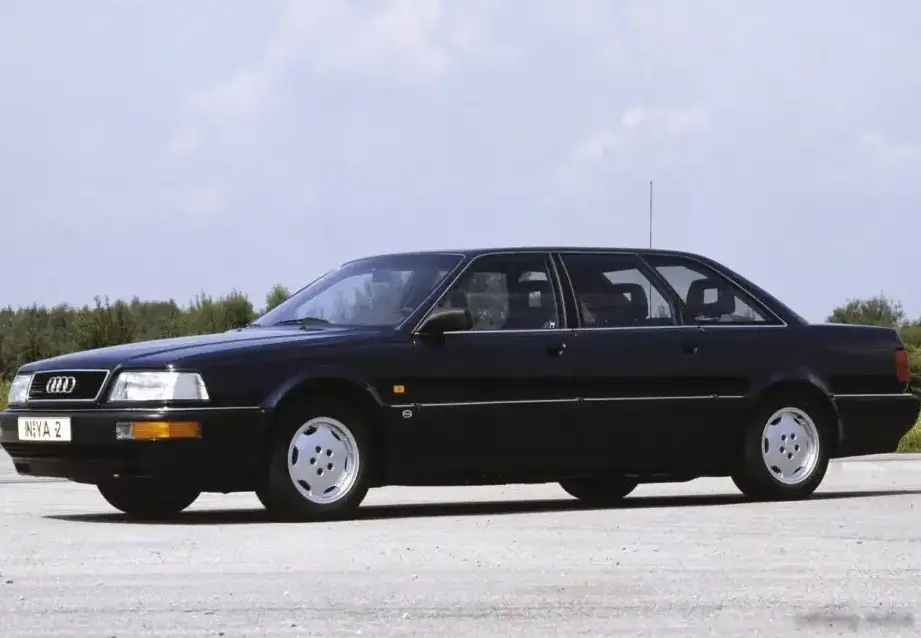
The Audi V8L (D11) 3.6 quattro Automatic, produced between May 1991 and April 1994, represented a significant step forward for Audi, solidifying its position in the luxury performance sedan market. As an evolution of the original Audi V8 (D11) launched in 1988, the “L” designation denoted a long-wheelbase version, offering increased rear passenger space. This variant, equipped with the 3.6-liter V8 engine and a five-speed automatic transmission, was positioned as a premium offering within the V8 range, appealing to buyers seeking a blend of power, comfort, and all-weather capability. It was built on the Audi 1HX0 platform, shared with other early 1990s Audi models.
Technical Specifications
| Brand | Audi |
| Model | V8 |
| Generation | V8L (D11) |
| Type (Engine) | 3.6 (250 Hp) quattro Automatic |
| Start of production | May, 1991 |
| End of production | April, 1994 |
| Powertrain Architecture | Internal Combustion engine |
| Body type | Sedan |
| Seats | 4 |
| Doors | 4 |
| Fuel consumption (urban) | 17.1 l/100 km (13.8 US mpg) |
| Fuel consumption (extra urban) | 8.9 l/100 km (26.4 US mpg) |
| Fuel Type | Petrol (Gasoline) |
| Acceleration 0 – 100 km/h | 9.1 sec |
| Acceleration 0 – 62 mph | 9.1 sec |
| Acceleration 0 – 60 mph | 8.6 sec |
| Maximum speed | 235 km/h (146.02 mph) |
| Weight-to-power ratio | 7.1 kg/Hp |
| Weight-to-torque ratio | 5.2 kg/Nm |
| Power | 250 Hp @ 5800 rpm |
| Torque | 340 Nm @ 4000 rpm (250.77 lb.-ft. @ 4000 rpm) |
| Engine layout | Front, Longitudinal |
| Engine Model/Code | PT |
| Engine displacement | 3562 cm3 (217.37 cu. in.) |
| Number of cylinders | 8 |
| Engine configuration | V-engine |
| Cylinder Bore | 81 mm (3.19 in.) |
| Piston Stroke | 86.4 mm (3.4 in.) |
| Compression ratio | 10.6:1 |
| Number of valves per cylinder | 4 |
| Fuel injection system | Multi-port manifold injection |
| Engine aspiration | Naturally aspirated engine |
| Valvetrain | DOHC |
| Engine oil capacity | 8 l (8.45 US qt | 7.04 UK qt) |
| Coolant | 10.5 l (11.1 US qt | 9.24 UK qt) |
| Kerb Weight | 1770 kg (3902.18 lbs.) |
| Max. weight | 2310 kg (5092.68 lbs.) |
| Max load | 540 kg (1190.5 lbs.) |
| Trunk (boot) space – minimum | 570 l (20.13 cu. ft.) |
| Fuel tank capacity | 80 l (21.13 US gal | 17.6 UK gal) |
| Max. roof load | 75 kg (165.35 lbs.) |
| Length | 5190 mm (204.33 in.) |
| Width | 1814 mm (71.42 in.) |
| Height | 1420 mm (55.91 in.) |
| Wheelbase | 3018 mm (118.82 in.) |
| Front track | 1514 mm (59.61 in.) |
| Rear (Back) track | 1531 mm (60.28 in.) |
| Ride height (ground clearance) | 94 mm (3.7 in.) |
| Minimum turning circle | 12.9 m (42.32 ft.) |
| Drivetrain Architecture | All wheel drive (4×4) |
| Number of gears and type of gearbox | 5 gears, automatic transmission |
| Front suspension | Spring Strut |
| Rear suspension | Coil spring |
| Front brakes | Ventilated discs |
| Rear brakes | Disc |
| Assisting systems | ABS (Anti-lock braking system) |
| Steering type | Steering rack and pinion |
| Power steering | Hydraulic Steering |
| Tires size | 215/60 R15 |
| Wheel rims size | 7.5J x 15 |
Powertrain & Engine Architecture
The heart of the V8L 3.6 quattro Automatic is the PT engine, a naturally aspirated 3.6-liter (3562 cc) V8. This engine featured a 90-degree V-angle, contributing to a smooth power delivery. It utilized a cast iron block with aluminum cylinder heads, and employed a dual overhead camshaft (DOHC) valvetrain with four valves per cylinder. Fuel delivery was managed by a Bosch Motronic multi-port fuel injection system. The engine produced 250 horsepower at 5800 rpm and 340 Nm (250.77 lb-ft) of torque at 4000 rpm. The five-speed automatic transmission, a ZF 4HP22 unit, was chosen for its smoothness and reliability. This transmission featured electronic control for optimized shift points, though it wasn’t known for particularly quick shifts compared to manual transmissions available in other V8 models.
Driving Characteristics
The 3.6-liter engine, coupled with the automatic transmission, provided a comfortable and refined driving experience. While not as overtly sporty as the manual transmission variants or the higher-output 4.2-liter V8, the automatic offered effortless cruising and adequate acceleration. The 0-60 mph time of around 8.6 seconds was respectable for the early 1990s. The automatic transmission’s gear ratios were geared towards relaxed highway driving, prioritizing fuel economy and smoothness over outright performance. Compared to the 2.8-liter V6 models, the 3.6 offered significantly more power and torque, resulting in a more confident and capable driving experience, especially when fully loaded or towing. However, the added weight of the larger engine and automatic transmission did impact handling slightly compared to lighter, manual-equipped models.
Equipment & Trim Levels
The V8L 3.6 quattro Automatic was well-equipped for its time. Standard features typically included leather upholstery, power-adjustable front seats, climate control, power windows and locks, and an upgraded sound system. The “L” designation meant extended rear legroom, enhancing passenger comfort. Optional extras included a sunroof, upgraded audio systems, and various trim enhancements. The interior design was characterized by a clean, functional layout with high-quality materials. Wood trim was often included as a standard or optional feature, adding to the luxurious ambiance.
Chassis & Braking
The V8L featured a robust chassis with independent suspension all around. The front suspension utilized MacPherson struts, while the rear employed a semi-trailing arm configuration with coil springs. This setup provided a good balance between ride comfort and handling. Braking duties were handled by ventilated disc brakes at all four corners, supplemented by an Anti-lock Braking System (ABS) as standard equipment. The quattro all-wheel-drive system, a hallmark of Audi, provided excellent traction in all weather conditions. The V8L typically featured a slightly softer suspension setup compared to the standard V8, prioritizing ride comfort over aggressive handling.
Market Reception & Comparison
The Audi V8L 3.6 quattro Automatic was generally well-received by automotive critics. It was praised for its refined engine, comfortable ride, and all-weather capability. However, some critics noted that the automatic transmission dulled the driving experience compared to the manual options. Fuel economy, at 17.1 l/100 km (13.8 US mpg) in urban driving, was typical for a large-displacement V8 engine of that era. Compared to the 2.8-liter V6 models, the 3.6 offered a significant performance upgrade but came at a higher price point. The 4.2-liter V8 models provided even more power but were considerably more expensive and less fuel-efficient.
Legacy
The Audi V8L 3.6 quattro Automatic, while not the most common variant, holds a special place in Audi’s history. The PT engine proved to be relatively reliable, although regular maintenance is crucial for any vehicle of this age. The automatic transmission, while not known for its sportiness, is generally durable. Today, these cars are sought after by enthusiasts and collectors, particularly well-maintained examples. Parts availability can be a challenge, but a dedicated network of Audi specialists and aftermarket suppliers exists. The V8L represents a pivotal moment in Audi’s evolution, showcasing the brand’s commitment to luxury, performance, and technological innovation.
