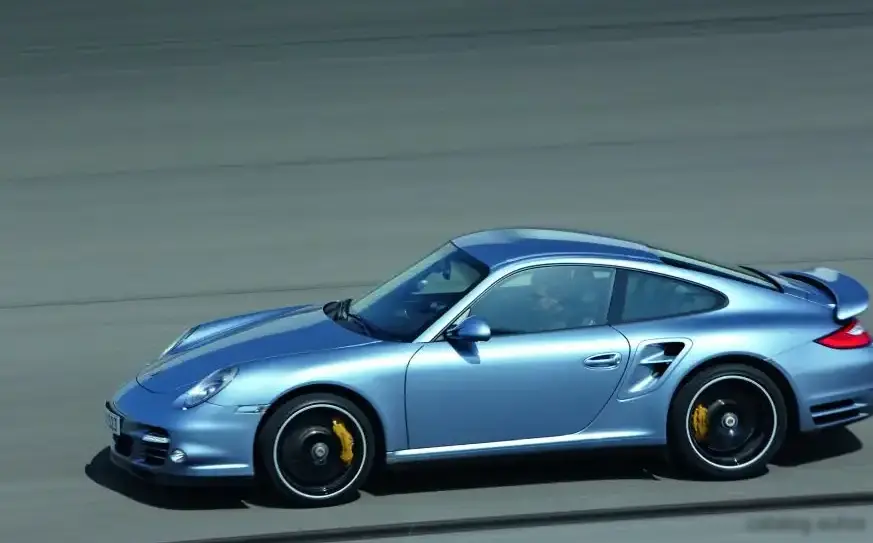
The Porsche 911 Turbo S (997.2) represents the pinnacle of performance for the second facelift of the 997 generation 911, produced from 2010 to 2011. Building upon the already potent 997 Turbo, the ‘S’ variant significantly increased power output and refined the driving experience. This model occupied the top-tier performance position within the 997.2 lineup, surpassing even the standard Turbo in both price and capability. It was positioned as a direct competitor to high-performance sports cars from Ferrari, Lamborghini, and other exotic manufacturers, offering a unique blend of everyday usability and track-focused performance.
Technical Specifications
| Brand | Porsche |
| Model | 911 |
| Generation | 911 (997, facelift 2008) |
| Type (Engine) | Turbo S 3.8 (530 Hp) PDK |
| Start of production | 2010 |
| End of production | 2011 |
| Powertrain Architecture | Internal Combustion engine |
| Body type | Coupe |
| Seats | 4 |
| Doors | 2 |
| Fuel consumption (economy) – urban | 16.5 l/100 km (14.3 US mpg, 17.1 UK mpg, 6.1 km/l) |
| Fuel consumption (economy) – extra urban | 8.1 l/100 km (29 US mpg, 34.9 UK mpg, 12.3 km/l) |
| Fuel consumption (economy) – combined | 11.4 l/100 km (20.6 US mpg, 24.8 UK mpg, 8.8 km/l) |
| CO2 emissions | 268 g/km |
| Fuel Type | Petrol (Gasoline) |
| Acceleration 0 – 100 km/h | 3.3 sec |
| Acceleration 0 – 62 mph | 3.3 sec |
| Acceleration 0 – 60 mph | 3.1 sec |
| Maximum speed | 315 km/h (195.73 mph) |
| Emission standard | Euro 5 |
| Weight-to-power ratio | 3 kg/Hp, 334.4 Hp/tonne |
| Weight-to-torque ratio | 2.3 kg/Nm, 441.6 Nm/tonne |
| Power | 530 Hp @ 6250-6750 rpm |
| Power per litre | 139.5 Hp/l |
| Torque | 700 Nm @ 2100-4250 rpm (516.29 lb.-ft. @ 2100-4250 rpm) |
| Engine layout | Front, Longitudinal |
| Engine Model/Code | MA1.70S |
| Engine displacement | 3800 cm3 (231.89 cu. in.) |
| Number of cylinders | 6 |
| Engine configuration | Boxer |
| Compression ratio | 9.8:1 |
| Number of valves per cylinder | 4 |
| Fuel injection system | Direct injection |
| Engine aspiration | Turbocharger, Intercooler |
| Engine oil capacity | 8 l (8.45 US qt | 7.04 UK qt) |
| Coolant | 29 l (30.64 US qt | 25.52 UK qt) |
| Kerb Weight | 1585 kg (3494.33 lbs.) |
| Max. weight | 1950 kg (4299.01 lbs.) |
| Max load | 365 kg (804.69 lbs.) |
| Trunk (boot) space – maximum | 105 l (3.71 cu. ft.) |
| Fuel tank capacity | 67 l (17.7 US gal | 14.74 UK gal) |
| Length | 4450 mm (175.2 in.) |
| Width | 1852 mm (72.91 in.) |
| Width including mirrors | 1952 mm (76.85 in.) |
| Height | 1300 mm (51.18 in.) |
| Wheelbase | 2350 mm (92.52 in.) |
| Drag coefficient (Cd) | 0.31 |
| Minimum turning circle | 10.9 m (35.76 ft.) |
| Drive wheel | All wheel drive (4×4) |
| Number of gears and type of gearbox | 7 gears, automatic transmission PDK |
| Front suspension | Independent type McPherson |
| Rear suspension | Independent multi-link suspension |
| Front brakes | Ventilated discs, 350 mm |
| Rear brakes | Ventilated discs, 350 mm |
| Assisting systems | ABS (Anti-lock braking system) |
| Steering type | Steering rack and pinion |
| Power steering | Hydraulic Steering |
| Tires size | 235/35 ZR19; 305/30 ZR19 |
| Wheel rims size | 8.5J x 19; 11J x 19 |
Powertrain & Engine Architecture
At the heart of the 911 Turbo S (997.2) lies the MA1.70S engine, a 3.8-liter twin-turbocharged flat-six. This engine represents a significant upgrade over the standard 997 Turbo, boasting an additional 50 horsepower. The engine utilizes direct fuel injection, ensuring precise fuel delivery and maximizing combustion efficiency. The twin turbochargers, with variable turbine geometry (VTG), minimize turbo lag and provide a broad, flat torque curve. The engine’s boxer configuration contributes to a low center of gravity, enhancing handling and stability. The 7-speed Porsche Doppelkupplung (PDK) dual-clutch transmission is standard, offering incredibly fast and smooth gear changes. This transmission allows for both fully automatic operation and manual control via steering wheel-mounted paddles.
Driving Characteristics
The 911 Turbo S (997.2) delivers breathtaking acceleration and performance. The combination of the powerful engine and the PDK transmission results in a 0-60 mph time of around 3.1 seconds and a top speed of 195.73 mph. The all-wheel-drive system provides exceptional traction, allowing for confident acceleration even in challenging conditions. Compared to the standard 997 Turbo, the ‘S’ model feels noticeably more responsive and eager to accelerate. The PDK transmission’s quick shifts contribute to a seamless power delivery, while the active suspension system (Porsche Active Suspension Management – PASM) provides a comfortable yet controlled ride. The steering is precise and communicative, offering excellent feedback to the driver.
Equipment & Trim Levels
The 911 Turbo S (997.2) came exceptionally well-equipped as standard. Interior features included full leather upholstery, sport seats with adjustable bolstering, a Bose sound system, and a navigation system. Standard exterior features included a unique front fascia with larger air intakes, a rear wing, and 19-inch alloy wheels. Optional extras included carbon fiber interior trim, extended leather upholstery, and a lift system for the front axle, which increased ground clearance. The interior was focused on driver ergonomics and luxury, providing a comfortable and refined environment despite the car’s performance capabilities.
Chassis & Braking
The 911 Turbo S (997.2) features a sophisticated chassis designed to handle the car’s immense power. The suspension utilizes Porsche Active Suspension Management (PASM), which electronically adjusts the damping characteristics based on driving conditions. The car is equipped with ventilated disc brakes on all four wheels, providing exceptional stopping power. Larger brake rotors and calipers were used compared to the standard 997 Turbo. The all-wheel-drive system utilizes a viscous coupling to distribute power between the front and rear axles, optimizing traction and stability. The steering system is a rack-and-pinion design with hydraulic power assistance, offering precise and responsive steering feel.
Market Reception & Comparison
The 911 Turbo S (997.2) was widely praised by automotive critics for its exceptional performance, handling, and refinement. It was consistently ranked among the fastest and most capable sports cars available. Compared to the standard 997 Turbo, the ‘S’ model offered a significant performance upgrade and a more exclusive driving experience. While the standard Turbo provided a compelling blend of performance and value, the ‘S’ model catered to enthusiasts seeking the ultimate 911 experience. Fuel economy, while not a primary concern for buyers in this segment, was reasonable for a car of this performance level, averaging around 20.6 US mpg in combined driving.
Legacy
The 911 Turbo S (997.2) remains a highly sought-after sports car in the used car market. Its combination of performance, luxury, and relative reliability has made it a favorite among collectors and enthusiasts. The MA1.70S engine is known for its durability, although regular maintenance is essential. The PDK transmission has also proven to be reliable, provided it is properly serviced. As a final iteration of the 997 generation, the Turbo S represents a sweet spot in the 911 lineage, offering a classic Porsche driving experience with modern performance and technology. Its value has steadily increased over time, reflecting its desirability and collectibility.