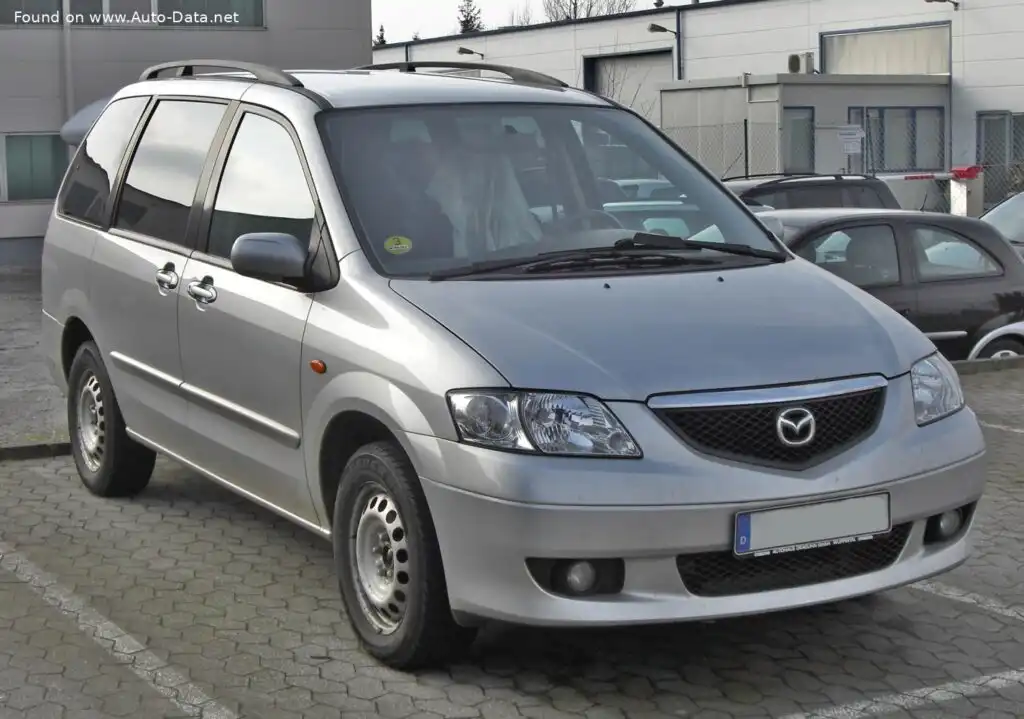
The Mazda MPV II (LW) 2.5 24V, produced between 1999 and 2002, represented Mazda’s second-generation entry into the highly competitive minivan segment. Positioned as a family-focused vehicle, the LW MPV aimed to offer a blend of practicality, comfort, and Mazda’s signature driving dynamics. This particular variant, equipped with the 2.5-liter V6 engine producing 170 horsepower and paired with a four-speed automatic transmission, was a common configuration in the North American market, where minivans were – and continue to be – a popular choice for families. The MPV II, built on the GY platform, sought to improve upon the first generation with increased interior space, refined styling, and updated technology.
Technical Specifications
| Brand | Mazda |
| Model | MPV |
| Generation | MPV II (LW) |
| Type (Engine) | 2.5 24V (170 Hp) |
| Start of production | 1999 |
| End of production | 2002 |
| Powertrain Architecture | Internal Combustion engine |
| Body type | Minivan |
| Seats | 7 |
| Doors | 5 |
| Fuel consumption (urban) | 12.9 l/100 km (18.2 US mpg) |
| Fuel consumption (extra urban) | 10.1 l/100 km (23.3 US mpg) |
| Fuel Type | Petrol (Gasoline) |
| Acceleration 0 – 100 km/h | 14.2 sec |
| Acceleration 0 – 62 mph | 14.2 sec |
| Acceleration 0 – 60 mph | 13.5 sec |
| Maximum speed | 180 km/h (111.85 mph) |
| Weight-to-power ratio | 9.9 kg/Hp |
| Weight-to-torque ratio | 8.1 kg/Nm |
| Power | 170 Hp @ 6250 rpm |
| Torque | 207 Nm @ 5000 rpm (152.68 lb.-ft. @ 5000 rpm) |
| Engine layout | Front, Transverse |
| Engine displacement | 2495 cm3 (152.25 cu. in.) |
| Number of cylinders | 6 |
| Engine configuration | V-engine |
| Cylinder Bore | 81.6 mm (3.21 in.) |
| Piston Stroke | 79.5 mm (3.13 in.) |
| Compression ratio | 9.7:1 |
| Number of valves per cylinder | 4 |
| Fuel injection system | Multi-port manifold injection |
| Engine aspiration | Naturally aspirated engine |
| Valvetrain | DOHC |
| Kerb Weight | 1680 kg (3703.77 lbs.) |
| Max. weight | 2230 kg (4916.31 lbs.) |
| Max load | 550 kg (1212.54 lbs.) |
| Trunk (boot) space – minimum | 481 l (16.99 cu. ft.) |
| Fuel tank capacity | 70 l (18.49 US gal | 15.4 UK gal) |
| Length | 4750 mm (187.01 in.) |
| Width | 1830 mm (72.05 in.) |
| Height | 1750 mm (68.9 in.) |
| Wheelbase | 2840 mm (111.81 in.) |
| Front track | 1545 mm (60.83 in.) |
| Rear (Back) track | 1545 mm (60.83 in.) |
| Drivetrain Architecture | Front wheel drive |
| Number of gears and type of gearbox | 4 gears, automatic transmission |
| Front suspension | Spring Strut |
| Rear suspension | Coil spring |
| Front brakes | Ventilated discs |
| Rear brakes | Disc |
| Assisting systems | ABS (Anti-lock braking system) |
| Steering type | Steering rack and pinion |
| Power steering | Hydraulic Steering |
| Tires size | 215/60 R16 |
| Wheel rims size | 16 |
Powertrain & Engine Architecture
The heart of this MPV variant is Mazda’s 2.5-liter (2495 cc) V6 engine, designated as the KJ-ZE. This engine utilizes a 60-degree V-angle, contributing to a smoother power delivery and reduced vibrations. The engine features a dual overhead camshaft (DOHC) valvetrain with four valves per cylinder, enhancing breathing and overall efficiency. Fuel delivery is managed by a multi-port fuel injection system, providing precise fuel metering for optimal combustion. The 9.7:1 compression ratio strikes a balance between performance and fuel economy. Paired with this engine is a four-speed automatic transmission, designed for smooth and convenient operation. While not offering the most advanced gear ratios, it was a common choice for minivan buyers prioritizing ease of use over outright performance.
Driving Characteristics
The 170 horsepower and 152.68 lb-ft of torque produced by the 2.5L V6, when channeled through the four-speed automatic, resulted in adequate, but not exhilarating, performance. Acceleration from 0-60 mph took around 13.5 seconds, making it competitive with other minivans of the era, but noticeably slower than models equipped with larger engines or manual transmissions. The automatic transmission’s gear ratios were tuned for comfortable cruising and everyday drivability, rather than aggressive acceleration. The front-wheel-drive configuration provided predictable handling, although it lacked the all-wheel-drive capability offered on some competing models. The overall driving experience was geared towards comfort and practicality, making it well-suited for family transportation.
Equipment & Trim Levels
The 2.5 24V automatic MPV typically came with a reasonable level of standard equipment. Features generally included air conditioning, power windows and locks, an AM/FM stereo with cassette player, and cloth upholstery. Higher trim levels, such as the LX or ES, added features like alloy wheels, upgraded audio systems, a sunroof, and leather upholstery. Optional extras included a rear entertainment system, power sliding doors, and upgraded seating configurations. The interior design focused on maximizing space and functionality, with a flexible seating arrangement allowing for various configurations to accommodate passengers and cargo.
Chassis & Braking
The MPV II utilized a front-wheel-drive chassis with an independent front suspension featuring MacPherson struts and a coil-sprung rear suspension. This setup provided a comfortable ride quality, absorbing bumps and irregularities in the road surface effectively. Braking duties were handled by ventilated discs at the front and solid discs at the rear, providing adequate stopping power for the vehicle’s weight. An anti-lock braking system (ABS) was standard, enhancing safety by preventing wheel lockup during hard braking. The steering system employed a rack-and-pinion setup with hydraulic power assistance, offering responsive and precise steering control.
Market Reception & Comparison
The Mazda MPV II, including the 2.5 24V automatic variant, received generally positive reviews for its spacious interior, comfortable ride, and Mazda’s reputation for reliability. However, critics often noted that the 170-horsepower engine felt underpowered when the vehicle was fully loaded with passengers and cargo. Compared to competitors like the Honda Odyssey and Toyota Sienna, the MPV II often lagged in terms of performance and refinement. Fuel economy was also average for the class, with the 2.5L V6 returning around 18 mpg in the city and 23 mpg on the highway. The MPV II offered a more affordable alternative to some of its rivals, making it an attractive option for budget-conscious families.
Legacy
The Mazda MPV II, while not a sales leader in the minivan segment, established Mazda as a viable contender in the market. The 2.5-liter V6 engine, when properly maintained, proved to be a relatively reliable powertrain. However, like many vehicles of this era, age and mileage can lead to issues with the automatic transmission and various sensors. Today, the MPV II is becoming increasingly rare, and well-maintained examples are sought after by enthusiasts and collectors. Its blend of practicality, comfort, and Mazda’s driving dynamics continues to appeal to those seeking a classic minivan experience.