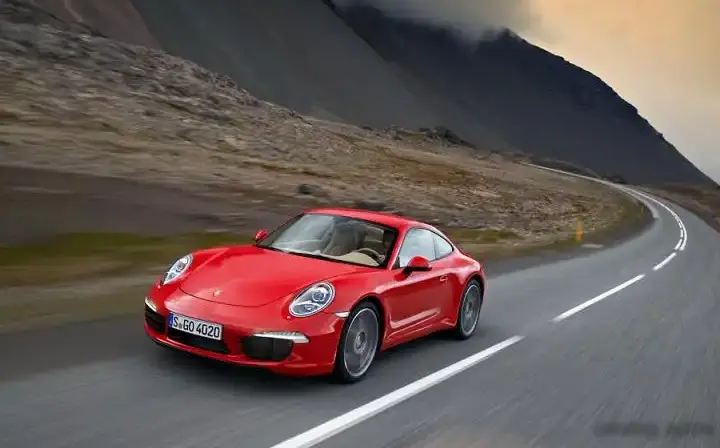
The Porsche 911 Turbo (997) 3.6, produced from 2006 to 2009, represents a significant evolution in the iconic 911 lineage. Positioned as the flagship performance variant of the 997 generation, it brought forced induction and all-wheel drive to the forefront, delivering supercar-level performance. This model year marked a transition, bridging the gap between the earlier 997 models and the later, more technologically advanced iterations. It was a key offering in Porsche’s strategy to provide a truly capable, everyday sports car, appealing to enthusiasts seeking both exhilarating performance and a degree of practicality.
Technical Specifications
| Brand | Porsche |
| Model | 911 |
| Generation | 911 (997) |
| Type (Engine) | Turbo 3.6 (480 Hp) |
| Start of production | 2006 |
| End of production | 2009 |
| Powertrain Architecture | Internal Combustion engine |
| Body type | Coupe |
| Seats | 4 |
| Doors | 2 |
| Fuel consumption (economy) – urban | 18.8 l/100 km (12.5 US mpg, 15 UK mpg, 5.3 km/l) |
| Fuel consumption (economy) – extra urban | 9.5 l/100 km (24.8 US mpg, 29.7 UK mpg, 10.5 km/l) |
| Fuel consumption (economy) – combined | 12.8 l/100 km (18.4 US mpg, 22.1 UK mpg, 7.8 km/l) |
| CO2 emissions | 307 g/km |
| Fuel Type | Petrol (Gasoline) |
| Acceleration 0 – 100 km/h | 3.9 sec |
| Acceleration 0 – 62 mph | 3.9 sec |
| Acceleration 0 – 60 mph | 3.7 sec |
| Maximum speed | 310 km/h (192.63 mph) |
| Emission standard | Euro 4 |
| Weight-to-power ratio | 3.3 kg/Hp, 302.8 Hp/tonne |
| Weight-to-torque ratio | 2.6 kg/Nm, 391.2 Nm/tonne |
| Power | 480 Hp @ 6000 rpm |
| Power per litre | 133.3 Hp/l |
| Torque | 620 Nm @ 1950 rpm (457.29 lb.-ft. @ 1950 rpm) |
| Engine layout | Rear, Longitudinal |
| Engine Model/Code | M97.70 |
| Engine displacement | 3600 cm3 (219.69 cu. in.) |
| Number of cylinders | 6 |
| Engine configuration | Boxer |
| Cylinder Bore | 100 mm (3.94 in.) |
| Piston Stroke | 76.4 mm (3.01 in.) |
| Compression ratio | 9:1 |
| Number of valves per cylinder | 4 |
| Fuel injection system | Multi-port manifold injection |
| Engine aspiration | Turbocharger, Intercooler |
| Engine oil capacity | 8 l (8.45 US qt | 7.04 UK qt) |
| Coolant | 25 l (26.42 US qt | 22 UK qt) |
| Kerb Weight | 1585 kg (3494.33 lbs.) |
| Max. weight | 1950 kg (4299.01 lbs.) |
| Max load | 365 kg (804.69 lbs.) |
| Trunk (boot) space – maximum | 105 l (3.71 cu. ft.) |
| Fuel tank capacity | 67 l (17.7 US gal | 14.74 UK gal) |
| Length | 4450 mm (175.2 in.) |
| Width | 1852 mm (72.91 in.) |
| Height | 1300 mm (51.18 in.) |
| Wheelbase | 2350 mm (92.52 in.) |
| Drag coefficient (Cd) | 0.31 |
| Minimum turning circle | 10.9 m (35.76 ft.) |
| Drive wheel | All wheel drive (4×4) |
| Number of gears and type of gearbox | 6 gears, manual transmission |
| Front suspension | Independent type McPherson |
| Rear suspension | Independent multi-link suspension |
| Front brakes | Ventilated discs |
| Rear brakes | Ventilated discs |
| Assisting systems | ABS (Anti-lock braking system) |
| Steering type | Steering rack and pinion |
| Power steering | Hydraulic Steering |
| Tires size | 235/35 ZR19; 305/30 ZR19 |
| Wheel rims size | 8.5J x 19; 11J x 19 |
Powertrain & Engine Architecture
At the heart of the 997 Turbo 3.6 lies the M97.70 engine, a 3.6-liter twin-turbocharged flat-six. This engine is a direct descendant of the engines used in Porsche’s racing programs, adapted for road use. The engine utilizes a dry-sump lubrication system, a hallmark of Porsche engineering, ensuring consistent oil supply even under extreme cornering forces. Both turbochargers feature variable turbine geometry (VTG), allowing for optimized boost pressure across the rev range, minimizing turbo lag and maximizing power delivery. Fuel is delivered via multi-port fuel injection, carefully calibrated to work in conjunction with the turbocharging system. The engine produces 480 horsepower at 6,000 rpm and a substantial 620 Nm (457 lb-ft) of torque, readily available from just 1,950 rpm. The standard transmission for this variant was a six-speed manual, although a five-speed Tiptronic S automatic transmission was also available as an option.
Driving Characteristics
The 997 Turbo 3.6 delivers a driving experience that is both visceral and refined. The all-wheel-drive system provides exceptional traction, allowing for rapid acceleration even in less-than-ideal conditions. The manual transmission offers precise shifts and a direct connection to the engine, while the Tiptronic S automatic provides smooth and responsive gear changes. The car’s suspension, tuned for performance, offers a firm but controlled ride. The steering is direct and communicative, providing the driver with a strong sense of connection to the road. Compared to naturally aspirated 997 models, the Turbo offers significantly more power and torque, resulting in noticeably quicker acceleration and higher top speeds. While the manual transmission provides a more engaging driving experience, the Tiptronic S automatic offers greater convenience, particularly in urban environments.
Equipment & Trim Levels
The 997 Turbo 3.6 came generously equipped as standard. Interior features included leather upholstery, sport seats, a Bose sound system, and automatic climate control. Optional extras were plentiful, including adaptive sport seats, a navigation system, a sunroof, and carbon fiber interior trim. Exterior options included various wheel designs, paint colors, and aerodynamic enhancements. The overall interior design was focused on functionality and driver engagement, with a clear and concise instrument cluster and ergonomically placed controls.
Chassis & Braking
The 997 Turbo 3.6 features a robust chassis designed to handle the increased power and performance. The suspension utilizes independent McPherson struts at the front and a multi-link setup at the rear. Braking duties are handled by ventilated discs on all four wheels, providing ample stopping power. The car is equipped with Porsche’s Porsche Stability Management (PSM) system, which helps to maintain control in challenging driving situations. The standard wheel and tire combination was 19-inch, providing a good balance of grip and ride comfort.
Market Reception & Comparison
The 997 Turbo 3.6 was widely praised by automotive critics for its exceptional performance, handling, and refinement. It was often compared favorably to other high-performance sports cars, such as the Ferrari 360 and the Lamborghini Gallardo. Fuel economy, while not a primary concern for buyers in this segment, was reasonable for a car of its performance capabilities. Reliability was generally good, although the complex turbocharging system required regular maintenance. Compared to the later 997 Turbo S, the 3.6 offered a slightly less aggressive driving experience but at a lower price point.
Legacy
The Porsche 911 Turbo (997) 3.6 remains a highly sought-after sports car in the used car market. Its combination of performance, refinement, and relative reliability has made it a favorite among enthusiasts. The M97.70 engine, while complex, has proven to be durable when properly maintained. Today, these cars represent a compelling value proposition for those seeking a high-performance Porsche experience without the price tag of newer models. The 997 Turbo 3.6 solidified the 911 Turbo’s reputation as one of the most capable and desirable sports cars in the world.