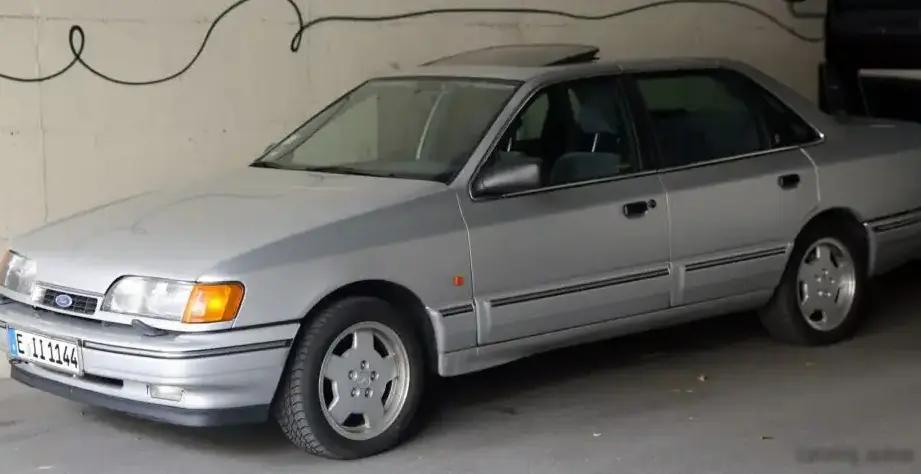
The Ford Scorpio I Hatch (GGE) 2.0 i, produced between 1992 and 1994, represented a mid-range offering within the first generation of the Scorpio line. Positioned above the base 1.8L models and below the more powerful 2.9L V6, the 2.0 i aimed to balance performance with affordability for the European market. The Scorpio, intended as a flagship for Ford of Europe, replaced the Granada and Consul models, offering a more modern and spacious package. This particular 2.0L variant, typically paired with either a manual or automatic transmission, was designed to appeal to buyers seeking a comfortable and reasonably efficient family car.
Technical Specifications
| Brand | Ford |
| Model | Scorpio |
| Generation | Scorpio I Hatch (GGE) |
| Type (Engine) | 2.0 i (115 Hp) |
| Start of production | 1992 |
| End of production | 1994 |
| Powertrain Architecture | Internal Combustion engine |
| Body type | Hatchback |
| Fuel Type | Petrol (Gasoline) |
| Power | 115 Hp @ 5500 rpm |
| Power per litre | 57.7 Hp/l |
| Torque | 160 Nm @ 4000 rpm / 118.01 lb.-ft. @ 4000 rpm |
| Engine layout | Front, Longitudinal |
| Engine Model/Code | NRA, NRI |
| Engine displacement | 1993 cm3 / 121.62 cu. in. |
| Number of cylinders | 4 |
| Engine configuration | Inline |
| Cylinder Bore | 90.8 mm / 3.57 in. |
| Piston Stroke | 77 mm / 3.03 in. |
| Number of valves per cylinder | 4 |
| Fuel injection system | Multi-port manifold injection |
| Engine aspiration | Naturally aspirated engine |
| Valvetrain | DOHC |
| Engine oil capacity | 3.8 l / 4.02 US qt | 3.34 UK qt |
| Coolant | 8 l / 8.45 US qt | 7.04 UK qt |
Powertrain & Engine Architecture
The 2.0 i Scorpio utilized Ford’s NRA or NRI engine code, a four-cylinder, inline engine displacing 1993cc. This engine was a development of Ford’s earlier Zetec series, featuring a dual overhead camshaft (DOHC) valvetrain and multi-port fuel injection. The fuel injection system, crucial for meeting increasingly stringent emissions standards, precisely controlled fuel delivery to each cylinder, optimizing combustion efficiency. The engine’s architecture was longitudinal, meaning it was mounted lengthwise within the engine bay, driving the front wheels. This layout, while common in European front-wheel-drive cars, differed from some contemporary American designs. The engine’s 115 horsepower output at 5500 rpm and 160 Nm (118 lb-ft) of torque at 4000 rpm were respectable for its time, providing adequate performance for everyday driving. The automatic transmission offered with this variant was typically a four-speed unit, designed for smooth and comfortable gear changes.
Driving Characteristics
The 2.0 i automatic Scorpio offered a comfortable, if not particularly sporty, driving experience. The automatic transmission, while providing convenience, did slightly diminish the engine’s responsiveness compared to the five-speed manual version. Acceleration was adequate for merging onto highways and overtaking, but it wasn’t a particularly quick car. The gear ratios were tuned for fuel efficiency and relaxed cruising rather than outright performance. Compared to the higher-output 2.9L V6, the 2.0 i felt noticeably less powerful, especially when fully loaded with passengers and luggage. However, the 2.0 i offered a better balance between performance and fuel economy than the V6, making it a more practical choice for many buyers. The steering was light and easy, making it maneuverable in urban environments, but lacked the feedback preferred by more enthusiastic drivers.
Equipment & Trim Levels
The 2.0 i Scorpio typically came equipped with a reasonable level of standard features. Interior upholstery was usually cloth, with options for upgraded velour or leather available at extra cost. The dashboard layout was functional and straightforward, with clear instrumentation. Standard equipment often included power steering, central locking, and an AM/FM radio. Optional extras could include air conditioning, electric windows, a sunroof, and upgraded sound systems. Trim levels varied slightly depending on the market, but generally, the 2.0 i sat in the middle of the Scorpio range, offering more features than the base models but fewer than the luxury-oriented V6 versions.
Chassis & Braking
The Scorpio I utilized a MacPherson strut front suspension and a semi-independent twist beam rear suspension. This setup provided a comfortable ride, absorbing bumps and imperfections in the road surface effectively. The front brakes were typically ventilated discs, while the rear brakes were often drum brakes, although some higher-spec models featured rear discs. Stabilizer bars were fitted to both the front and rear axles to reduce body roll during cornering. The chassis was designed to provide a good balance between handling and ride comfort, prioritizing stability and predictability over sporty agility. The steering system was a rack-and-pinion setup, providing precise and responsive steering.
Market Reception & Comparison
The Ford Scorpio 2.0 i received generally positive reviews from automotive critics. It was praised for its spacious interior, comfortable ride, and reasonable fuel economy. However, some critics noted that the styling was somewhat conservative and lacked the visual appeal of some of its rivals. Compared to other cars in its class, such as the Opel Omega and the Volvo 740, the Scorpio offered a competitive package in terms of price, features, and performance. The 2.0 i automatic version was often seen as a good all-rounder, suitable for families and long-distance drivers. Fuel economy was a key selling point, with the 2.0 i returning around 28-32 mpg on average, depending on driving conditions. Reliability was generally good, although some owners reported minor issues with the automatic transmission.
Legacy
The Ford Scorpio I 2.0 i, while not a particularly iconic or collectible car, remains a reasonably popular choice among classic car enthusiasts and those seeking an affordable and practical classic. The NRA/NRI engine is known for its durability and relatively simple maintenance requirements. Parts availability is generally good, although some specific components may be difficult to find. The automatic transmission, while reliable, can require more frequent servicing than the manual version. Today, well-maintained examples of the 2.0 i Scorpio can be found for relatively low prices, making them an attractive option for those looking for a comfortable and spacious classic car. The Scorpio, in general, represents a significant chapter in Ford of Europe’s history, showcasing the company’s commitment to innovation and quality.