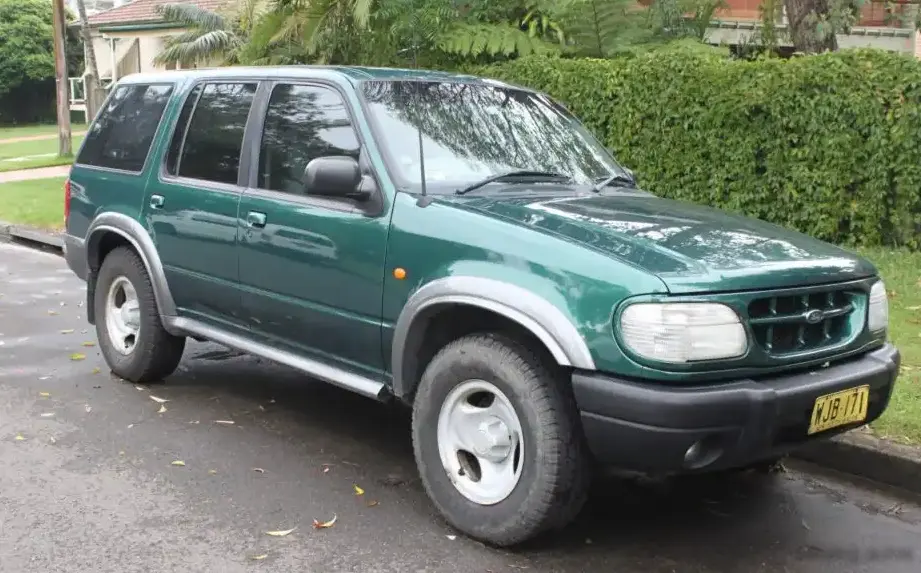
The Ford Explorer, launched in 1991, represented a significant shift in the American automotive landscape. It was Ford’s first foray into the mid-size SUV segment, and quickly became a sales success, capitalizing on a growing demand for vehicles that combined the practicality of a station wagon with the ruggedness of a truck. The Explorer I, produced from 1991 to 1994, was based on the Ford Ranger pickup truck chassis, offering a body-on-frame construction. Among the engine options available, the 4.0-liter V6 producing 160 horsepower became a popular choice, offering a balance of power and affordability. This variant positioned itself as a step up from the base 2.3-liter four-cylinder, appealing to buyers needing more capability for towing and hauling, but who didn’t require the higher cost and complexity of the optional 4.0-liter V6 with enhanced performance.
Technical Specifications
| Brand | Ford |
| Model | Explorer |
| Generation | Explorer I |
| Type (Engine) | 4.0 V6 (160 Hp) |
| Start of production | 1991 |
| End of production | 1994 |
| Powertrain Architecture | Internal Combustion engine |
| Body type | SUV |
| Seats | 5 |
| Doors | 5 |
| Fuel consumption (economy) – urban | 17 l/100 km (13.8 US mpg, 16.6 UK mpg, 5.9 km/l) |
| Fuel consumption (economy) – extra urban | 11.6 l/100 km (20.3 US mpg, 24.4 UK mpg, 8.6 km/l) |
| Fuel consumption (economy) – combined | 15 l/100 km (15.7 US mpg, 18.8 UK mpg, 6.7 km/l) |
| Fuel Type | Petrol (Gasoline) |
| Weight-to-power ratio | 14.7 kg/Hp (68.2 Hp/tonne) |
| Weight-to-torque ratio | 7.7 kg/Nm (130.1 Nm/tonne) |
| Power | 160 Hp @ 4200 rpm |
| Power per litre | 40.4 Hp/l |
| Torque | 305 Nm @ 2800 rpm (224.96 lb.-ft. @ 2800 rpm) |
| Engine layout | Front, Longitudinal |
| Engine displacement | 3958 cm3 (241.53 cu. in.) |
| Number of cylinders | 6 |
| Engine configuration | V-engine |
| Cylinder Bore | 100 mm (3.94 in.) |
| Piston Stroke | 84 mm (3.31 in.) |
| Compression ratio | 9:1 |
| Number of valves per cylinder | 2 |
| Fuel injection system | Multi-port manifold injection |
| Engine aspiration | Naturally aspirated engine |
| Valvetrain | OHC |
| Kerb Weight | 2345 kg (5169.84 lbs.) |
| Max. weight | 3395 kg (7484.69 lbs.) |
| Max load | 1050 kg (2314.85 lbs.) |
| Fuel tank capacity | 71.9 l (18.99 US gal | 15.82 UK gal) |
| Length | 4673 mm (183.98 in.) |
| Width | 1778 mm (70 in.) |
| Height | 1709 mm (67.28 in.) |
| Wheelbase | 2842 mm (111.89 in.) |
| Minimum turning circle | 11 m (36.09 ft.) |
| Drive wheel | All wheel drive (4×4) |
| Number of gears and type of gearbox | 5 gears, manual transmission |
| Front suspension | Independent multi-link suspension |
| Rear suspension | Dependent suspension of two longitudinal semi-elliptic leaf springs |
| Front brakes | Ventilated discs |
| Rear brakes | Drum |
| Assisting systems | ABS (Anti-lock braking system) |
| Tires size | 235/75 R15 |
| Wheel rims size | 7j x 15 |
Powertrain & Engine Architecture
The heart of this Explorer variant is the 4.0-liter Cologne V6 engine. This engine, designated as the 4.0L OHV, is a naturally aspirated, 90-degree V6. It utilizes a cast iron block and aluminum cylinder heads. The engine employs a multi-port fuel injection system, delivering fuel directly to each intake port for improved efficiency and power delivery. The overhead valve (OHV) valvetrain, while simpler than overhead cam designs, proved durable and reliable. The 160 horsepower output was achieved through a combination of a 9:1 compression ratio and careful tuning of the fuel injection system. The five-speed manual transmission was the standard offering, providing drivers with full control over gear selection. The transmission was chosen for its robustness and ability to handle the engine’s torque output.
Driving Characteristics
The 160-horsepower 4.0-liter V6, paired with the five-speed manual transmission, offered a reasonably engaging driving experience for its time. Acceleration was adequate, though not particularly brisk, with a 0-60 mph time estimated around 10-11 seconds. The manual transmission allowed drivers to keep the engine in its optimal power band, providing better responsiveness than the optional automatic. The Explorer’s body-on-frame construction resulted in a more truck-like ride compared to contemporary car-based SUVs. While comfortable enough for everyday driving, it wasn’t as refined in terms of handling and road noise. The all-wheel-drive system provided enhanced traction in inclement weather and on loose surfaces, making it a capable vehicle for a variety of conditions. Compared to the higher-output 4.0-liter V6, this version felt less powerful, especially when fully loaded or towing. However, it offered a more economical driving experience.
Equipment & Trim Levels
The base Explorer trim level, equipped with the 4.0-liter V6 and manual transmission, was fairly spartan. Standard features included cloth upholstery, air conditioning, an AM/FM stereo, and basic instrumentation. Power steering and power brakes were also standard. Optional extras included features like upgraded sound systems, cruise control, and a tilt steering wheel. The Explorer XLT trim level added more comfort and convenience features, such as upgraded interior trim, power windows and locks, and alloy wheels. The Eddie Bauer trim, the most luxurious offering, included leather upholstery, woodgrain interior trim, and a premium sound system. The 160 hp variant was typically found in the base and XLT trims, with the Eddie Bauer usually equipped with the more powerful engine.
Chassis & Braking
The Explorer I utilized a body-on-frame construction, providing a robust and durable chassis. The front suspension consisted of an independent multi-link design, offering a reasonable level of ride comfort and handling. The rear suspension employed a traditional solid axle with leaf springs, which was well-suited for carrying loads and towing. Braking duties were handled by ventilated discs in the front and drum brakes in the rear. Anti-lock brakes (ABS) were available as an option, enhancing safety by preventing wheel lockup during hard braking. The Explorer’s tires were typically 235/75R15, providing a good balance of on-road and off-road performance.
Market Reception & Comparison
The Ford Explorer I was a resounding success in the marketplace. Critics praised its spacious interior, rugged construction, and available all-wheel-drive system. The 4.0-liter V6 with 160 horsepower was generally well-received as a capable and reliable engine. Fuel economy, however, was a common criticism, averaging around 15-16 mpg in combined driving. Compared to the four-cylinder engine, the V6 offered significantly more power and refinement. Compared to the higher-output V6, it provided a more affordable entry point into the Explorer lineup, appealing to budget-conscious buyers. The Explorer quickly became a dominant force in the mid-size SUV segment, outselling its competitors by a significant margin.
Legacy
The Ford Explorer I laid the foundation for one of the most successful SUVs in automotive history. The 4.0-liter V6 engine proved to be remarkably durable, with many examples still on the road today. While not known for exceptional fuel economy, the engine’s reliability and relatively simple design made it a favorite among mechanics and owners alike. In the used car market, Explorers from this era are often sought after for their affordability and ruggedness. However, potential buyers should be aware of common issues such as rust, worn suspension components, and potential oil leaks. Despite these potential issues, the 1991-1994 Ford Explorer 4.0L V6 remains a popular and iconic vehicle, representing a pivotal moment in the evolution of the American SUV.