Technical Specifications
| Brand | Dacia |
| Model | Logan |
| Generation | Logan I MCV (facelift 2008) |
| Type (Engine) | 1.5 dCi (68 Hp) |
| Start of production | 2008 |
| End of production | 2010 |
| Powertrain Architecture | Internal Combustion engine |
| Body type | Station wagon (estate) |
| Seats | 5 |
| Doors | 5 |
| Fuel consumption (urban) | 6.2 l/100 km (37.9 US mpg, 45.6 UK mpg, 16.1 km/l) |
| Fuel consumption (extra urban) | 4.8 l/100 km (49 US mpg, 58.9 UK mpg, 20.8 km/l) |
| Fuel consumption (combined) | 5.3 l/100 km (44.4 US mpg, 53.3 UK mpg, 18.9 km/l) |
| CO2 emissions | 140 g/km |
| Fuel Type | Diesel |
| Acceleration 0 – 100 km/h | 17.7 sec |
| Acceleration 0 – 62 mph | 17.7 sec |
| Acceleration 0 – 60 mph | 16.8 sec |
| Maximum speed | 150 km/h (93.21 mph) |
| Emission standard | Euro 4 |
| Weight-to-power ratio | 17.7 kg/Hp, 56.4 Hp/tonne |
| Weight-to-torque ratio | 7.5 kg/Nm, 132.8 Nm/tonne |
| Power | 68 Hp @ 4000 rpm |
| Power per litre | 46.5 Hp/l |
| Torque | 160 Nm @ 1700 rpm (118.01 lb.-ft. @ 1700 rpm) |
| Engine layout | Front, Transverse |
| Engine Model/Code | K9K 792 |
| Engine displacement | 1461 cm3 (89.16 cu. in.) |
| Number of cylinders | 4 |
| Engine configuration | Inline |
| Cylinder Bore | 76 mm (2.99 in.) |
| Piston Stroke | 80.5 mm (3.17 in.) |
| Compression ratio | 17.9:1 |
| Number of valves per cylinder | 2 |
| Fuel injection system | Diesel Commonrail |
| Engine aspiration | Turbocharger, Intercooler |
| Valvetrain | SOHC |
| Engine oil capacity | 4.5 l (4.76 US qt | 3.96 UK qt) |
| Coolant capacity | 4.5 l (4.76 US qt | 3.96 UK qt) |
| Kerb Weight | 1205 kg (2656.57 lbs.) |
| Max. weight | 1796 kg (3959.5 lbs.) |
| Max load | 591 kg (1302.93 lbs.) |
| Trunk (boot) space – minimum | 700 l (24.72 cu. ft.) |
| Trunk (boot) space – maximum | 2350 l (82.99 cu. ft.) |
| Fuel tank capacity | 50 l (13.21 US gal | 11 UK gal) |
| Max. roof load | 80 kg (176.37 lbs.) |
| Permitted trailer load with brakes (12%) | 1300 kg (2866.01 lbs.) |
| Permitted trailer load without brakes | 640 kg (1410.96 lbs.) |
| Permitted towbar download | 75 kg (165.35 lbs.) |
| Length | 4473 mm (176.1 in.) |
| Width | 1740 mm (68.5 in.) |
| Width including mirrors | 1993 mm (78.46 in.) |
| Height | 1640 mm (64.57 in.) |
| Wheelbase | 2905 mm (114.37 in.) |
| Front track | 1469 mm (57.83 in.) |
| Rear track | 1466 mm (57.72 in.) |
| Front overhang | 797 mm (31.38 in.) |
| Rear overhang | 771 mm (30.35 in.) |
| Ride height (ground clearance) | 160 mm (6.3 in.) |
| Drag coefficient (Cd) | 0.36 |
| Minimum turning circle | 11.25 m (36.91 ft.) |
| Drivetrain Architecture | ICE, Front wheel drive |
| Number of gears and type of gearbox | 5 gears, manual transmission |
| Front suspension | Independent type McPherson, Transverse stabilizer |
| Rear suspension | Coil spring, Torsion |
| Front brakes | Ventilated discs, 259 mm |
| Rear brakes | Drum, 203 mm |
| Assisting systems | ABS (Anti-lock braking system) |
| Steering type | Steering rack and pinion |
| Power steering | Hydraulic Steering |
| Tires size | 185/65 R15 |
| Wheel rims size | 6J x 15 |
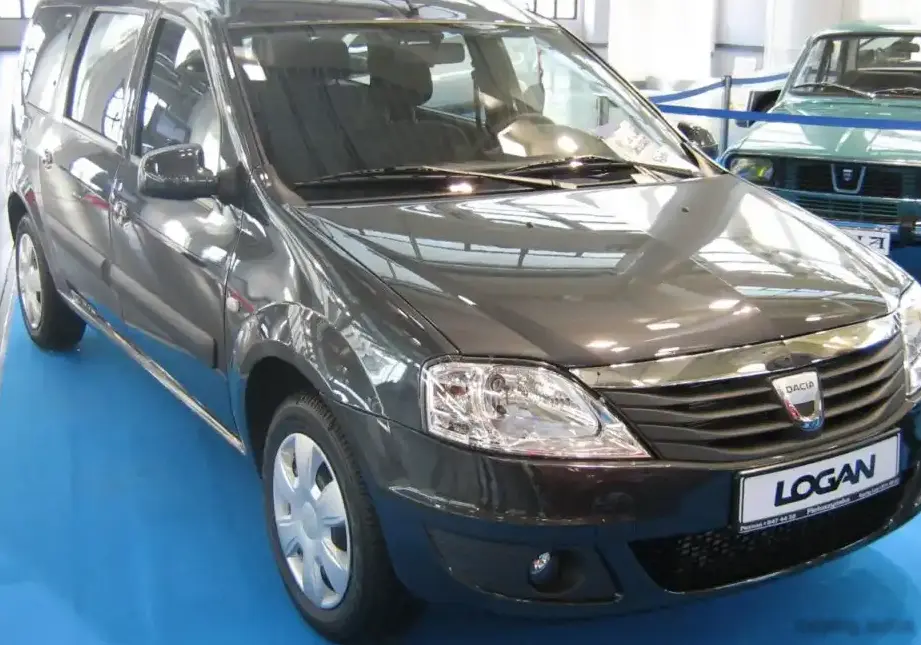
The Dacia Logan I MCV facelift, launched in 2008, built upon the success of the original Logan sedan, offering a more versatile body style. The 1.5 dCi 68 hp variant was a key component of the MCV lineup, specifically targeted at budget-conscious buyers seeking a practical and economical vehicle. This engine, part of the K9K series developed in collaboration with Renault, was known for its fuel efficiency and relatively low maintenance costs. The facelift brought minor cosmetic updates and improvements to interior trim, but the core mechanicals remained largely unchanged from the pre-facelift models. The MCV’s spacious interior and large cargo area made it a popular choice for families, small businesses, and those needing a vehicle capable of carrying significant loads.
Powertrain & Engine Architecture
The heart of this Logan MCV is the K9K 792 1.5-liter inline-four diesel engine. This engine utilizes a common rail direct injection system, delivering fuel directly into the combustion chamber at high pressure for improved efficiency and reduced emissions. The engine features a single overhead camshaft (SOHC) operating two valves per cylinder. A turbocharger with an intercooler is employed to boost power output and improve torque across a wider rev range. The 68 hp output is achieved at 4000 rpm, while peak torque of 160 Nm (118 lb-ft) is available from 1700 rpm. This relatively low peak torque figure contributes to the engine’s fuel efficiency but also impacts its acceleration performance. The engine is transversely mounted at the front of the vehicle. The transmission is a five-speed manual gearbox, chosen for its simplicity and cost-effectiveness. This gearbox features relatively long gear ratios, further prioritizing fuel economy over spirited driving.
Driving Characteristics
The 1.5 dCi 68 hp Logan MCV is not a performance-oriented vehicle. Acceleration is leisurely, with a 0-60 mph time of around 16.8 seconds. The long gearing and modest power output mean that overtaking maneuvers require careful planning. However, the engine is surprisingly tractable at low speeds, and the torque delivery is reasonably smooth. The manual transmission is light and easy to operate, but the shift quality can feel somewhat notchy. The focus is clearly on maximizing fuel economy, and in real-world driving, the Logan MCV 1.5 dCi can achieve impressive figures, particularly on longer journeys. Compared to higher-powered versions of the Logan MCV, such as those equipped with the 1.6-liter petrol engine, this diesel variant offers significantly better fuel economy but sacrifices performance.
Equipment & Trim Levels
The 1.5 dCi 68 hp Logan MCV typically came with a basic level of equipment, reflecting its position as an entry-level model. Standard features generally included power steering, central locking, and an immobilizer. Interior trim was functional and durable, with hard-wearing plastics dominating the cabin. Air conditioning was often an optional extra, as were electric windows and a radio/CD player. The seats were typically upholstered in a basic fabric. Higher trim levels offered upgrades such as alloy wheels, fog lights, and more sophisticated audio systems, but these were not commonly found on the base 68 hp model.
Chassis & Braking
The Logan MCV utilizes a relatively simple chassis design. The front suspension consists of independent MacPherson struts with a transverse stabilizer bar, while the rear suspension employs a coil spring and torsion beam setup. This configuration provides a comfortable ride, but handling is not particularly sharp. The braking system features ventilated discs at the front and drum brakes at the rear. ABS (Anti-lock Braking System) was standard equipment, providing enhanced safety in emergency braking situations. The relatively light weight of the vehicle helps to compensate for the modest braking performance.
Market Reception & Comparison
The Dacia Logan I MCV 1.5 dCi 68 hp was generally well-received by critics for its affordability, practicality, and fuel efficiency. However, it was often criticized for its lack of refinement and its underwhelming performance. Compared to other station wagons on the market at the time, the Logan MCV offered a significantly lower price point, making it an attractive option for budget-conscious buyers. Its fuel economy was competitive with other diesel-powered vehicles in its class. However, rivals often offered more features and a more refined driving experience. Compared to the petrol-powered Logan MCV variants, the 1.5 dCi offered superior fuel economy but lower performance.
Legacy
The K9K engine, in its various iterations, proved to be a reliable and durable powerplant. The 1.5 dCi 68 hp version of the Logan MCV remains a popular choice in the used car market, particularly for those seeking an affordable and economical vehicle. While maintenance costs are generally low, potential buyers should be aware of the possibility of issues with the turbocharger and fuel injectors as these components age. The Logan MCV, in general, established Dacia as a major player in the European budget car market, and its success paved the way for subsequent models. The 1.5 dCi engine continued to be used in various Renault and Dacia models for many years, demonstrating its versatility and reliability.