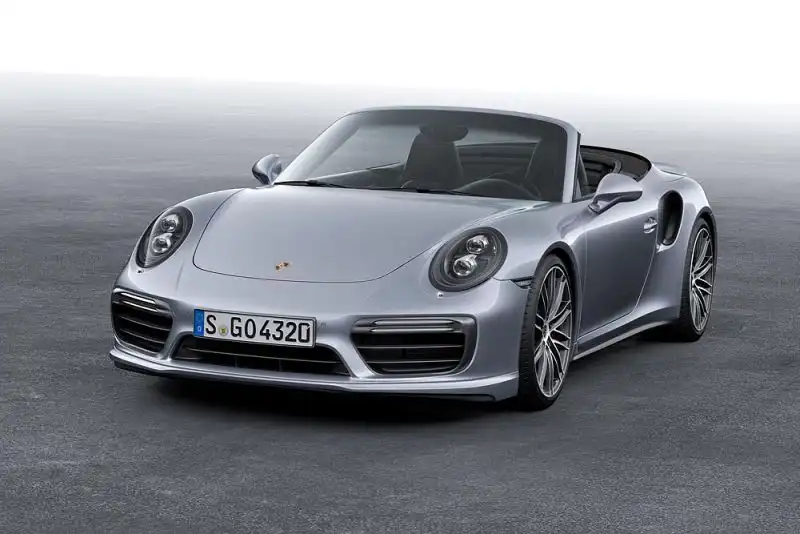
The Porsche 911 Turbo Cabriolet (991 II), produced from 2015 to 2018, represents the pinnacle of open-top performance within the 991.2 generation of Porsche’s iconic sports car. Positioned as the flagship convertible, it combined the exhilarating performance of the 911 Turbo with the added enjoyment of open-air driving. This variant sat at the top of the 911 Cabriolet range, offering significantly more power and advanced technology than the base Carrera models. It was a key offering for Porsche buyers seeking uncompromising performance and luxury in a convertible package, primarily targeting the North American and European markets.
Technical Specifications
| Brand | Porsche |
| Model | 911 |
| Generation | 911 Cabriolet (991 II) |
| Type (Engine) | Turbo 3.8 (540 Hp) PDK |
| Start of production | 2015 |
| End of production | 2018 |
| Powertrain Architecture | Internal Combustion engine |
| Body type | Cabriolet |
| Seats | 4 |
| Doors | 2 |
| Fuel consumption (economy) – urban | 12.1 l/100 km (19.4 US mpg, 23.3 UK mpg, 8.3 km/l) |
| Fuel consumption (economy) – extra urban | 7.6 l/100 km (30.9 US mpg, 37.2 UK mpg, 13.2 km/l) |
| Fuel consumption (economy) – combined | 9.3 l/100 km (25.3 US mpg, 30.4 UK mpg, 10.8 km/l) |
| CO2 emissions | 216 g/km |
| Fuel Type | Petrol (Gasoline) |
| Acceleration 0 – 100 km/h | 3.1 sec |
| Acceleration 0 – 62 mph | 3.1 sec |
| Acceleration 0 – 60 mph | 2.9 sec |
| Maximum speed | 320 km/h (198.84 mph) |
| Emission standard | Euro 6 |
| Weight-to-power ratio | 3.1 kg/Hp, 324.3 Hp/tonne |
| Weight-to-torque ratio | 2.3 kg/Nm, 426.4 Nm/tonne |
| Power | 540 Hp @ 6400 rpm |
| Power per litre | 142.1 Hp/l |
| Torque | 710 Nm @ 2250-4000 rpm (523.67 lb.-ft. @ 2250-4000 rpm) |
| Engine layout | Rear, Longitudinal |
| Engine Model/Code | MDA.BA |
| Engine displacement | 3800 cm3 (231.89 cu. in.) |
| Number of cylinders | 6 |
| Engine configuration | Boxer |
| Cylinder Bore | 102 mm (4.02 in.) |
| Piston Stroke | 77.5 mm (3.05 in.) |
| Compression ratio | 9.8:1 |
| Number of valves per cylinder | 4 |
| Fuel injection system | Direct injection |
| Engine aspiration | BiTurbo, Intercooler |
| Engine oil capacity | 7.5 l (7.93 US qt | 6.6 UK qt) |
| Kerb Weight | 1665 kg (3670.7 lbs.) |
| Max. weight | 2065 kg (4552.55 lbs.) |
| Max load | 400 kg (881.85 lbs.) |
| Trunk (boot) space – minimum | 115 l (4.06 cu. ft.) |
| Trunk (boot) space – maximum | 160 l (5.65 cu. ft.) |
| Fuel tank capacity | 68 l (17.96 US gal | 14.96 UK gal) |
| Length | 4507 mm (177.44 in.) |
| Width | 1880 mm (74.02 in.) |
| Width including mirrors | 1978 mm (77.87 in.) |
| Height | 1294 mm (50.94 in.) |
| Wheelbase | 2450 mm (96.46 in.) |
| Front track | 1541 mm (60.67 in.) |
| Rear (Back) track | 1590 mm (62.6 in.) |
| Drag coefficient (Cd) | 0.32 |
| Drive wheel | All wheel drive (4×4) |
| Number of gears and type of gearbox | 7 gears, automatic transmission PDK |
| Front suspension | Independent type McPherson |
| Rear suspension | Independent multi-link suspension |
| Front brakes | Ventilated discs |
| Rear brakes | Ventilated discs |
| Assisting systems | ABS (Anti-lock braking system) |
| Steering type | Steering rack and pinion |
| Tires size | 245/35 ZR 20; 305/30 ZR 20 |
| Wheel rims size | 9J x 20; 11.5J x 20 |
Powertrain & Engine Architecture
The heart of the 911 Turbo Cabriolet (991 II) is the 3.8-liter twin-turbocharged flat-six engine, designated as the MDA.BA. This engine builds upon the already potent powerplant of the 991.1 Turbo, featuring revised turbochargers and fuel injection for increased power and efficiency. The engine utilizes direct fuel injection, delivering fuel directly into the combustion chambers for precise control and improved performance. The valvetrain employs four valves per cylinder, optimized for high-flow breathing. The engine’s layout is rear-mounted and longitudinal, a defining characteristic of the 911. The 7-speed Porsche Doppelkupplung (PDK) dual-clutch transmission is standard, providing incredibly fast and smooth gear changes. The PDK transmission is electronically controlled and offers both fully automatic and manual shifting modes via steering wheel-mounted paddles.
Driving Characteristics
The 911 Turbo Cabriolet (991 II) delivers a truly exhilarating driving experience. The 540 horsepower and 710 Nm (523.67 lb-ft) of torque provide relentless acceleration, with 0-60 mph achieved in just 2.9 seconds. The PDK transmission ensures that power is delivered seamlessly, with minimal interruption. Compared to the naturally aspirated Carrera models, the Turbo offers significantly more low-end torque and a broader powerband. While the manual transmission was available on other 911 variants, the Turbo was exclusively offered with the PDK, prioritizing performance and responsiveness. The all-wheel-drive system provides exceptional traction, allowing for confident handling in all weather conditions. The convertible top, while adding some weight, does not significantly detract from the car’s dynamic capabilities. The suspension is tuned for a balance between comfort and performance, providing a surprisingly compliant ride for a high-performance sports car.
Equipment & Trim Levels
The 911 Turbo Cabriolet came standard with a comprehensive list of features, including a power-retractable soft top, leather interior, heated and ventilated front seats, a premium sound system, and Porsche’s Communication Management (PCM) infotainment system. Interior upholstery options included various leather colors and materials. Optional extras were plentiful, allowing buyers to personalize their vehicles. Popular options included carbon fiber interior trim, adaptive cruise control, a sport exhaust system, and Porsche Dynamic Chassis Control (PDCC) which minimizes body roll during cornering. The dashboard layout is typical of the 991 generation, with a central touchscreen display and a driver-focused cockpit.
Chassis & Braking
The 911 Turbo Cabriolet features a sophisticated chassis designed to handle the immense power of the engine. The suspension utilizes independent McPherson struts at the front and a multi-link setup at the rear. Porsche Active Suspension Management (PASM) is standard, allowing the driver to adjust the damping characteristics. Braking is provided by ventilated discs on all four wheels, with larger rotors and more powerful calipers compared to the base Carrera models. Porsche Ceramic Composite Brakes (PCCB) were available as an option, offering even greater stopping power and fade resistance. The steering system is a rack-and-pinion setup with power assistance, providing precise and responsive steering feel.
Market Reception & Comparison
The 911 Turbo Cabriolet (991 II) was widely praised by automotive critics for its exceptional performance, luxurious interior, and advanced technology. It was consistently ranked among the best high-performance convertibles on the market. Compared to the 911 Carrera Cabriolet, the Turbo offered a significant performance upgrade, but at a substantial price premium. The Turbo also offered more standard features and a more refined driving experience. Fuel economy, while not a primary concern for buyers in this segment, was respectable for a car of its performance capabilities. Reliability was generally good, although maintenance costs were relatively high due to the complexity of the engine and drivetrain.
Legacy
The 911 Turbo Cabriolet (991 II) remains a highly sought-after vehicle in the used car market. Its combination of performance, luxury, and exclusivity ensures its continued desirability. The 3.8-liter twin-turbo engine has proven to be a robust and reliable powerplant, provided it is properly maintained. The PDK transmission is also known for its durability. Values have remained strong, reflecting the car’s enduring appeal and its status as a modern classic. It represents a high point in the evolution of the 911, offering a compelling blend of performance and open-air enjoyment.