
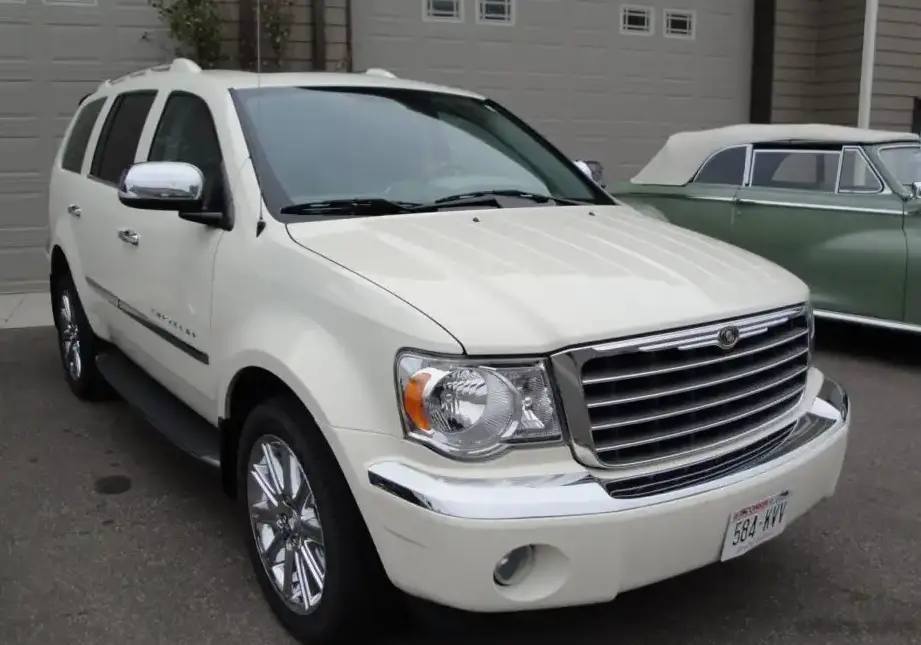
The Chrysler Aspen 5.7i V8 16V (335 Hp) Automatic, produced from 2006 to 2008, was a full-size SUV positioned as Chrysler’s entry into the competitive American SUV market. Built on the Chrysler LX platform, shared with the Dodge Durango, it aimed to provide a more premium experience than the Durango while offering similar capabilities. The Aspen represented a relatively short-lived attempt by Chrysler to capitalize on the demand for large, body-on-frame SUVs before shifting towards more fuel-efficient crossover vehicles. This particular variant, equipped with the 5.7-liter HEMI V8 and a five-speed automatic transmission, was the standard engine offering for the model, representing the bulk of Aspen sales.
Technical Specifications
| Brand | Chrysler |
| Model | Aspen |
| Generation | Aspen |
| Type (Engine) | 5.7 i V8 16V (335 Hp) Automatic |
| Start of production | September, 2006 |
| End of production | 2008 |
| Powertrain Architecture | Internal Combustion engine |
| Body type | SUV |
| Seats | 8 |
| Doors | 5 |
| Fuel consumption (urban) | 15.7 l/100 km (15 US mpg, 18 UK mpg, 6.4 km/l) |
| Fuel consumption (extra urban) | 11.8 l/100 km (19.9 US mpg, 23.9 UK mpg, 8.5 km/l) |
| Fuel Type | Petrol (Gasoline) |
| Maximum speed | 180 km/h (111.85 mph) |
| Weight-to-power ratio | 6.6 kg/Hp, 150.6 Hp/tonne |
| Weight-to-torque ratio | 4.4 kg/Nm, 225.7 Nm/tonne |
| Power | 335 Hp @ 5200 rpm |
| Power per litre | 59.3 Hp/l |
| Torque | 502 Nm @ 4200 rpm (370.26 lb.-ft. @ 4200 rpm) |
| Maximum engine speed | 5800 rpm |
| Engine layout | Front, Longitudinal |
| Engine Model/Code | EZB |
| Engine displacement | 5654 cm3 (345.03 cu. in.) |
| Number of cylinders | 8 |
| Engine configuration | V-engine |
| Cylinder Bore | 99.5 mm (3.92 in.) |
| Piston Stroke | 90.9 mm (3.58 in.) |
| Compression ratio | 9.6:1 |
| Number of valves per cylinder | 2 |
| Fuel injection system | Multi-port manifold injection |
| Engine aspiration | Naturally aspirated engine |
| Valvetrain | OHV |
| Engine oil capacity | 6.6 l (6.97 US qt | 5.81 UK qt) |
| Coolant | 15.8 l (16.7 US qt | 13.9 UK qt) |
| Kerb Weight | 2224 kg (4903.08 lbs.) |
| Max. weight | 2948 kg (6499.23 lbs.) |
| Max load | 724 kg (1596.15 lbs.) |
| Trunk (boot) space – minimum | 538 l (19 cu. ft.) |
| Trunk (boot) space – maximum | 2900 l (102.41 cu. ft.) |
| Fuel tank capacity | 102 l (26.95 US gal | 22.44 UK gal) |
| Permitted trailer load with brakes (12%) | 3379 kg (7449.42 lbs.) |
| Length | 5101 mm (200.83 in.) |
| Width | 1930 mm (75.98 in.) |
| Height | 1887 mm (74.29 in.) |
| Wheelbase | 3027 mm (119.17 in.) |
| Front track | 1637 mm (64.45 in.) |
| Rear (Back) track | 1636 mm (64.41 in.) |
| Ride height (ground clearance) | 254 mm (10 in.) |
| Drag coefficient (Cd) | 0.391 |
| Minimum turning circle (turning diameter) | 12.2 m (40.03 ft.) |
| Drivetrain Architecture | The Internal combustion engine (ICE) drives the rear wheels of the vehicle. |
| Drive wheel | Rear wheel drive |
| Number of gears and type of gearbox | 5 gears, automatic transmission |
| Front suspension | Independent torsion bar, double wishbone |
| Rear suspension | Coil spring, Elastic beam |
| Front brakes | Ventilated discs, 336×28 mm |
| Rear brakes | Disc, 352×22 mm |
| Assisting systems | ABS (Anti-lock braking system) |
| Steering type | Steering rack and pinion |
| Tires size | 265/60 R18; 265/50 R20 |
| Wheel rims size | 8J x 18; 8J x 20 |
Powertrain & Engine Architecture
The heart of the Aspen 5.7i was the EZB engine, a 5.7-liter (345 cubic inch) HEMI V8. This engine featured Chrysler’s Multi-Displacement System (MDS), a cylinder deactivation technology that allowed the engine to switch to four-cylinder mode during light-load cruising to improve fuel economy. The engine utilized a cast iron block with aluminum cylinder heads, and a single overhead valve (OHV) valvetrain. Fuel delivery was handled by a multi-port fuel injection system. The 5.7L HEMI produced 335 horsepower at 5,200 rpm and 370 lb-ft of torque at 4,200 rpm. The engine was mated to a five-speed automatic transmission (545RFE), chosen for its durability and ability to handle the engine’s output. This transmission featured electronically controlled shifts and overdrive for highway efficiency.
Driving Characteristics
The 5.7L V8 and five-speed automatic combination provided adequate, though not exceptional, performance for a full-size SUV. Acceleration was brisk, but the Aspen’s considerable weight (over 4,900 lbs) limited its overall agility. The automatic transmission was tuned for smooth shifts and comfortable cruising, prioritizing ease of use over sporty responsiveness. Compared to the Durango’s available V6 engine, the 5.7L offered significantly more power and towing capacity. However, it lacked the fuel efficiency of the V6. The gear ratios were optimized for towing and hauling, with a relatively low first gear for quick starts and a high overdrive gear for relaxed highway driving. The Aspen wasn’t designed for spirited driving; it excelled at providing a comfortable and capable experience for families and those needing to tow.
Equipment & Trim Levels
The Aspen 5.7i came standard with a respectable array of features, including tri-zone automatic climate control, power windows and locks, a premium audio system, and leather upholstery. Available options included a rear-seat entertainment system, navigation system, sunroof, and upgraded sound systems. Trim levels were relatively simple, with the 5.7i representing the primary offering. Interior materials were generally of good quality, aiming for a more upscale feel than the Dodge Durango. The Aspen’s spacious interior comfortably accommodated up to eight passengers, with ample cargo space, especially with the second and third-row seats folded down.
Chassis & Braking
The Aspen utilized a traditional body-on-frame construction, providing a robust and durable platform. The front suspension featured an independent torsion bar setup with a double wishbone design, while the rear suspension employed a coil-spring elastic beam axle. This configuration prioritized ride comfort and load-carrying capacity. Braking duties were handled by ventilated discs up front and solid discs in the rear. An Anti-lock Braking System (ABS) was standard. The Aspen’s steering was rack-and-pinion, providing reasonably precise control, though it lacked the feedback of more performance-oriented SUVs.
Market Reception & Comparison
The Chrysler Aspen received mixed reviews from automotive critics. While praised for its spacious interior, comfortable ride, and powerful engine, it was often criticized for its fuel economy and somewhat dated design. Compared to competitors like the Chevrolet Tahoe and Ford Expedition, the Aspen offered a similar level of capability but lacked the brand recognition and established reputation of those models. The 5.7L V8 offered a good balance of power and refinement, but its fuel consumption was a significant drawback, especially as gasoline prices rose during its production run. Reliability was generally average, with some reports of issues with the MDS system and electrical components.
Legacy
The Chrysler Aspen was discontinued after only two model years, largely due to declining sales and the increasing popularity of crossover SUVs. While not a commercial success, the Aspen offered a unique combination of HEMI V8 power and Chrysler’s focus on interior comfort. Today, the Aspen 5.7i can be found on the used car market at relatively affordable prices. The 5.7L HEMI engine is known for its durability and relatively straightforward maintenance, making it a reasonably reliable choice for those seeking a large, capable SUV. However, potential buyers should be aware of the potential for MDS system issues and the vehicle’s relatively poor fuel economy. The Aspen remains a somewhat obscure but interesting footnote in Chrysler’s SUV history.
