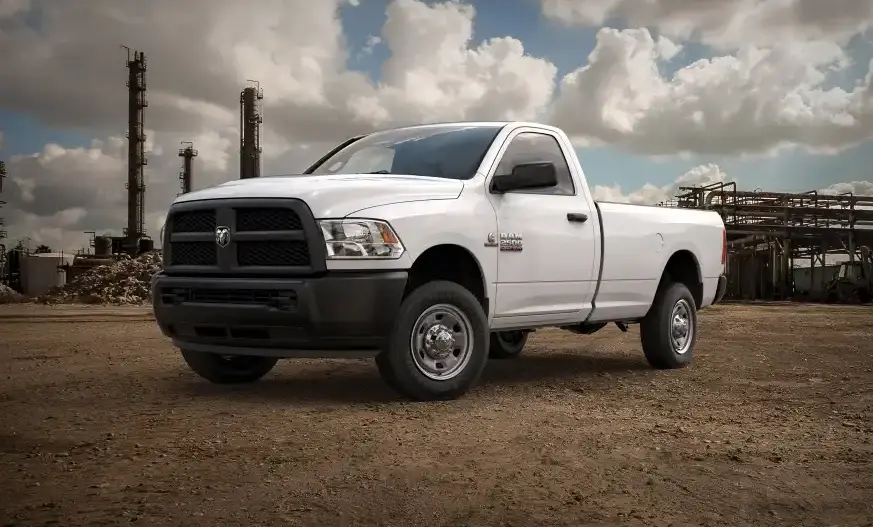
The RAM 2500/3500 Regular Cab I (facelift 2013), specifically the 2500 model equipped with the 6.7-liter Cummins turbodiesel engine producing 370 horsepower and paired with a six-speed automatic transmission and a 4×4 drivetrain, represents a significant iteration in the heavy-duty pickup truck market. Produced from 2013 to 2018, this configuration occupied a sweet spot in the RAM lineup, offering a balance of robust capability, towing capacity, and everyday usability. It was positioned as a workhorse for those needing serious power without necessarily opting for the highest trim levels or the maximum payload capacity of the 3500 series.
Technical Specifications
| Brand | RAM |
| Model | 2500/3500 |
| Generation | 2500/3500 Regular Cab I (facelift 2013) |
| Type (Engine) | 2500 6.7 Cummins TD (370 Hp) 4×4 Automatic |
| Start of production | 2013 |
| End of production | 2018 |
| Powertrain Architecture | Internal Combustion engine |
| Body type | Pick-up |
| Seats | 2-3 |
| Doors | 2 |
| Fuel Type | Diesel |
| Weight-to-power ratio | 8.5 kg/Hp, 117.4 Hp/tonne |
| Weight-to-torque ratio | 2.9 kg/Nm, 343.9 Nm/tonne |
| Power | 370 Hp @ 2800 rpm |
| Power per litre | 55.3 Hp/l |
| Torque | 1084 Nm @ 1600 rpm (799.52 lb.-ft. @ 1600 rpm) |
| Maximum engine speed | 3200 rpm |
| Engine layout | Front, Longitudinal |
| Engine Model/Code | ETJ |
| Engine displacement | 6690 cm3 (408.25 cu. in.) |
| Number of cylinders | 6 |
| Engine configuration | Inline |
| Cylinder Bore | 107 mm (4.21 in.) |
| Piston Stroke | 124 mm (4.88 in.) |
| Compression ratio | 16.2:1 |
| Number of valves per cylinder | 2 |
| Fuel injection system | Diesel Commonrail |
| Engine aspiration | Turbocharger, Intercooler |
| Valvetrain | OHV |
| Engine oil capacity | 11.4 l (12.05 US qt | 10.03 UK qt) |
| Coolant | 21.4 l (22.61 US qt | 18.83 UK qt) |
| Kerb Weight | 3152 kg (6948.97 lbs.) |
| Max. weight | 4082 kg (8999.27 lbs.) |
| Max load | 930 kg (2050.3 lbs.) |
| Trunk (boot) space – maximum | 2115 l (74.69 cu. ft.) |
| Fuel tank capacity | 121 l (31.96 US gal | 26.62 UK gal) |
| Length | 5867 mm (230.98 in.) |
| Width including mirrors | 2004 mm (78.9 in.) |
| Height | 1923 mm (75.71 in.) |
| Wheelbase | 3556 mm (140 in.) |
| Front track | 1735 mm (68.31 in.) |
| Rear (Back) track | 1732 mm (68.19 in.) |
| Minimum turning circle (turning diameter) | 13.3 m (43.64 ft.) |
| Approach angle | 23.0° |
| Departure angle | 21.6° |
| Ramp-over (brakeover) angle | 16.9° |
| Drive wheel | All wheel drive (4×4) |
| Number of gears and type of gearbox | 6 gears, automatic transmission |
| Front suspension | Independent multi-link suspension |
| Rear suspension | Independent multi-link suspension |
| Front brakes | Disc |
| Rear brakes | Disc |
| Assisting systems | ABS (Anti-lock braking system) |
| Power steering | Hydraulic Steering |
| Tires size | 245/70 R17; 265/70 R17; 275/70 R18 |
| Wheel rims size | 7.5J x 17; 8J x 17; 8J x 18 |
INTRODUCTION
The 2013-2018 RAM 2500/3500 Regular Cab, particularly the 2500 variant with the 6.7L Cummins diesel and automatic transmission, was a key player in the North American heavy-duty truck segment. Following the split from Dodge, RAM sought to establish itself as a brand focused on capability and innovation. This generation, a facelift of the previous model, brought updated styling, improved interior materials, and enhanced technology. The Regular Cab configuration catered to buyers prioritizing functionality and affordability over passenger space, making it popular with commercial users, farmers, and those needing a robust work truck. This specific engine and transmission combination was a popular choice, offering a strong balance of power and ease of use.
Powertrain & Engine Architecture
At the heart of this RAM 2500 is the 6.7-liter Cummins inline-six turbodiesel engine, designated with the ETJ code. This engine is a robust and well-regarded powerplant known for its durability and longevity. It utilizes a cast iron block and head, contributing to its inherent strength. The engine employs a diesel commonrail fuel injection system, delivering highly pressurized fuel directly into the cylinders for efficient combustion. The turbocharger, coupled with an intercooler, forces more air into the engine, boosting power output. The overhead valve (OHV) valvetrain, while a more traditional design, is known for its simplicity and reliability.
The six-speed automatic transmission, sourced from Aisin, was a significant upgrade over previous offerings. It provided smoother shifts and improved fuel economy compared to earlier automatic transmissions used in RAM trucks. The transmission is electronically controlled, optimizing shift points based on driving conditions and throttle input. The 4×4 drivetrain features an electronically selectable transfer case, allowing the driver to switch between two-wheel drive and four-wheel drive modes as needed.
Driving Characteristics
The 370 horsepower and 1084 lb-ft of torque delivered by the 6.7L Cummins engine provide substantial pulling power. While not the highest output Cummins available (higher horsepower versions were offered), this configuration offered a very usable powerband. Acceleration is brisk for a heavy-duty truck, and the automatic transmission makes it easy to drive in various conditions. The gear ratios are optimized for towing and hauling, providing ample low-end torque. Compared to the manual transmission versions, the automatic offers greater convenience, especially in stop-and-go traffic. However, some drivers may prefer the more direct control offered by a manual gearbox. Compared to the higher output Cummins variants, this version felt more manageable for daily driving, with less aggressive throttle response.
Equipment & Trim Levels
The 2500 Regular Cab with the 6.7L Cummins typically came standard with features like air conditioning, a basic audio system, and vinyl upholstery. Higher trim levels, such as SLT and Laramie, added features like cloth or leather upholstery, power windows and locks, a more advanced audio system, and chrome exterior trim. Optional extras included a navigation system, a backup camera, and various towing packages. The Regular Cab configuration generally featured a bench seat, accommodating up to three passengers, although the rear seat space was limited. The dashboard layout was functional and straightforward, prioritizing usability over luxury.
Chassis & Braking
The RAM 2500/3500 utilizes a robust chassis designed to withstand heavy loads. The front suspension features an independent multi-link setup, providing a comfortable ride and good handling. The rear suspension also employs a multi-link design, further enhancing ride quality and stability. Braking duties are handled by disc brakes on all four wheels, providing ample stopping power. An Anti-lock Braking System (ABS) is standard, enhancing safety during emergency braking situations. Hydraulic power steering provides responsive and precise steering control. The truck’s tires, typically ranging in size from 245/70 R17 to 275/70 R18, are designed to handle heavy loads and provide good traction.
Market Reception & Comparison
The RAM 2500/3500 with the 6.7L Cummins engine received generally positive reviews from critics. The engine was praised for its power, durability, and fuel efficiency. The automatic transmission was also well-received, offering smooth and convenient operation. Compared to its competitors, the Ford Super Duty and Chevrolet Silverado/GMC Sierra, the RAM 2500 was often lauded for its comfortable ride and well-appointed interior. Fuel economy, while not a primary concern for heavy-duty truck buyers, was competitive with other diesel-powered trucks in its class. Reliability was generally good, although some owners reported issues with the exhaust gas recirculation (EGR) system and the diesel particulate filter (DPF).
Legacy
The 2013-2018 RAM 2500/3500 with the 6.7L Cummins engine has proven to be a durable and reliable workhorse. These trucks continue to hold their value well in the used car market, reflecting their reputation for longevity and capability. The 6.7L Cummins engine is particularly well-regarded, and well-maintained examples can easily exceed 200,000 miles. While the cost of maintenance can be higher than gasoline-powered trucks, the Cummins engine’s durability and fuel efficiency often offset these costs. This generation of RAM 2500 remains a popular choice for those needing a capable and reliable heavy-duty pickup truck.