
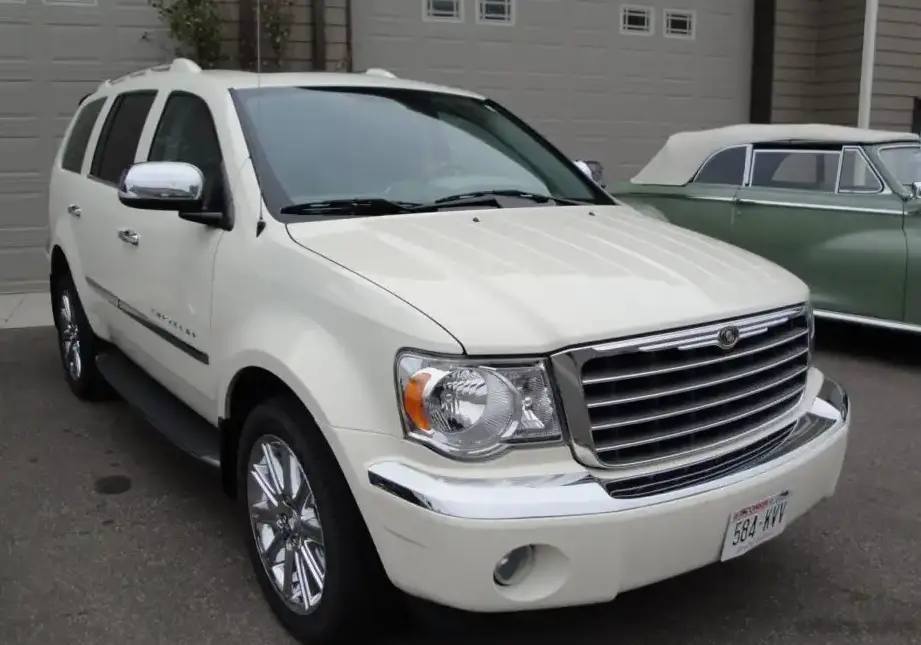
The Chrysler Aspen 5.7i V8 16V (376 hp) Automatic, produced for the 2008 and 2009 model years, was a full-size SUV positioned as Chrysler’s offering in the competitive American SUV market. Built on a truck-based platform, the Aspen aimed to provide a more refined experience than the Dodge Durango with which it shared its underpinnings. It represented a relatively short-lived attempt by Chrysler to capitalize on the demand for large, body-on-frame SUVs before the market shifted towards more fuel-efficient crossover vehicles. This particular variant, equipped with the 5.7-liter HEMI V8 and a five-speed automatic transmission, occupied the upper-mid range of the Aspen lineup, offering a balance of power, towing capacity, and features.
Technical Specifications
| Brand | Chrysler |
| Model | Aspen |
| Generation | Aspen |
| Type (Engine) | 5.7 i V8 16V (376 Hp) Automatic |
| Start of production | 2008 |
| End of production | 2009 |
| Powertrain Architecture | Internal Combustion engine |
| Body type | SUV |
| Seats | 8 |
| Doors | 5 |
| Fuel consumption (urban) | 18.1 l/100 km (13 US mpg, 15.6 UK mpg, 5.5 km/l) |
| Fuel consumption (extra urban) | 12.4 l/100 km (19 US mpg, 22.8 UK mpg, 8.1 km/l) |
| Fuel Type | Petrol (Gasoline) |
| Weight-to-power ratio | 6 kg/Hp, 166.7 Hp/tonne |
| Weight-to-torque ratio | 4.1 kg/Nm, 241.1 Nm/tonne |
| Power | 376 Hp @ 5600 rpm |
| Power per litre | 66.5 Hp/l |
| Torque | 544 Nm @ 3600 rpm (401.23 lb.-ft. @ 3600 rpm) |
| Maximum engine speed | 5800 rpm |
| Engine layout | Front, Longitudinal |
| Engine Model/Code | HEMI |
| Engine displacement | 5654 cm3 (345.03 cu. in.) |
| Number of cylinders | 8 |
| Engine configuration | V-engine |
| Cylinder Bore | 99.5 mm (3.92 in.) |
| Piston Stroke | 90.9 mm (3.58 in.) |
| Compression ratio | 10.5:1 |
| Number of valves per cylinder | 2 |
| Fuel injection system | Multi-port manifold injection |
| Engine aspiration | Naturally aspirated engine |
| Valvetrain | OHV |
| Engine oil capacity | 6.6 l (6.97 US qt | 5.81 UK qt) |
| Coolant | 15.8 l (16.7 US qt | 13.9 UK qt) |
| Kerb Weight | 2256 kg (4973.63 lbs.) |
| Max. weight | 2948 kg (6499.23 lbs.) |
| Max load | 692 kg (1525.6 lbs.) |
| Trunk (boot) space – minimum | 538 l (19 cu. ft.) |
| Trunk (boot) space – maximum | 2900 l (102.41 cu. ft.) |
| Fuel tank capacity | 102 l (26.95 US gal | 22.44 UK gal) |
| Permitted trailer load with brakes (12%) | 2676 kg (5899.57 lbs.) |
| Length | 5101 mm (200.83 in.) |
| Width | 1930 mm (75.98 in.) |
| Height | 1887 mm (74.29 in.) |
| Wheelbase | 3027 mm (119.17 in.) |
| Front track | 1637 mm (64.45 in.) |
| Rear (Back) track | 1636 mm (64.41 in.) |
| Ride height (ground clearance) | 254 mm (10 in.) |
| Drag coefficient (Cd) | 0.391 |
| Minimum turning circle (turning diameter) | 12.2 m (40.03 ft.) |
| Drivetrain Architecture | The Internal combustion engine (ICE) drives the rear wheels of the vehicle. |
| Drive wheel | Rear wheel drive |
| Number of gears and type of gearbox | 5 gears, automatic transmission |
| Front suspension | Independent torsion bar, double wishbone |
| Rear suspension | Coil spring, Elastic beam |
| Front brakes | Ventilated discs, 336×28 mm |
| Rear brakes | Disc, 352×22 mm |
| Assisting systems | ABS (Anti-lock braking system) |
| Steering type | Steering rack and pinion |
| Tires size | 265/60 R18; 265/50 R20 |
| Wheel rims size | 8J x 18; 8J x 20 |
INTRODUCTION
The Chrysler Aspen debuted in 2007 as a 2008 model, sharing its platform with the Dodge Durango. Both vehicles were based on the Chrysler DU platform, a body-on-frame design intended to provide robust towing capability and a comfortable ride. The Aspen was positioned as the more luxurious of the two, featuring a more refined interior and a focus on premium features. The 5.7i V8 Automatic variant was a key offering, providing substantial power for hauling and towing while remaining accessible to a broad range of buyers. Production of the Aspen was relatively short-lived, ending in 2009 due to declining SUV sales and Chrysler’s financial difficulties at the time.
Powertrain & Engine Architecture
At the heart of the Aspen 5.7i was the 5.7-liter HEMI V8 engine, internally designated as the engine code. This engine featured Chrysler’s Multi-Displacement System (MDS), a cylinder deactivation technology that allowed the engine to operate on four cylinders during light-load conditions, improving fuel economy. The engine utilized a cast iron block with aluminum cylinder heads, and a single overhead valve (OHV) valvetrain. Fuel delivery was handled by a multi-port fuel injection system. The 5.7L HEMI produced 376 horsepower at 5,600 rpm and 401 lb-ft of torque at 3,600 rpm. The engine was mated to a five-speed automatic transmission, providing smooth and responsive shifting. This transmission was designed to handle the engine’s substantial torque output and provide adequate gear ratios for both highway cruising and towing.
Driving Characteristics
The Aspen 5.7i Automatic offered a comfortable and capable driving experience. The 5.7-liter HEMI provided ample power for accelerating and merging onto highways, although it wasn’t particularly sporty in its delivery. The automatic transmission was well-tuned for everyday driving, offering smooth shifts and a predictable response. Compared to the Durango, the Aspen’s suspension was tuned for a more comfortable ride, absorbing bumps and imperfections in the road effectively. However, this came at the expense of some handling precision. The 5-speed automatic, while adequate, lacked the efficiency and responsiveness of more modern transmissions found in later SUVs. Compared to a manual transmission equipped Durango, the automatic offered less driver engagement but greater convenience.
Equipment & Trim Levels
The Aspen 5.7i Automatic typically came standard with features such as tri-zone automatic climate control, a premium audio system, leather upholstery, power-adjustable front seats, and a rear-seat entertainment system. Optional extras included a navigation system, sunroof, and upgraded wheels. The interior was generally well-appointed, with a focus on comfort and convenience. Trim levels varied, with higher trims offering additional luxury features such as heated and ventilated front seats, premium leather, and wood trim accents. The Aspen aimed to provide a more upscale experience than its Dodge Durango counterpart, with a greater emphasis on interior refinement.
Chassis & Braking
The Aspen’s chassis was a traditional body-on-frame construction, providing a robust and durable platform. The front suspension utilized an independent torsion bar and double wishbone setup, while the rear suspension employed a coil spring and elastic beam design. This configuration provided a comfortable ride but wasn’t particularly sporty. Braking duties were handled by ventilated discs up front and discs in the rear. An Anti-lock Braking System (ABS) was standard. The Aspen’s weight, exceeding 5,000 pounds, necessitated a capable braking system to ensure safe stopping distances.
Market Reception & Comparison
The Chrysler Aspen received mixed reviews from automotive critics. While praised for its comfortable ride and spacious interior, it was often criticized for its fuel economy and somewhat dated design. Compared to other SUVs in its class, such as the Chevrolet Tahoe and Ford Expedition, the Aspen offered a similar level of capability but lacked the brand recognition and established reputation of its competitors. The 5.7-liter HEMI engine provided competitive power, but its fuel economy was significantly lower than that of smaller-displacement engines offered in other SUVs. Reliability was generally average, with some reports of issues with the transmission and electrical systems.
Legacy
The Chrysler Aspen, despite its short production run, remains a notable vehicle in Chrysler’s history. The 5.7-liter HEMI V8 and five-speed automatic transmission proved to be relatively durable powertrains, and many Aspen models remain on the road today. However, due to its age and relatively low production numbers, parts availability can be a challenge. On the used car market, the Aspen 5.7i Automatic is often sought after by buyers looking for a large, capable SUV with a powerful V8 engine. While it may not offer the fuel efficiency or modern features of newer SUVs, it provides a classic American driving experience and a robust towing capacity.
