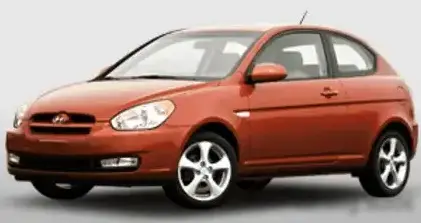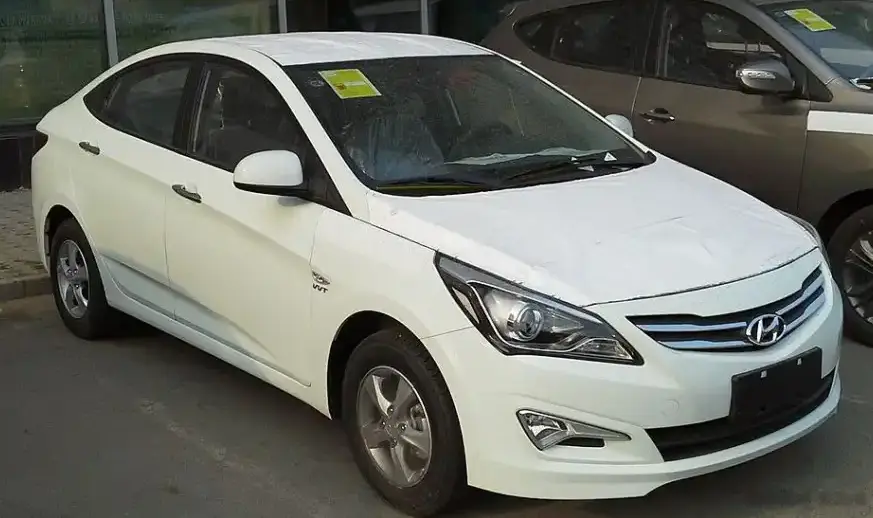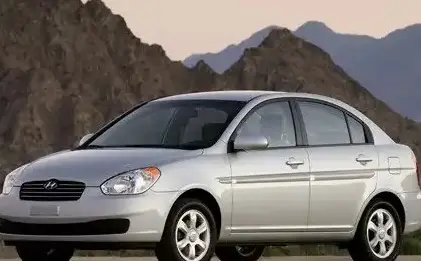
The Hyundai Verna Sedan 1.4 i 16V (97 Hp), produced between 2006 and 2009, represented an entry-level offering within the second generation (LC) Verna lineup. This generation, sold globally under various names including Accent, was a significant step forward for Hyundai in terms of design, build quality, and features. The 1.4L engine and five-speed manual transmission combination was aimed at buyers seeking an affordable and fuel-efficient compact sedan. It served as the base model, positioned below the 1.6L variants which offered increased performance. The Verna, in this iteration, was primarily targeted towards emerging markets and value-conscious consumers.
Technical Specifications
| Brand | Hyundai |
| Model | Verna |
| Generation | Verna Sedan |
| Type (Engine) | 1.4 i 16V (97 Hp) |
| Start of production | 2006 |
| End of production | 2009 |
| Powertrain Architecture | Internal Combustion engine |
| Body type | Sedan |
| Seats | 5 |
| Doors | 4 |
| Fuel consumption (urban) | 8 l/100 km (29.4 US mpg) |
| Fuel consumption (extra urban) | 5.1 l/100 km (46.1 US mpg) |
| Fuel consumption (combined) | 6.2 l/100 km (37.9 US mpg) |
| Fuel Type | Petrol (Gasoline) |
| Acceleration 0 – 100 km/h | 12.3 sec |
| Acceleration 0 – 62 mph | 12.3 sec |
| Acceleration 0 – 60 mph | 11.7 sec |
| Maximum speed | 177 km/h (109.98 mph) |
| Weight-to-power ratio | 10.9 kg/Hp |
| Weight-to-torque ratio | 8.5 kg/Nm |
| Power | 97 Hp @ 6000 rpm |
| Power per litre | 69.3 Hp/l |
| Torque | 125 Nm @ 4700 rpm (92.2 lb.-ft. @ 4700 rpm) |
| Engine layout | Front, Transverse |
| Engine Model/Code | Alpha II / G4EE |
| Engine displacement | 1399 cm3 (85.37 cu. in.) |
| Number of cylinders | 4 |
| Engine configuration | Inline |
| Number of valves per cylinder | 4 |
| Fuel injection system | Multi-port manifold injection |
| Engine aspiration | Naturally aspirated engine |
| Valvetrain | DOHC |
| Engine oil capacity | 3.3 l (3.49 US qt | 2.9 UK qt) |
| Coolant capacity | 5.5 l (5.81 US qt | 4.84 UK qt) |
| Kerb Weight | 1058 kg (2332.49 lbs) |
| Max. weight | 1580 kg (3483.3 lbs) |
| Max load | 522 kg (1150.81 lbs) |
| Trunk (boot) space – minimum | 390 l (13.77 cu. ft) |
| Fuel tank capacity | 45 l (11.89 US gal | 9.9 UK gal) |
| Length | 4280 mm (168.5 in) |
| Width | 1695 mm (66.73 in) |
| Height | 1470 mm (57.87 in) |
| Wheelbase | 2500 mm (98.43 in) |
| Minimum turning circle | 10.2 m (33.46 ft) |
| Drivetrain Architecture | Front wheel drive |
| Number of gears | 5 gears, manual transmission |
| Front suspension | Transverse stabilizer |
| Rear suspension | Torsion |
| Front brakes | Ventilated discs |
| Rear brakes | Drum |
| Steering type | Steering rack and pinion |
| Tires size | 175/70 R14 |
Powertrain & Engine Architecture
The heart of the Verna 1.4 i 16V is the Hyundai Alpha II engine, specifically the G4EE code. This 1.4-liter inline-four cylinder engine utilizes a multi-point fuel injection system, delivering fuel directly to the intake ports. The engine features a double overhead camshaft (DOHC) valvetrain, operating 16 valves (four per cylinder) to optimize airflow and improve volumetric efficiency. This configuration, while not groundbreaking, was known for its relative simplicity and reliability. The engine’s 97 horsepower at 6000 rpm and 92.2 lb-ft of torque at 4700 rpm were adequate for everyday driving, but didn’t offer particularly spirited performance. The five-speed manual transmission was the standard offering, providing a reasonably direct connection between the engine and the front wheels. The transmission’s gear ratios were tuned for fuel economy rather than outright acceleration.
Driving Characteristics
The Verna 1.4L with the manual transmission offered a predictable, if somewhat uninspiring, driving experience. Acceleration was modest, taking around 12.3 seconds to reach 62 mph. The engine felt strained when pushed hard, and overtaking maneuvers required careful planning. The five-speed gearbox was light and easy to use, but the long throws didn’t encourage aggressive shifting. Compared to the 1.6L versions, the 1.4L felt noticeably slower, particularly at higher speeds. However, the lighter engine weight contributed to slightly better handling and a more nimble feel in city driving. The suspension, tuned for comfort, absorbed bumps reasonably well, but didn’t provide a particularly sporty ride.
Equipment & Trim Levels
The 1.4 i 16V Verna typically came with a basic level of equipment. Standard features generally included power steering, air conditioning, and a basic audio system. Interior upholstery was typically cloth, and the dashboard featured a functional, if somewhat plain, design. Optional extras, depending on the market, could include power windows, central locking, and an upgraded audio system. The trim level was generally considered the base model, focusing on affordability and essential features. It was aimed at buyers who prioritized value over luxury.
Chassis & Braking
The Verna’s chassis featured a front MacPherson strut suspension and a rear torsion beam setup. This configuration provided a good balance between ride comfort and handling. The front brakes were ventilated discs, offering adequate stopping power, while the rear brakes were drums, a cost-saving measure common in this segment. A transverse stabilizer bar was included at the front to reduce body roll during cornering. The steering was a rack and pinion system, providing reasonably precise control. The tires were typically 175/70 R14, chosen for their balance of comfort and fuel efficiency.
Market Reception & Comparison
The Verna 1.4 i 16V was generally well-received as an affordable and reliable compact sedan. Critics praised its fuel economy and spacious interior, but noted its lack of performance. Compared to the 1.6L variants, the 1.4L offered significantly lower running costs but at the expense of driving enjoyment. In terms of reliability, the Alpha II engine proved to be relatively robust, with few major issues reported. Fuel economy figures of around 37.9 US mpg combined were competitive for its class. Competitors in this segment included the Toyota Corolla, Honda Civic, and Nissan Sentra, all of which offered similar levels of practicality and reliability.
Legacy
The Hyundai Verna 1.4 i 16V, while not a performance icon, established Hyundai as a credible player in the compact sedan market. The Alpha II engine, in its various iterations, proved to be a durable and reliable powerplant. Today, these vehicles are relatively common on the used car market, often prized for their affordability and low maintenance costs. While finding parts may become more challenging over time, the engine’s simplicity and widespread use mean that components are still generally available. The Verna 1.4L represents a significant step in Hyundai’s journey towards becoming a global automotive leader, demonstrating a commitment to value, reliability, and practicality.