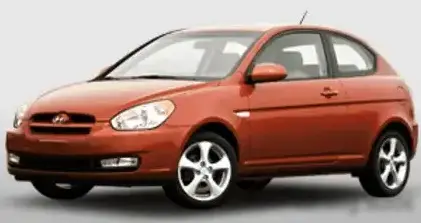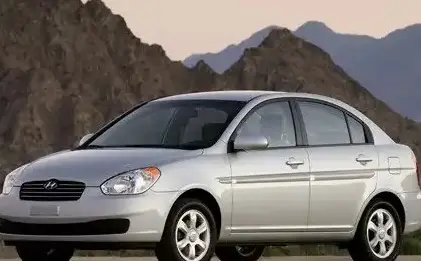
The Hyundai Verna Sedan 1.5 CRDi, producing 110 horsepower, was a significant offering in Hyundai’s lineup from 2006 to 2009. This variant occupied a middle ground within the second-generation Verna (also known as the Accent in some markets), positioned as a fuel-efficient and reasonably equipped option for buyers seeking a compact diesel sedan. It represented Hyundai’s growing ambition to compete in the global automotive market with vehicles offering a blend of value, practicality, and modern features. The Verna, in general, aimed to provide a more sophisticated alternative to basic economy cars, and the 1.5 CRDi model was central to that strategy, particularly in markets where diesel fuel was prevalent and cost-effective.
Technical Specifications
| Brand | Hyundai |
| Model | Verna |
| Generation | Verna Sedan |
| Type (Engine) | 1.5 CRDi (110 Hp) |
| Start of production | 2006 |
| End of production | 2009 |
| Powertrain Architecture | Internal Combustion engine |
| Body type | Sedan |
| Seats | 5 |
| Doors | 4 |
| Fuel Type | Diesel |
| Acceleration 0 – 100 km/h | 11.5 sec |
| Acceleration 0 – 62 mph | 11.5 sec |
| Acceleration 0 – 60 mph | 10.9 sec |
| Maximum speed | 190 km/h (118.06 mph) |
| Weight-to-power ratio | 10.2 kg/Hp, 97.8 Hp/tonne |
| Weight-to-torque ratio | 4.8 kg/Nm, 208.9 Nm/tonne |
| Power | 110 Hp @ 4000 rpm |
| Power per litre | 73.7 Hp/l |
| Torque | 235 Nm @ 1900 rpm (173.33 lb.-ft. @ 1900 rpm) |
| Engine layout | Front, Transverse |
| Engine Model/Code | U / D4FA |
| Engine displacement | 1493 cm3 (91.11 cu. in.) |
| Number of cylinders | 4 |
| Engine configuration | Inline |
| Cylinder Bore | 75 mm (2.95 in.) |
| Piston Stroke | 84.5 mm (3.33 in.) |
| Compression ratio | 17.8:1 |
| Number of valves per cylinder | 4 |
| Fuel injection system | Diesel Commonrail |
| Engine aspiration | Turbocharger, Intercooler |
| Engine oil capacity | 5.3 l (5.6 US qt | 4.66 UK qt) |
| Coolant | 5.3 l (5.6 US qt | 4.66 UK qt) |
| Kerb Weight | 1125 kg (2480.2 lbs.) |
| Max. weight | 1670 kg (3681.72 lbs.) |
| Max load | 545 kg (1201.52 lbs.) |
| Trunk (boot) space – maximum | 390 l (13.77 cu. ft.) |
| Fuel tank capacity | 45 l (11.89 US gal | 9.9 UK gal) |
| Length | 4280 mm (168.5 in.) |
| Width | 1695 mm (66.73 in.) |
| Height | 1470 mm (57.87 in.) |
| Wheelbase | 2500 mm (98.43 in.) |
| Front track | 1470 mm (57.87 in.) |
| Rear (Back) track | 1460 mm (57.48 in.) |
| Drivetrain Architecture | The Internal combustion engine (ICE) drives the front wheels of the vehicle. |
| Drive wheel | Front wheel drive |
| Number of gears and type of gearbox | 5 gears, manual transmission |
| Front suspension | Independent, type McPherson with coil spring and anti-roll bar |
| Rear suspension | Coil spring |
| Front brakes | Disc |
| Rear brakes | Drum |
| Assisting systems | ABS (Anti-lock braking system) |
| Steering type | Steering rack and pinion |
| Tires size | 185/65 R14 |
Powertrain & Engine Architecture
The heart of the Verna 1.5 CRDi was the D4FA engine, a 1.5-liter inline-four cylinder diesel. This engine utilized a second-generation common rail direct injection (CRDi) system, which allowed for precise fuel delivery and optimized combustion. The turbocharger, coupled with an intercooler, boosted power output and improved torque across a wider RPM range. The engine featured four valves per cylinder and a compression ratio of 17.8:1, contributing to its efficiency. The 5-speed manual transmission was the standard offering, providing a balance between fuel economy and drivability. The engine code ‘U’ was sometimes used interchangeably with D4FA, depending on regional specifications.
Driving Characteristics
The 110 horsepower and 235 Nm (173 lb-ft) of torque provided adequate performance for everyday driving. Acceleration to 60 mph took around 10.9 seconds, and the top speed was approximately 118 mph. While not a sports car, the 1.5 CRDi offered sufficient power for highway cruising and overtaking. The manual transmission allowed for driver control, but the gear ratios were tuned for fuel efficiency rather than outright performance. Compared to the gasoline-powered Verna variants, the CRDi offered significantly better fuel economy and a more robust low-end torque curve. However, it lacked the responsiveness and higher-revving nature of the gasoline engines.
Equipment & Trim Levels
The Verna 1.5 CRDi typically came with a reasonable level of standard equipment. This included power windows, power steering, air conditioning, and a basic audio system. Higher trim levels added features such as alloy wheels, a more sophisticated audio system, and upgraded interior trim. Interior upholstery was generally cloth, with options for higher-quality materials on premium trims. Safety features included ABS brakes, but airbags were often optional depending on the market and trim level.
Chassis & Braking
The Verna utilized a McPherson strut front suspension and a coil spring rear suspension. This setup provided a comfortable ride, although it wasn’t particularly sporty. The front brakes were discs, while the rear brakes were drums, a common configuration for this class of vehicle at the time. The ABS system helped to improve braking performance and stability, especially on slippery surfaces. The chassis was designed to balance ride comfort with handling stability, prioritizing practicality over dynamic performance.
Market Reception & Comparison
The Verna 1.5 CRDi was generally well-received by automotive critics for its fuel efficiency, practicality, and value for money. It was often praised as a sensible and economical choice for buyers seeking a compact sedan. Compared to other diesel-powered compacts of the era, the Verna offered a competitive combination of performance, fuel economy, and features. However, some critics noted that the interior quality wasn’t as refined as some of its rivals, and the ride could be somewhat firm on rough roads. The 1.5 CRDi was a strong alternative to gasoline-powered Vernas, offering significantly better fuel economy, but at the cost of some refinement and responsiveness.
Legacy
The Hyundai Verna 1.5 CRDi has proven to be a relatively reliable vehicle, with many examples still on the road today. The D4FA engine is known for its durability, although regular maintenance is essential to prevent issues. Common issues include turbocharger wear and potential problems with the fuel injection system. In the used car market, the Verna 1.5 CRDi remains an affordable and practical option for buyers seeking a fuel-efficient and reliable compact sedan. Its legacy lies in demonstrating Hyundai’s ability to produce competitive diesel-powered vehicles and establish a stronger presence in the global automotive market.