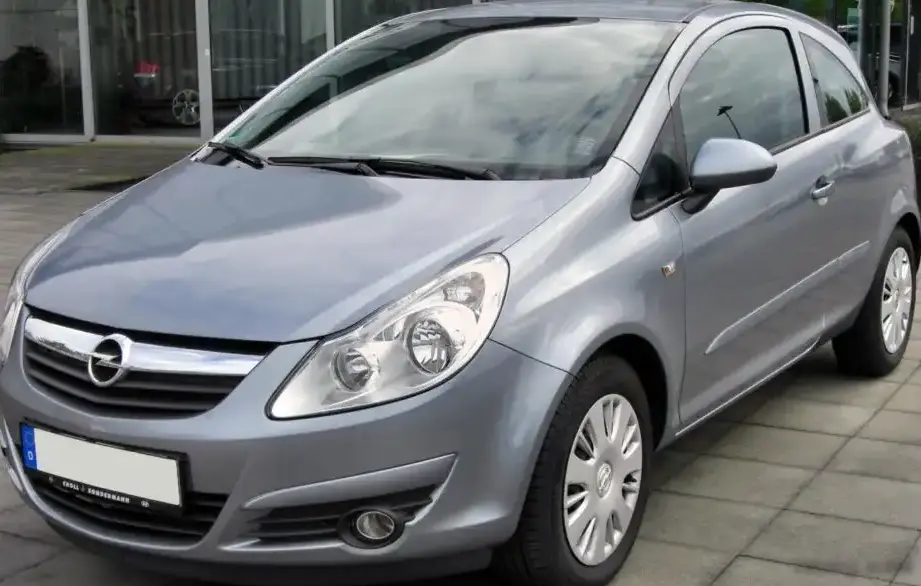
The Opel Corsa D 3-door 1.6i 16V OPC, produced from March 2007 to October 2009, represented the performance variant of the fourth-generation Corsa (D). Positioned as the flagship model within the Corsa D 3-door range, the OPC (Opel Performance Center) aimed to deliver a more engaging driving experience than the standard trims. It was primarily marketed in Europe, offering a hot hatch alternative to rivals like the Volkswagen Polo GTI and Renault Clio RS. The Corsa D OPC was never officially sold in the United States.
Technical Specifications
| Brand | Opel |
| Model | Corsa |
| Generation | Corsa D 3-door |
| Type (Engine) | 1.6i 16V OPC (192 Hp) |
| Start of production | March, 2007 |
| End of production | October, 2009 |
| Powertrain Architecture | Internal Combustion engine |
| Body type | Hatchback |
| Seats | 5 |
| Doors | 3 |
| Fuel consumption (urban) | 10.5 l/100 km (22.4 US mpg, 26.9 UK mpg, 9.5 km/l) |
| Fuel consumption (extra urban) | 6.4 l/100 km (36.8 US mpg, 44.1 UK mpg, 15.6 km/l) |
| Fuel consumption (combined) | 7.9 l/100 km (29.8 US mpg, 35.8 UK mpg, 12.7 km/l) |
| Fuel Type | Petrol (Gasoline) |
| Acceleration 0 – 100 km/h | 7.2 sec |
| Acceleration 0 – 62 mph | 7.2 sec |
| Acceleration 0 – 60 mph | 6.8 sec |
| Maximum speed | 225 km/h (139.81 mph) |
| Emission standard | Euro 4 |
| Weight-to-power ratio | 6.3 kg/Hp, 159.6 Hp/tonne |
| Weight-to-torque ratio | 5.2 kg/Nm, 191.2 Nm/tonne |
| Power | 192 Hp @ 5850 rpm |
| Power per litre | 120.2 Hp/l |
| Torque | 230 Nm @ 1980-5800 rpm (169.64 lb.-ft. @ 1980-5800 rpm) |
| Engine layout | Front, Transverse |
| Engine Model/Code | Z16LER |
| Engine displacement | 1598 cm3 (97.52 cu. in.) |
| Number of cylinders | 4 |
| Engine configuration | Inline |
| Number of valves per cylinder | 4 |
| Fuel injection system | Multi-port manifold injection |
| Engine aspiration | Turbocharger, Intercooler |
| Valvetrain | DOHC |
| Engine oil capacity | 4.5 l (4.76 US qt | 3.96 UK qt) |
| Coolant | 5.8 l (6.13 US qt | 5.1 UK qt) |
| Kerb Weight | 1203 kg (2652.16 lbs.) |
| Max. weight | 1703 kg (3754.47 lbs.) |
| Max load | 500 kg (1102.31 lbs.) |
| Trunk (boot) space – minimum | 285 l (10.06 cu. ft.) |
| Trunk (boot) space – maximum | 1050 l (37.08 cu. ft.) |
| Fuel tank capacity | 44 l (11.62 US gal | 9.68 UK gal) |
| Length | 4040 mm (159.06 in.) |
| Width | 1713 mm (67.44 in.) |
| Height | 1488 mm (58.58 in.) |
| Wheelbase | 2511 mm (98.86 in.) |
| Front track | 1486 mm (58.5 in.) |
| Rear (Back) track | 1478 mm (58.19 in.) |
| Ride height (ground clearance) | 150 mm (5.91 in.) |
| Drag coefficient (Cd) | 0.33 |
| Minimum turning circle | 10.4 m (34.12 ft.) |
| Drivetrain Architecture | Front wheel drive |
| Number of gears | 6 gears, manual transmission |
| Front suspension | Independent, type McPherson with coil spring and anti-roll bar |
| Rear suspension | Rigid axle suspension |
| Front brakes | Ventilated discs |
| Rear brakes | Ventilated discs |
| Assisting systems | ABS (Anti-lock braking system) |
| Steering type | Steering rack and pinion |
| Power steering | Electric Steering |
| Tires size | 215/45 R17 |
| Wheel rims size | 17 |
Introduction
The Corsa D OPC was a direct response to the growing demand for accessible, yet potent, hot hatches in Europe. Building upon the standard Corsa D platform (based on the GM Gamma architecture), the OPC variant featured significant mechanical upgrades to deliver a noticeably more spirited driving experience. Production spanned from 2007 to 2009, with the 3-door body style being the only configuration offered for the OPC model. It aimed to bridge the gap between everyday usability and enthusiast-focused performance.
Powertrain & Engine Architecture
At the heart of the Corsa D OPC lies the Z16LER engine, a 1.6-liter turbocharged inline-four cylinder powerplant. This engine, a derivative of the Family 1 series, was specifically tuned for higher output. It utilized a single scroll turbocharger with an intercooler to boost power and torque. The engine employed multi-port fuel injection and a double overhead camshaft (DOHC) valvetrain with four valves per cylinder. The Z16LER produced 192 horsepower at 5850 rpm and 230 Nm (169.64 lb-ft) of torque between 1980 and 5800 rpm. The engine was paired exclusively with a Getrag M32 six-speed manual transmission, chosen for its durability and precise shift feel. This transmission featured relatively short gear ratios, optimized for acceleration.
Driving Characteristics
The Corsa D OPC offered a distinctly more engaging driving experience compared to the naturally aspirated Corsa D models. The turbocharger provided a noticeable surge of power, particularly in the mid-range, making overtaking maneuvers effortless. While not as brutally fast as some of its rivals, the OPC’s relatively light weight (1203 kg / 2652.16 lbs) contributed to brisk acceleration – 0 to 62 mph in 7.2 seconds and a top speed of 225 km/h (139.81 mph). The six-speed manual transmission allowed drivers to keep the engine in its optimal power band. The steering was direct and responsive, providing good feedback. However, the rigid rear axle suspension could sometimes result in a slightly unsettled ride on uneven surfaces.
Equipment & Trim Levels
The Corsa D OPC came reasonably well-equipped as standard. Key features included sports seats with distinctive cloth upholstery, a leather-wrapped steering wheel, air conditioning, and alloy wheels (typically 17-inch). Optional extras included a panoramic sunroof, upgraded audio system, and parking sensors. The interior design was functional and driver-focused, with a clear instrument cluster and well-placed controls. The OPC also featured unique exterior styling cues, such as a more aggressive front bumper with larger air intakes, side skirts, a rear spoiler, and a centrally mounted exhaust outlet.
Chassis & Braking
The OPC benefited from several chassis upgrades compared to the standard Corsa D. The suspension was lowered and stiffened, with upgraded dampers and springs. A thicker anti-roll bar was fitted to reduce body roll during cornering. The braking system was also upgraded, featuring ventilated discs on all four wheels, providing ample stopping power. ABS (Anti-lock Braking System) was standard. The steering utilized an electric power steering system, offering a balance between assistance and feel.
Market Reception & Comparison
The Corsa D OPC was generally well-received by automotive journalists, who praised its performance, handling, and value for money. It was often compared to rivals such as the Volkswagen Polo GTI and Renault Clio RS. While the Polo GTI offered a more refined driving experience, the Corsa OPC was considered to be more raw and engaging. The Clio RS was often seen as the more focused performance car, but also more expensive. The Corsa OPC offered a good compromise between performance, practicality, and affordability. Fuel economy, while not exceptional, was reasonable for a hot hatch of its era, averaging around 29.8 US mpg (combined).
Legacy
The Corsa D OPC has developed a loyal following among enthusiasts. The Z16LER engine, while not without its quirks, is generally considered to be reliable when properly maintained. Common issues include turbocharger wear and potential oil leaks. Today, well-maintained examples of the Corsa D OPC are becoming increasingly sought after by collectors and enthusiasts. Its relatively affordable price point and engaging driving dynamics make it an attractive option for those seeking a fun and practical hot hatch. The OPC represents a high point in the Corsa’s history, demonstrating Opel’s ability to create a genuinely enjoyable performance car.