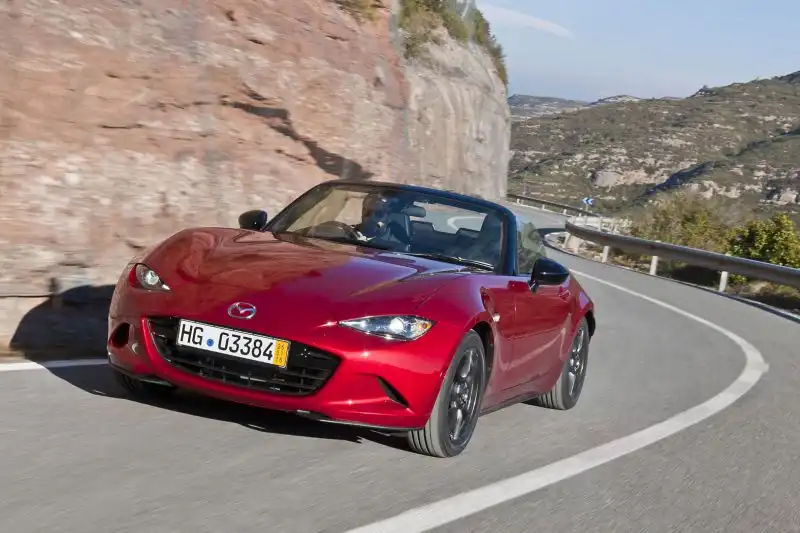
The Mazda MX-5 (fourth generation, ND) 2.0 SkyActiv-G with i-ELOOP, produced from 2015 to 2018, represents a significant evolution in Mazda’s long-running roadster lineage. Positioned as the higher-performance engine option within the ND range, it offered a substantial upgrade over the base 1.5-liter engine. This variant aimed to deliver a more engaging driving experience while maintaining the MX-5’s core principles of lightweight design and balanced handling. The i-ELOOP system, a mild hybrid technology, further enhanced fuel efficiency. It was primarily marketed towards driving enthusiasts seeking a pure, sporty roadster experience.
Technical Specifications
| Brand | Mazda |
| Model | MX-5 |
| Generation | MX-5 IV (ND) |
| Type (Engine) | 2.0 SkyActiv-G (160 Hp) i-ELOOP |
| Start of production | 2015 |
| End of production | 2018 |
| Powertrain Architecture | Internal Combustion engine |
| Body type | Roadster |
| Seats | 2 |
| Doors | 2 |
| Fuel consumption (urban) | 8.7 l/100 km (27 US mpg, 32.5 UK mpg, 11.5 km/l) |
| Fuel consumption (extra urban) | 5.4 l/100 km (43.6 US mpg, 52.3 UK mpg, 18.5 km/l) |
| Fuel consumption (combined) | 6.6 l/100 km (35.6 US mpg, 42.8 UK mpg, 15.2 km/l) |
| CO2 emissions | 154 g/km |
| Fuel Type | Petrol (Gasoline) |
| Acceleration 0 – 100 km/h | 7.3 sec |
| Acceleration 0 – 62 mph | 7.3 sec |
| Acceleration 0 – 60 mph | 6.9 sec |
| Maximum speed | 214 km/h (132.97 mph) |
| Emission standard | Euro 6 |
| Weight-to-power ratio | 6.3 kg/Hp, 157.6 Hp/tonne |
| Weight-to-torque ratio | 5.1 kg/Nm, 197 Nm/tonne |
| Power | 160 Hp @ 6000 rpm |
| Power per litre | 80.1 Hp/l |
| Torque | 200 Nm @ 4600 rpm (147.51 lb.-ft. @ 4600 rpm) |
| Engine layout | Front, Longitudinal |
| Engine displacement | 1998 cm3 (121.93 cu. in.) |
| Number of cylinders | 4 |
| Engine configuration | Inline |
| Cylinder Bore | 83.5 mm (3.29 in.) |
| Piston Stroke | 91.2 mm (3.59 in.) |
| Compression ratio | 13:1 |
| Number of valves per cylinder | 4 |
| Fuel injection system | Direct injection |
| Engine aspiration | Naturally aspirated engine |
| Engine oil capacity | 4.3 l (4.54 US qt | 3.78 UK qt) |
| Coolant | 6 l (6.34 US qt | 5.28 UK qt) |
| Kerb Weight | 1015 kg (2237.69 lbs.) |
| Max. weight | 1260 kg (2777.82 lbs.) |
| Max load | 245 kg (540.13 lbs.) |
| Trunk (boot) space – minimum | 130 l (4.59 cu. ft.) |
| Fuel tank capacity | 45 l (11.89 US gal | 9.9 UK gal) |
| Length | 3915 mm (154.13 in.) |
| Width | 1735 mm (68.31 in.) |
| Width including mirrors | 1918 mm (75.51 in.) |
| Height | 1230 mm (48.43 in.) |
| Wheelbase | 2310 mm (90.94 in.) |
| Front track | 1495 mm (58.86 in.) |
| Rear (Back) track | 1505 mm (59.25 in.) |
| Ride height (ground clearance) | 125 mm (4.92 in.) |
| Minimum turning circle (turning diameter) | 9.4 m (30.84 ft.) |
| Drivetrain Architecture | Rear wheel drive |
| Drive wheel | Rear wheel drive |
| Number of gears and type of gearbox | 6 gears, manual transmission |
| Front brakes | Ventilated discs |
| Rear brakes | Disc |
| Assisting systems | ABS (Anti-lock braking system) |
| Steering type | Steering rack and pinion |
| Power steering | Electric Steering |
INTRODUCTION
The ND MX-5, launched in 2015, marked the fourth generation of Mazda’s iconic roadster. Built on the SkyActiv chassis, it prioritized lightweight construction and a driver-focused experience. The 2.0-liter SkyActiv-G engine, paired with the i-ELOOP system, was introduced as the premium engine option, offering increased power and torque compared to the 1.5-liter variant. The i-ELOOP system, a capacitor-based regenerative braking system, stored energy during deceleration to power electrical components, reducing engine load and improving fuel economy. This 2.0L variant was available throughout the ND’s initial production run (2015-2018) and became a popular choice for enthusiasts.
Powertrain & Engine Architecture
The heart of this MX-5 variant is the PE-VPH 2.0-liter inline-four cylinder SkyActiv-G engine. This engine utilizes a high compression ratio of 13:1, achieved through advanced combustion control and precise fuel injection. The engine employs direct injection, optimizing fuel delivery and enhancing efficiency. The valvetrain features dual overhead camshafts (DOHC) and four valves per cylinder, contributing to its responsive nature. The i-ELOOP system, a key feature, recovers kinetic energy during braking and stores it in a capacitor, providing power to auxiliary systems like the headlights and air conditioning, reducing the load on the engine. The engine is longitudinally mounted, driving the rear wheels. The standard transmission was a precise six-speed manual, although a six-speed automatic transmission was also available, albeit less common among enthusiasts.
Driving Characteristics
The 2.0-liter engine significantly enhanced the driving experience compared to the 1.5-liter version. With 160 horsepower and 147 lb-ft of torque, the ND MX-5 2.0 offered brisk acceleration and ample power for spirited driving. The six-speed manual transmission provided precise shifts and allowed drivers to fully exploit the engine’s powerband. The automatic transmission, while offering convenience, slightly dulled the driving experience. The ND’s lightweight construction (around 2238 lbs) and well-tuned suspension contributed to exceptional handling and cornering ability. The rear-wheel-drive layout provided a balanced and engaging driving feel. Compared to the 1.5L, the 2.0L felt noticeably more confident during highway merges and overtaking maneuvers.
Equipment & Trim Levels
The 2.0-liter MX-5 typically came with a higher level of standard equipment than the 1.5-liter model. Standard features included power windows and locks, air conditioning, a leather-wrapped steering wheel, and a basic audio system. Higher trim levels, such as the Club and Grand Touring, added features like a limited-slip differential (Club), heated leather seats, a Bose premium audio system, and advanced safety features like blind-spot monitoring and lane-departure warning. Interior upholstery was typically cloth on the base models, with leather options available on higher trims. Optional extras included a retractable hardtop, various exterior color options, and upgraded wheel designs.
Chassis & Braking
The ND MX-5 utilizes a MacPherson strut front suspension and a multi-link rear suspension, optimized for lightweight and responsive handling. The chassis is constructed with high-strength steel, contributing to its rigidity and safety. Braking duties are handled by ventilated discs at the front and solid discs at the rear. Anti-lock braking system (ABS) was standard. The relatively low weight of the vehicle meant that the braking system was more than adequate for most driving situations. The suspension tuning was firm, prioritizing handling over ride comfort, although it remained reasonably compliant for everyday use.
Market Reception & Comparison
The ND MX-5, particularly the 2.0-liter variant, received overwhelmingly positive reviews from automotive critics. It was praised for its engaging driving dynamics, lightweight design, and stylish aesthetics. The 2.0-liter engine was considered a significant improvement over the 1.5-liter, offering a more satisfying driving experience. Compared to the 1.5-liter, the 2.0-liter model commanded a higher price but offered a noticeable performance advantage. Fuel economy was respectable, especially considering the engine’s output, and the i-ELOOP system contributed to improved efficiency. Reliability has been generally good, with few widespread issues reported.
Legacy
The ND MX-5 2.0 SkyActiv-G with i-ELOOP has established itself as a highly desirable roadster in the used car market. Its combination of performance, handling, and reliability has made it a popular choice among driving enthusiasts. The powertrain has proven to be durable and relatively maintenance-free. While the i-ELOOP system is not a full hybrid, it demonstrates Mazda’s commitment to fuel efficiency and innovative technology. The ND MX-5 continues to be celebrated as a modern interpretation of the classic roadster formula, offering a pure and engaging driving experience that remains unmatched in its class.