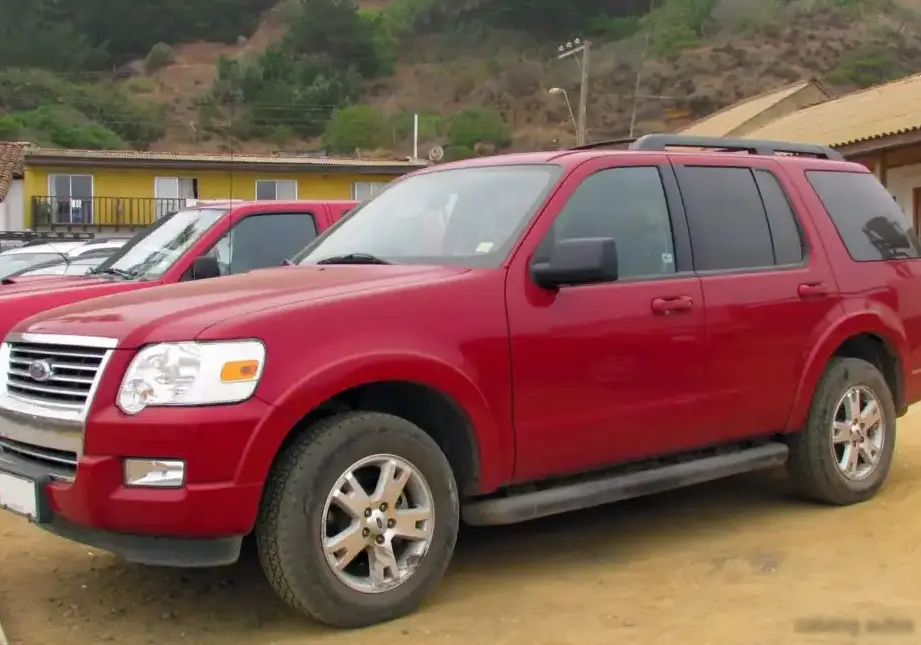
The Ford Explorer IV, produced between 2006 and 2010, represented a significant evolution for Ford’s popular SUV. This fourth generation Explorer moved away from the body-on-frame construction of its predecessors to a more modern unibody platform, shared with the Mercury Mountaineer and Lincoln Aviator. The 4.6-liter V8 engine paired with an automatic transmission was a key offering within the Explorer IV lineup, positioned as a robust and capable option for families and those needing towing capacity. This variant aimed to provide a balance between power, comfort, and practicality, appealing to buyers who desired a full-size SUV experience without the fuel consumption of some larger alternatives.
Technical Specifications
| Brand | Ford |
| Model | Explorer |
| Generation | Explorer IV |
| Type (Engine) | 4.6 V8 (292 Hp) Automatic |
| Start of production | 2006 |
| End of production | 2010 |
| Powertrain Architecture | Internal Combustion engine |
| Body type | SUV |
| Seats | 7 |
| Doors | 5 |
| Fuel consumption (urban) | 15.7 l/100 km (15 US mpg, 18 UK mpg) |
| Fuel consumption (extra urban) | 11.2 l/100 km (21 US mpg, 25.2 UK mpg) |
| Fuel Type | Petrol (Gasoline) |
| Weight-to-power ratio | 7.2 kg/Hp |
| Weight-to-torque ratio | 5.1 kg/Nm |
| Power | 292 Hp @ 5750 rpm |
| Power per litre | 63.5 Hp/l |
| Torque | 407 Nm @ 3950 rpm (300.19 lb.-ft. @ 3950 rpm) |
| Engine layout | Front, Longitudinal |
| Engine displacement | 4601 cm3 (280.77 cu. in.) |
| Number of cylinders | 8 |
| Engine configuration | V-engine |
| Cylinder Bore | 90.2 mm (3.55 in.) |
| Piston Stroke | 90 mm (3.54 in.) |
| Compression ratio | 9.8:1 |
| Number of valves per cylinder | 3 |
| Fuel injection system | Multi-port manifold injection |
| Engine aspiration | Naturally aspirated engine |
| Valvetrain | SOHC |
| Engine oil capacity | 5.7 l (6.02 US qt | 5.02 UK qt) |
| Coolant capacity | 13.2 l (13.95 US qt | 11.61 UK qt) |
| Kerb Weight | 2090 kg (4607.66 lbs.) |
| Max. weight | 2750 kg (6062.71 lbs.) |
| Max load | 660 kg (1455.05 lbs.) |
| Trunk (boot) space – minimum | 385 l (13.6 cu. ft.) |
| Trunk (boot) space – maximum | 2370 l (83.7 cu. ft.) |
| Fuel tank capacity | 85 l (22.45 US gal | 18.7 UK gal) |
| Permitted trailer load with brakes (12%) | 3500 kg (7716.18 lbs.) |
| Length | 4912 mm (193.39 in.) |
| Width | 1872 mm (73.7 in.) |
| Width with mirrors folded | 1969 mm (77.52 in.) |
| Width including mirrors | 2154 mm (84.8 in.) |
| Height | 1849 mm (72.8 in.) |
| Wheelbase | 2888 mm (113.7 in.) |
| Front track | 1547 mm (60.91 in.) |
| Rear (Back) track | 1570 mm (61.81 in.) |
| Front overhang | 899 mm (35.39 in.) |
| Rear overhang | 1125 mm (44.29 in.) |
| Ride height (ground clearance) | 208 mm (8.19 in.) |
| Approach angle | 28.2° |
| Departure angle | 23.8° |
| Ramp-over (brakeover) angle | 18.4° |
| Drivetrain Architecture | Rear wheel drive |
| Number of gears and type of gearbox | 6 gears, automatic transmission |
| Front suspension | Independent, type McPherson with coil spring and anti-roll bar |
| Rear suspension | Independent multi-link spring suspension with stabilizer |
| Front brakes | Disc |
| Rear brakes | Disc |
| Assisting systems | ABS (Anti-lock braking system) |
| Power steering | Hydraulic Steering |
| Tires size | 235/70 R16; 245/65 R17 |
| Wheel rims size | 7J x 16; 7.5J x 17 |
Powertrain & Engine Architecture
The heart of this Explorer variant is the 4.6-liter Modular V8 engine, specifically the version producing 292 horsepower. This engine, part of Ford’s long-running Modular engine family, utilizes a single overhead camshaft (SOHC) design with three valves per cylinder (two intake, one exhaust). The engine employs multi-port fuel injection, delivering fuel directly into the intake ports. The 4.6L engine is known for its relatively smooth operation and ample low-end torque. Paired with this engine is a six-speed automatic transmission, a significant upgrade from the four-speed units found in earlier Explorers. This transmission offered smoother shifts and improved fuel efficiency compared to its predecessors. The transmission was designed to handle the V8’s torque output while providing a comfortable driving experience.
Driving Characteristics
The 4.6L V8 and six-speed automatic combination delivered a noticeable step up in performance compared to the base 4.0L V6 Explorer. Acceleration was brisk, and the engine provided ample power for highway merging and passing maneuvers. While not a sports car, the Explorer IV 4.6L offered a confident and capable driving experience. The automatic transmission was tuned for comfort, with relatively smooth shifts. However, it wasn’t particularly sporty, lacking the responsiveness of some competitor’s transmissions. The six-speed configuration helped to keep the engine in its optimal power band, improving both acceleration and fuel economy. Towing capacity was a strong point for this variant, making it a popular choice for families with boats, campers, or other recreational vehicles.
Equipment & Trim Levels
The 4.6L V8 engine was typically offered on higher trim levels of the Explorer IV, such as the Limited and Eddie Bauer models. Standard features included leather upholstery, heated front seats, a premium audio system, and tri-zone automatic climate control. Optional extras included a navigation system, a rear-seat entertainment system, and power-adjustable pedals. The Eddie Bauer trim, in particular, often featured unique exterior styling cues and additional comfort features. Interior materials were generally of good quality, providing a comfortable and refined cabin environment.
Chassis & Braking
The Explorer IV’s switch to a unibody construction resulted in a more refined ride quality compared to previous generations. The independent front suspension, utilizing McPherson struts and a coil spring, provided good handling and comfort. The rear suspension, an independent multi-link design, further enhanced ride quality and stability. All four wheels featured disc brakes, providing ample stopping power. Anti-lock braking system (ABS) was standard, enhancing safety in emergency braking situations. The Explorer IV’s chassis was designed to balance ride comfort with handling capability, making it a versatile vehicle for a variety of driving conditions.
Market Reception & Comparison
The Explorer IV 4.6L V8 Automatic received generally positive reviews from automotive critics. It was praised for its powerful engine, comfortable ride, and spacious interior. However, some critics noted that its fuel economy was relatively poor compared to some competitors. Compared to the base 4.0L V6 Explorer, the 4.6L V8 offered significantly more power and a more refined driving experience, but at a higher price point. Compared to other V8-powered SUVs of the time, such as the Chevrolet TrailBlazer and GMC Envoy, the Explorer IV offered a more modern interior and a more comfortable ride.
Legacy
The Ford Explorer IV 4.6L V8 Automatic remains a popular choice in the used car market today. The 4.6L engine is generally considered to be reliable, although regular maintenance is essential. Common issues include oil leaks and potential problems with the timing chain tensioners. The six-speed automatic transmission is also generally reliable, but it’s important to ensure that it has been properly maintained. Overall, this Explorer variant offers a good balance of power, comfort, and practicality, making it a compelling option for buyers seeking a capable and affordable SUV.