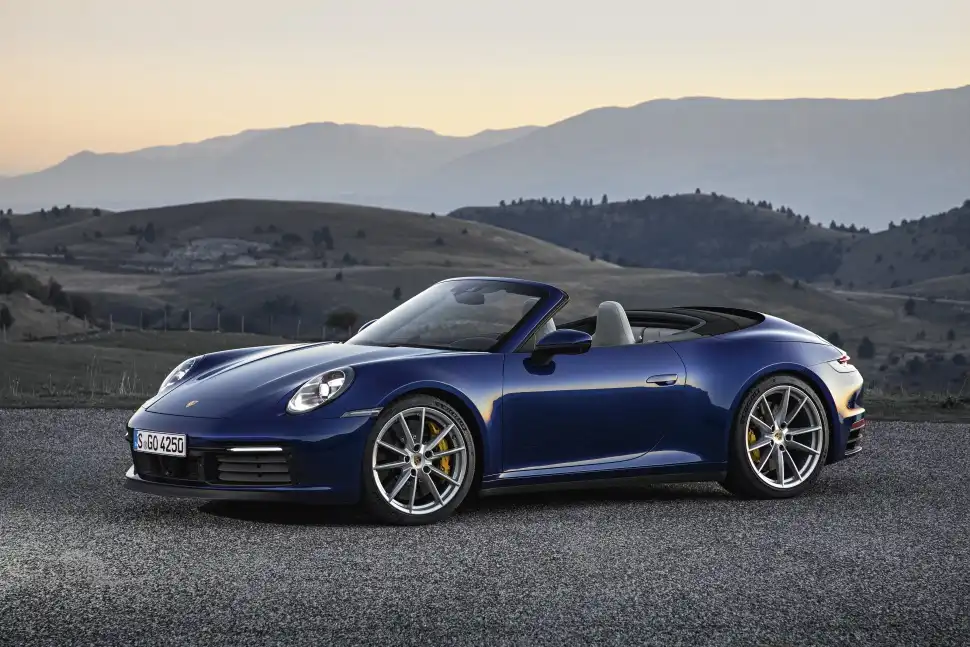
The Porsche 911 Turbo Cabriolet (992) represents the pinnacle of open-top performance within the iconic 911 lineage. Introduced in July 2020 and continuing through May 2024, this variant combines the thrill of a high-performance turbocharged engine with the exhilaration of open-air driving. Positioned as the flagship convertible within the 992 generation, it offers a substantial step up in power and technology compared to base Carrera models. The 992 generation itself marked a significant evolution for the 911, incorporating wider bodywork, updated interior technology, and enhanced aerodynamics. This particular Turbo Cabriolet model caters to drivers seeking uncompromising performance and luxury in a convertible package.
Technical Specifications
| Brand | Porsche |
| Model | 911 |
| Generation | 911 Cabriolet (992) |
| Type (Engine) | Turbo 3.8 (580 Hp) PDK |
| Start of production | July, 2020 |
| End of production | May, 2024 |
| Powertrain Architecture | Internal Combustion engine |
| Body type | Cabriolet |
| Seats | 4 |
| Doors | 2 |
| Fuel consumption (economy) – urban (NEDC) | 15.2 l/100 km (15.5 US mpg, 18.6 UK mpg, 6.6 km/l) |
| Fuel consumption (economy) – extra urban (NEDC) | 8.9 l/100 km (26.4 US mpg, 31.7 UK mpg, 11.2 km/l) |
| Fuel consumption (economy) – combined (NEDC) | 11.3 l/100 km (20.8 US mpg, 25 UK mpg, 8.8 km/l) |
| CO2 emissions (NEDC) | 257 g/km |
| Fuel Type | Petrol (Gasoline) |
| Acceleration 0 – 100 km/h | 2.9 sec |
| Acceleration 0 – 62 mph | 2.9 sec |
| Acceleration 0 – 60 mph | 2.8 sec |
| Acceleration 0 – 200 km/h | 10.1 sec |
| Maximum speed | 320 km/h (198.84 mph) |
| Emission standard | Euro 6d-ISC-FCM |
| Weight-to-power ratio | 2.9 kg/Hp, 339.2 Hp/tonne |
| Weight-to-torque ratio | 2.3 kg/Nm, 438.6 Nm/tonne |
| Power | 580 Hp @ 6500 rpm |
| Power per litre | 154.9 Hp/l |
| Torque | 750 Nm @ 2250-4500 rpm (553.17 lb.-ft. @ 2250-4500 rpm) |
| Maximum engine speed | 7200 rpm |
| Engine layout | Rear, Longitudinal |
| Engine Model/Code | DKEA |
| Engine displacement | 3745 cm3 (228.53 cu. in.) |
| Number of cylinders | 6 |
| Engine configuration | Boxer |
| Cylinder Bore | 102 mm (4.02 in.) |
| Piston Stroke | 76.4 mm (3.01 in.) |
| Compression ratio | 8.7:1 |
| Number of valves per cylinder | 4 |
| Fuel injection system | Direct injection |
| Engine aspiration | BiTurbo, Intercooler |
| Engine oil capacity | 8.3 l (8.77 US qt | 7.3 UK qt) |
| Kerb Weight | 1710 kg (3769.9 lbs.) |
| Max. weight | 2100 kg (4629.71 lbs.) |
| Max load | 390 kg (859.8 lbs.) |
| Trunk (boot) space – minimum | 163 l (5.76 cu. ft.) |
| Fuel tank capacity | 67 l (17.7 US gal | 14.74 UK gal) |
| Length | 4535 mm (178.54 in.) |
| Width | 1900 mm (74.8 in.) |
| Width including mirrors | 2024 mm (79.69 in.) |
| Height | 1302 mm (51.26 in.) |
| Wheelbase | 2450 mm (96.46 in.) |
| Front track | 1583 mm (62.32 in.) |
| Rear (Back) track | 1600 mm (62.99 in.) |
| Drag coefficient (Cd) | 0.33 |
| Minimum turning circle (turning diameter) | 10.9 m (35.76 ft.) |
| Drivetrain Architecture | The Internal combustion engine (ICE) drives permanently the four wheels of the vehicle. |
| Drive wheel | All wheel drive (4×4) |
| Number of gears and type of gearbox | 8 gears, automatic transmission PDK |
| Front suspension | Independent type McPherson |
| Rear suspension | Independent multi-link suspension |
| Front brakes | Ventilated discs, 408 mm |
| Rear brakes | Ventilated discs, 380 mm |
| Assisting systems | ABS (Anti-lock braking system) |
| Steering type | Steering rack and pinion |
| Power steering | Electric Steering |
| Tires size | Front wheel tires: 255/35 ZR20 Rear wheel tires: 315/30 ZR21 |
| Wheel rims size | Front wheel rims: 9 J x 20 Rear wheel rims: 11.5 J x 21 |
Powertrain & Engine Architecture
At the heart of the 911 Turbo Cabriolet (992) lies a 3.8-liter twin-turbocharged flat-six engine, designated the DKEA. This engine represents a significant evolution of Porsche’s renowned boxer engine design. The use of two turbochargers, along with an intercooler, allows for exceptional power output and a broad torque curve. Direct fuel injection ensures precise fuel delivery, maximizing efficiency and performance. The engine produces 580 horsepower at 6500 rpm and a substantial 750 Nm (553 lb-ft) of torque available from 2250 to 4500 rpm. This power is channeled through a sophisticated 8-speed Porsche Doppelkupplung (PDK) dual-clutch automatic transmission. The PDK transmission offers incredibly fast and smooth gear changes, contributing to the car’s blistering acceleration. The engine’s layout, being rear-mounted and longitudinal, is a defining characteristic of the 911, influencing its handling dynamics.
Driving Characteristics
The 911 Turbo Cabriolet (992) delivers a driving experience that is both exhilarating and surprisingly refined. The combination of the powerful twin-turbo engine and the quick-shifting PDK transmission results in breathtaking acceleration – 0 to 60 mph in just 2.8 seconds. The all-wheel-drive system provides exceptional traction, allowing for confident acceleration even in challenging conditions. The PDK transmission’s gear ratios are optimized for both rapid acceleration and comfortable cruising. While the Turbo offers immense power, it’s also remarkably controllable, thanks to Porsche’s advanced stability control systems. Compared to lower-powered 911 variants, the Turbo provides a significantly more visceral and engaging driving experience. The increased torque makes overtaking effortless, and the engine’s responsiveness is immediate. The open-top configuration adds another layer of sensory engagement, enhancing the connection between driver and machine.
Equipment & Trim Levels
The 911 Turbo Cabriolet (992) comes standard with a comprehensive array of luxury and performance features. Interior appointments include leather upholstery, power-adjustable sports seats, and a high-end sound system. Standard technology features include a large touchscreen infotainment system with navigation, Apple CarPlay integration, and a suite of driver-assistance systems. Optional extras are extensive, allowing buyers to personalize their vehicle to their exact preferences. These options include carbon fiber trim, upgraded leather interiors, adaptive cruise control, and a sport exhaust system. The Cabriolet also features a fully automatic fabric roof that can be raised or lowered in seconds, even while driving at moderate speeds.
Chassis & Braking
The 911 Turbo Cabriolet (992) utilizes a sophisticated chassis designed to maximize performance and handling. It features an independent McPherson strut suspension at the front and an independent multi-link suspension at the rear. Porsche Active Suspension Management (PASM) is standard, allowing drivers to adjust the damping characteristics to suit their driving style and road conditions. Braking performance is equally impressive, with ventilated discs measuring 408 mm at the front and 380 mm at the rear. The braking system is equipped with ABS (Anti-lock Braking System) and other advanced safety features. The car’s wide track and low center of gravity contribute to its exceptional stability and cornering ability.
Market Reception & Comparison
The Porsche 911 Turbo Cabriolet (992) was widely praised by automotive critics for its exceptional performance, luxurious interior, and advanced technology. Reviewers consistently highlighted its blistering acceleration, precise handling, and comfortable ride. Compared to other high-performance convertibles, the 911 Turbo Cabriolet stands out for its unique combination of power, refinement, and everyday usability. While fuel economy is not a primary concern for buyers in this segment, the 911 Turbo Cabriolet’s combined fuel consumption of 11.3 l/100 km (20.8 US mpg) is relatively respectable for a car of its performance capabilities. Reliability is generally considered to be good, although maintenance costs can be high due to the car’s complex engineering and premium components.
Legacy
The 992 generation 911 Turbo Cabriolet is poised to become a highly sought-after collectible in the future. Its combination of iconic design, cutting-edge technology, and exhilarating performance ensures its place in Porsche’s storied history. The DKEA engine, while complex, is generally considered to be a robust and reliable unit when properly maintained. On the used car market, these models command a premium price, reflecting their desirability and limited production numbers. The 992 Turbo Cabriolet represents a high watermark in the evolution of the 911, offering a driving experience that is both thrilling and rewarding.