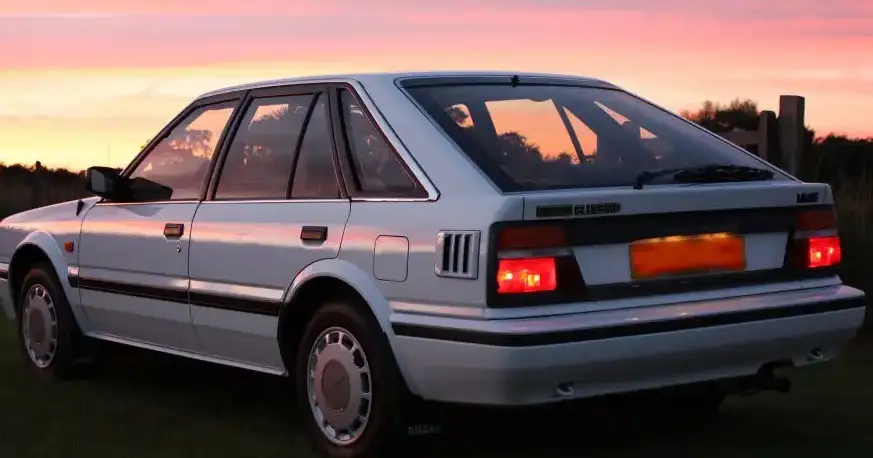
The Nissan Bluebird U12, produced between 1987 and 1991, represented a significant evolution for Nissan’s long-running Bluebird line. Positioned as a comfortable and reliable mid-size sedan, the U12 generation aimed to appeal to a broad market segment. Within the U12 range, the 1.8 SSS variant with an automatic transmission occupied a middle ground, offering a balance between performance and convenience. It was designed to provide a more engaging driving experience than the base models, while remaining accessible and practical for everyday use. The U12 Bluebird was primarily marketed in Japan, Australia, and select Asian markets, serving as a key competitor to models like the Toyota Corolla and Honda Accord.
Technical Specifications
| Brand | Nissan |
| Model | Bluebird |
| Generation | Bluebird (U12) |
| Type | 1.8 SSS (140 Hp) Automatic |
| Start of production | 1987 |
| End of production | 1991 |
| Powertrain Architecture | Internal Combustion engine |
| Body type | Sedan |
| Seats | 5 |
| Doors | 4 |
| Fuel consumption (urban) | 7.4 l/100 km (31.8 US mpg, 38.2 UK mpg, 13.5 km/l) |
| Fuel Type | Petrol (Gasoline) |
| Power | 140 Hp @ 6400 rpm |
| Power per litre | 76.1 Hp/l |
| Torque | 167 Nm @ 4800 rpm (123.17 lb.-ft. @ 4800 rpm) |
| Engine layout | Front, Transverse |
| Engine displacement | 1839 cm3 (112.22 cu. in.) |
| Number of cylinders | 4 |
| Engine configuration | Inline |
| Cylinder Bore | 82.5 mm (3.25 in.) |
| Piston Stroke | 86 mm (3.39 in.) |
| Compression ratio | 10:1 |
| Number of valves per cylinder | 4 |
| Fuel injection system | Multi-port manifold injection |
| Engine aspiration | Naturally aspirated engine |
| Valvetrain | DOHC |
| Fuel tank capacity | 60 l (15.85 US gal, 13.2 UK gal) |
| Length | 4520 mm (177.95 in.) |
| Width | 1690 mm (66.54 in.) |
| Height | 1375 mm (54.13 in.) |
| Wheelbase | 2550 mm (100.39 in.) |
| Front track | 1460 mm (57.48 in.) |
| Rear track | 1440 mm (56.69 in.) |
| Minimum turning circle | 10 m (32.81 ft.) |
| Drivetrain | Front wheel drive |
| Number of gears | 4 |
| Gearbox type | Automatic transmission |
| Front brakes | Ventilated discs |
| Rear brakes | Drum |
Powertrain & Engine Architecture
The heart of the 1.8 SSS variant was Nissan’s 1839cc (1.8L) inline-four cylinder engine. This engine, often identified by its internal code, utilized a multi-port fuel injection system to deliver fuel directly into the intake ports, improving efficiency and responsiveness. The engine featured a Double Overhead Camshaft (DOHC) valvetrain, operating four valves per cylinder. This configuration contributed to improved breathing and higher engine speeds. The 10:1 compression ratio was a standard figure for the era, balancing performance and fuel economy. The four-speed automatic transmission was a key component of this trim level, offering smooth gear changes and ease of driving. While not a particularly advanced transmission by modern standards, it was well-suited to the engine’s power characteristics and the intended market of drivers seeking convenience.
Driving Characteristics
The 140 horsepower and 167 Nm (123 lb-ft) of torque provided by the 1.8 SSS engine delivered adequate performance for everyday driving. Acceleration was respectable, though not particularly brisk, with the automatic transmission prioritizing smooth operation over aggressive shifts. Compared to the base Bluebird models with smaller engines, the 1.8 SSS offered a noticeable improvement in responsiveness, particularly when overtaking or climbing hills. However, it lagged behind the performance of the more powerful, and often more expensive, variants equipped with larger engines. The automatic transmission’s gear ratios were tuned for fuel efficiency and comfortable cruising, rather than outright acceleration. This resulted in a slightly less engaging driving experience compared to the available manual transmission options.
Equipment & Trim Levels
The 1.8 SSS trim level offered a step up in features compared to the base Bluebird models. Standard equipment typically included power steering, central locking, and a reasonably well-appointed interior. Upholstery was usually cloth, with options for upgraded materials available. The dashboard layout was functional and straightforward, with clear instrumentation. Optional extras could include air conditioning, a cassette player, and electric windows. The SSS designation also often included some subtle exterior styling enhancements, such as alloy wheels and a more prominent grille.
Chassis & Braking
The U12 Bluebird utilized a front-wheel-drive layout with independent suspension at the front and a semi-independent torsion beam suspension at the rear. The front suspension featured MacPherson struts, while the rear setup aimed to balance ride comfort and handling. Braking was accomplished via ventilated discs on the front wheels and drum brakes on the rear. This configuration was typical for vehicles in this class during the late 1980s and early 1990s. Stabilizer bars were often included to reduce body roll during cornering, enhancing handling stability.
Market Reception & Comparison
The Nissan Bluebird U12 1.8 SSS Automatic was generally well-received by automotive critics as a practical and reliable family sedan. It was praised for its comfortable ride, spacious interior, and fuel efficiency. However, some reviewers noted that the automatic transmission could feel somewhat sluggish, and the overall driving experience lacked the sportiness of some competitors. Compared to other trims in the Bluebird lineup, the 1.8 SSS Automatic offered a good balance between performance and price. It was more affordable than the higher-powered variants, while still providing a noticeable improvement over the base models. Fuel economy was comparable to other 1.8L sedans of the era, and reliability was generally considered to be excellent.
Legacy
The Nissan Bluebird U12, and specifically the 1.8 SSS Automatic variant, has developed a reputation for long-term reliability. The engine and transmission, when properly maintained, are known to withstand significant mileage. Today, these vehicles are relatively rare, but those that remain are often cherished by enthusiasts for their simplicity, durability, and classic styling. The U12 Bluebird represents a significant chapter in Nissan’s history, showcasing the company’s commitment to building practical and dependable vehicles. In the used car market, well-maintained examples of the 1.8 SSS Automatic can command a modest premium due to their relative rarity and reputation for reliability.