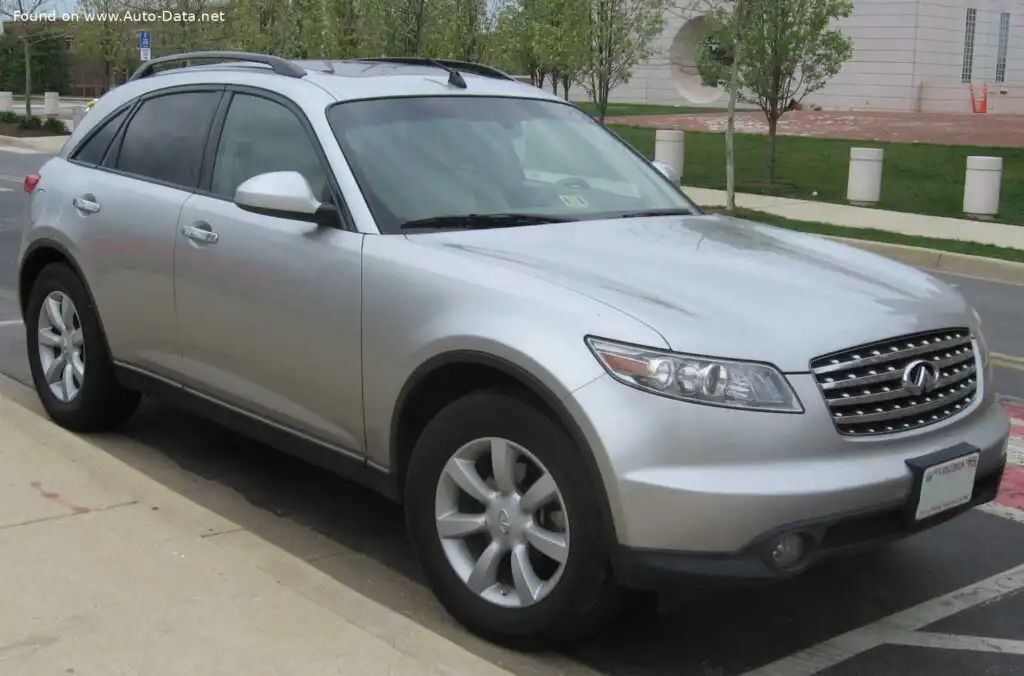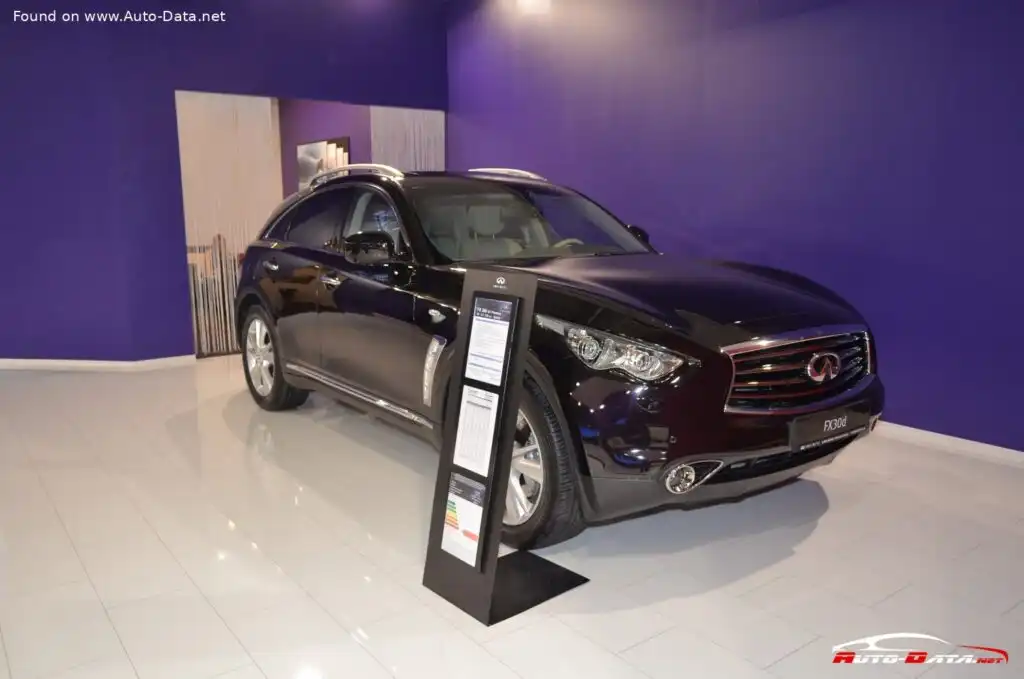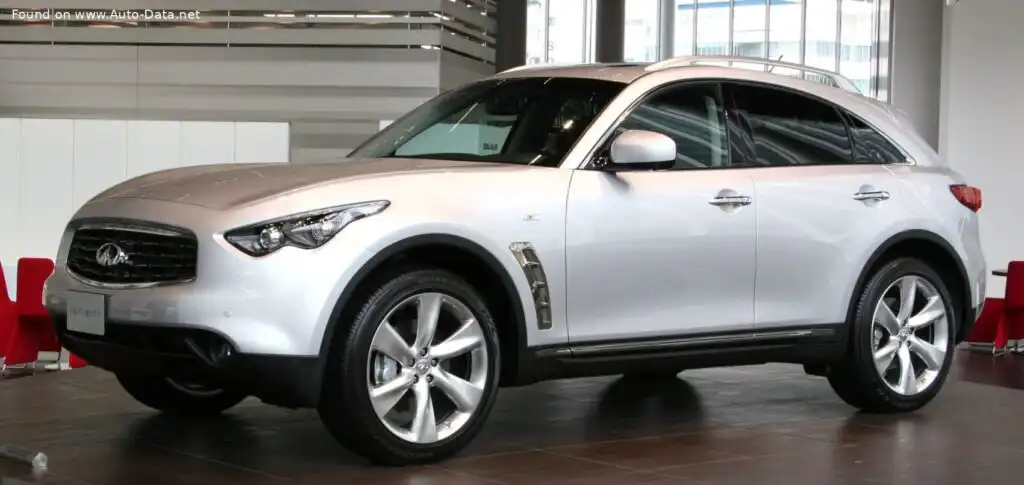
The Infiniti FX35, specifically the second-generation model (FX II) produced between 2008 and 2011, represented a significant entry for the Japanese luxury brand into the mid-size crossover segment. Positioned as a performance-oriented alternative to more conventional SUVs, the FX35 with the 3.5-liter V6 engine and a seven-speed automatic transmission was a core offering within the FX lineup. It aimed to blend sporty handling with the practicality expected of a crossover, targeting buyers who desired a more engaging driving experience than typically found in this class. The FX II was built on the Y62 platform, sharing underpinnings with the Nissan Pathfinder, but distinguished itself through unique styling and a focus on performance and luxury.
Technical Specifications
| Brand | Infiniti |
| Model | FX |
| Generation | FX II |
| Type (Engine) | 35 V6 (303 Hp) Automatic |
| Start of production | 2008 |
| End of production | 2011 |
| Powertrain Architecture | Internal Combustion engine |
| Body type | Crossover |
| Seats | 5 |
| Doors | 5 |
| Fuel consumption (economy) – urban (EPA) | 14.7 l/100 km (16 US mpg, 19.2 UK mpg, 6.8 km/l) |
| Fuel consumption (economy) – extra urban (EPA) | 10.2 l/100 km (23.1 US mpg, 27.7 UK mpg, 9.8 km/l) |
| Fuel consumption (economy) – combined (EPA) | 12.4 l/100 km (19 US mpg, 22.8 UK mpg, 8.1 km/l) |
| Fuel Type | Petrol (Gasoline) |
| Weight-to-power ratio | 6.1 kg/Hp, 163.2 Hp/tonne |
| Weight-to-torque ratio | 5.2 kg/Nm, 191.2 Nm/tonne |
| Power | 303 Hp @ 6800 rpm |
| Power per litre | 86.6 Hp/l |
| Torque | 355 Nm @ 4800 rpm (261.83 lb.-ft. @ 4800 rpm) |
| Maximum engine speed | 7500 rpm |
| Engine layout | Front, Longitudinal |
| Engine Model/Code | VQ35HR |
| Engine displacement | 3498 cm3 (213.46 cu. in.) |
| Number of cylinders | 6 |
| Engine configuration | V-engine |
| Cylinder Bore | 95.5 mm (3.76 in.) |
| Piston Stroke | 81.4 mm (3.2 in.) |
| Compression ratio | 10.6:1 |
| Number of valves per cylinder | 4 |
| Fuel injection system | Multi-port manifold injection |
| Engine aspiration | Naturally aspirated engine |
| Valvetrain | DOHC |
| Engine oil capacity | 4.9 l (5.18 US qt | 4.31 UK qt) |
| Coolant | 9.2 l (9.72 US qt | 8.09 UK qt) |
| Kerb Weight | 1857 kg (4093.98 lbs.) |
| Max. weight | 2404 kg (5299.91 lbs.) |
| Max load | 547 kg (1205.93 lbs.) |
| Trunk (boot) space – minimum | 702 l (24.79 cu. ft.) |
| Trunk (boot) space – maximum | 1756 l (62.01 cu. ft.) |
| Fuel tank capacity | 90 l (23.78 US gal | 19.8 UK gal) |
| Max. roof load | 45 kg (99.21 lbs.) |
| Length | 4860 mm (191.34 in.) |
| Width | 1925 mm (75.79 in.) |
| Height | 1680 mm (66.14 in.) |
| Wheelbase | 2885 mm (113.58 in.) |
| Front track | 1635 mm (64.37 in.) |
| Rear (Back) track | 1640 mm (64.57 in.) |
| Ride height (ground clearance) | 187 mm (7.36 in.) |
| Drag coefficient (Cd) | 0.35 |
| Minimum turning circle (turning diameter) | 11.2 m (36.75 ft.) |
| Approach angle | 28.8° |
| Departure angle | 20.9° |
| Drivetrain Architecture | The Internal combustion engine (ICE) drives the rear wheels of the vehicle. |
| Drive wheel | Rear wheel drive |
| Number of gears and type of gearbox | 7 gears, automatic transmission |
| Front suspension | Double wishbone, Transverse stabilizer |
| Rear suspension | Independent multi-link spring suspension with stabilizer |
| Front brakes | Ventilated discs, 320×33 mm |
| Rear brakes | Ventilated discs, 308×16 mm |
| Assisting systems | ABS (Anti-lock braking system) |
| Steering type | Steering rack and pinion |
| Power steering | Hydraulic Steering |
| Tires size | 265/60 R18; 265/50 R20 |
| Wheel rims size | 8J x 18; 8J x 20 |
Powertrain & Engine Architecture
The heart of the FX35 was the VQ35HR 3.5-liter V6 engine. This engine, a member of Nissan’s highly regarded VQ family, was known for its smooth operation, responsiveness, and overall reliability. The “HR” designation signified a high revolution version, featuring a revised cylinder head, variable valve timing (VVEL) on both intake and exhaust valves, and a higher redline. Fuel delivery was handled by a multi-port fuel injection system. The engine produced 303 horsepower at 6800 rpm and 261 lb-ft of torque at 4800 rpm. This power was channeled through a seven-speed automatic transmission, offering both manual shift control and adaptive learning capabilities. The transmission was designed to provide smooth and quick shifts, contributing to the FX35’s sporty character. The engine was mounted longitudinally, driving the rear wheels, a configuration that further enhanced the vehicle’s handling balance.
Driving Characteristics
The FX35 with the seven-speed automatic offered a comfortable yet engaging driving experience. While not as overtly sporty as some of its European rivals, it provided ample power for everyday driving and confident acceleration for highway merging and passing. The automatic transmission was generally responsive, although some reviewers noted a slight hesitation during kickdown. The gear ratios were tuned to balance fuel efficiency with performance, with the seventh gear providing a relaxed cruising experience. Compared to the higher-performance FX50 (equipped with a 5.0-liter V8), the FX35 felt less urgent in its acceleration, but it offered a more manageable and fuel-efficient driving experience. The rear-wheel-drive configuration contributed to a balanced feel, although it lacked the all-weather capability of the available all-wheel-drive system.
Equipment & Trim Levels
The FX35 came reasonably well-equipped as standard. Typical features included leather upholstery, power-adjustable front seats, a Bose audio system, automatic climate control, and a rearview camera. Optional extras included a navigation system, power-folding rear seats, adaptive cruise control, and a panoramic sunroof. Trim levels were relatively simple, with most variations stemming from the addition of option packages. Interior color schemes typically included shades of gray, black, and beige. The dashboard layout was driver-focused, with a prominent center console and easy-to-read gauges.
Chassis & Braking
The FX35 featured a double wishbone front suspension and an independent multi-link rear suspension, both incorporating stabilizer bars to minimize body roll. The suspension was tuned to provide a comfortable ride while maintaining good handling characteristics. Braking duties were handled by ventilated disc brakes on all four wheels, with ABS included as standard. The FX35’s chassis was relatively rigid, contributing to its overall stability and handling precision. The standard tire size was 265/60R18, with larger 265/50R20 tires available on higher trim levels.
Market Reception & Comparison
The Infiniti FX35 was generally well-received by automotive critics. It was praised for its distinctive styling, comfortable interior, and engaging driving dynamics. However, some reviewers criticized its fuel economy, which was relatively poor for a mid-size crossover. Compared to competitors like the BMW X5 and Acura MDX, the FX35 offered a more distinctive design and a more driver-focused experience, but it lacked the brand prestige of the BMW and the overall refinement of the Acura. The FX35’s reliability was generally considered good, although some owners reported minor issues with the electronic systems.
Legacy
The Infiniti FX35 (specifically the VQ35HR engine and 7-speed automatic combination) has proven to be a relatively reliable powertrain in the used car market. The VQ35HR engine is known for its durability, and with proper maintenance, it can easily exceed 200,000 miles. The seven-speed automatic transmission has also proven to be generally dependable. However, potential buyers should be aware of potential issues with the timing chain tensioners and oil consumption, which can occur with higher mileage examples. Today, the FX35 remains a popular choice for buyers seeking a stylish and sporty crossover at an affordable price point. Its unique design and engaging driving experience continue to appeal to enthusiasts.