
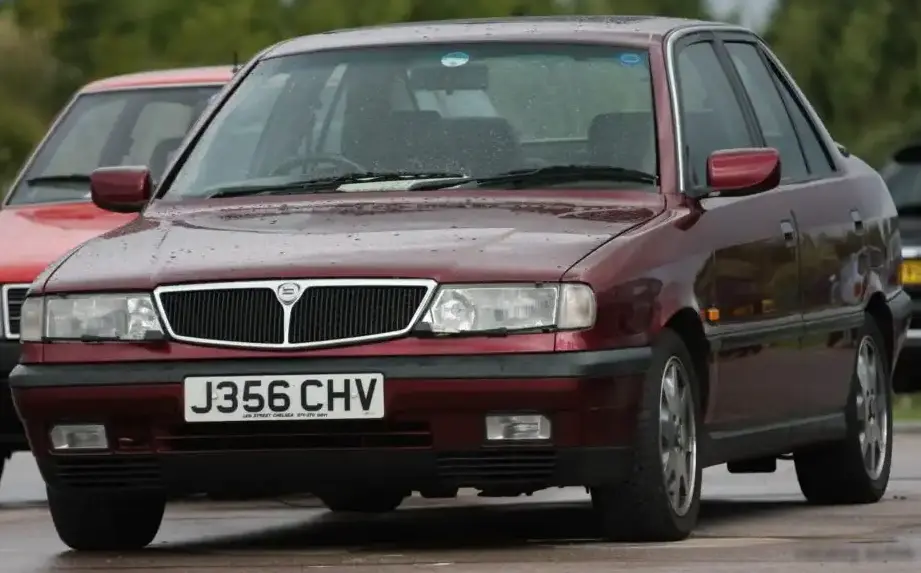
The Lancia Dedra (835) 2.0 16V, produced between 1994 and 1999, represented a significant offering in the upper-midsize segment for the Italian automaker. Positioned as a more sporting and refined alternative to the more common Dedra variants, the 2.0 16V was a key part of the 835 series, which itself was a substantial revision of the original Dedra launched in 1989. The Dedra, and its twin the Fiat Croma, were built on the Tipo Four platform, offering a spacious and comfortable interior within a relatively lightweight package. The 2.0 16V aimed to appeal to drivers seeking a blend of performance and Italian style, though it remained a relatively niche model within the broader Dedra lineup.
Technical Specifications
| Brand | Lancia |
| Model | Dedra |
| Generation | Dedra (835) |
| Type (Engine) | 2.0 16V (139 Hp) |
| Start of production | 1994 |
| End of production | 1999 |
| Powertrain Architecture | Internal Combustion engine |
| Body type | Sedan |
| Seats | 5 |
| Doors | 4 |
| Fuel consumption (combined) | 8.8 l/100 km |
| Fuel consumption (US mpg) | 26.7 US mpg |
| Fuel consumption (UK mpg) | 32.1 UK mpg |
| Fuel consumption (km/l) | 11.4 km/l |
| Fuel Type | Petrol (Gasoline) |
| Acceleration 0 – 100 km/h | 9.4 sec |
| Acceleration 0 – 62 mph | 9.4 sec |
| Acceleration 0 – 60 mph | 8.9 sec |
| Maximum speed | 210 km/h (130.49 mph) |
| Weight-to-power ratio | 9.1 kg/Hp |
| Weight-to-torque ratio | 7 kg/Nm |
| Power | 139 Hp @ 6000 rpm |
| Power per litre | 69.7 Hp/l |
| Torque | 180 Nm @ 4500 rpm (132.76 lb.-ft. @ 4500 rpm) |
| Engine layout | Front, Transverse |
| Engine Model/Code | 836 A3.000 |
| Engine displacement | 1995 cm3 (121.74 cu. in.) |
| Number of cylinders | 4 |
| Engine configuration | Inline |
| Cylinder Bore | 84 mm (3.31 in.) |
| Piston Stroke | 90 mm (3.54 in.) |
| Compression ratio | 9.5:1 |
| Number of valves per cylinder | 4 |
| Fuel injection system | Multi-port manifold injection |
| Engine aspiration | Naturally aspirated engine |
| Valvetrain | DOHC |
| Engine oil capacity | 5.2 l (5.49 US qt | 4.58 UK qt) |
| Coolant capacity | 8.2 l (8.66 US qt | 7.21 UK qt) |
| Kerb Weight | 1260 kg (2777.82 lbs.) |
| Trunk (boot) space – minimum | 480 l (16.95 cu. ft.) |
| Fuel tank capacity | 60 l (15.85 US gal | 13.2 UK gal) |
| Length | 4343 mm (170.98 in.) |
| Width | 1700 mm (66.93 in.) |
| Height | 1430 mm (56.3 in.) |
| Wheelbase | 2540 mm (100 in.) |
| Front track | 1436 mm (56.54 in.) |
| Rear track | 1415 mm (55.71 in.) |
| Drivetrain Architecture | Front wheel drive |
| Number of gears | 5 |
| Gearbox type | Manual transmission |
| Front suspension | Spring Strut |
| Rear suspension | Trailing arm |
| Front brakes | Ventilated discs |
| Rear brakes | Disc |
| Assisting systems | ABS (Anti-lock braking system) |
| Steering type | Steering rack and pinion |
| Power steering | Hydraulic Steering |
| Tires size | 185/60 R14 |
Powertrain & Engine Architecture
The heart of the Dedra 2.0 16V is the 836 A3.000 engine, a 1995cc inline-four cylinder unit. This engine is a derivative of the Fiat/Lancia Twin Cam engine family, known for its robust construction and relatively simple design. The “16V” designation indicates the use of a four-valve-per-cylinder cylinder head, a significant upgrade over earlier two-valve versions. This improved cylinder head design, coupled with a higher compression ratio of 9.5:1, allowed for increased power output and improved breathing. Fuel delivery is managed by a multi-port fuel injection system, providing precise fuel metering for optimal combustion. The engine utilizes a double overhead camshaft (DOHC) valvetrain, further enhancing its performance characteristics. The five-speed manual transmission was the standard offering, providing a direct connection between the engine and the front wheels. The gearbox was chosen for its durability and relatively short ratios, complementing the engine’s power band.
Driving Characteristics
The Dedra 2.0 16V offered a noticeable step up in performance compared to the lower-powered versions of the Dedra. With 139 horsepower on tap, acceleration to 60 mph took approximately 8.9 seconds, and it could achieve a top speed of around 130 mph. While not a sports car by any means, the 2.0 16V provided ample power for comfortable highway cruising and confident overtaking. The five-speed manual transmission allowed drivers to keep the engine in its optimal power band, maximizing performance. Compared to the 1.8L or diesel variants, the 2.0 16V felt significantly more responsive and eager to rev. The gear ratios were well-matched to the engine’s characteristics, providing good acceleration in each gear. However, the engine’s power delivery was relatively linear, lacking the pronounced torque peak found in some turbocharged engines.
Equipment & Trim Levels
The Dedra 2.0 16V typically came equipped with a reasonably comprehensive list of standard features. Interior appointments included comfortable cloth upholstery, power windows, central locking, and a basic stereo system. Air conditioning was often included as standard, or available as an option. Higher trim levels, such as the “Elegance” or “LX”, added features like alloy wheels, upgraded interior trim, and a sunroof. Optional extras included leather upholstery, a more sophisticated audio system, and anti-lock brakes (ABS), which became increasingly common towards the end of production. The dashboard layout was typical of Italian cars of the era, featuring a functional design with clear instrumentation.
Chassis & Braking
The Dedra 835 utilized a relatively conventional chassis setup. Front suspension consisted of MacPherson strut springs, while the rear employed a trailing arm configuration. This setup provided a good balance between ride comfort and handling. The 2.0 16V models typically featured ventilated disc brakes on the front wheels and solid discs on the rear, providing adequate stopping power for the car’s weight and performance. ABS was often an optional extra, improving braking performance and stability, particularly on slippery surfaces. Stabilizer bars were fitted to both the front and rear axles, helping to reduce body roll during cornering.
Market Reception & Comparison
The Lancia Dedra 2.0 16V was generally well-received by automotive critics, who praised its comfortable ride, spacious interior, and relatively strong performance. However, it was often criticized for its somewhat bland styling and the perceived lack of brand prestige compared to German rivals. Compared to the lower-powered Dedra variants, the 2.0 16V offered a significant improvement in performance, but at the cost of slightly reduced fuel economy. The 1.8L models were more affordable and fuel-efficient, while the diesel versions offered even better economy but lacked the 2.0 16V’s responsiveness. Reliability was generally good, although some owners reported issues with the electrical system and certain engine components.
Legacy
The Lancia Dedra 2.0 16V, while not a sales success on the scale of some of its competitors, remains a fondly remembered car among enthusiasts. The 836 A3.000 engine proved to be a durable and reliable unit, and well-maintained examples continue to be seen on the roads today. In the used car market, the 2.0 16V commands a slight premium over the lower-powered versions, due to its improved performance and relative rarity. The Dedra represents a final flourish of Italian automotive engineering before Lancia’s decline, and the 2.0 16V stands as one of the more desirable variants of this often-overlooked sedan.
