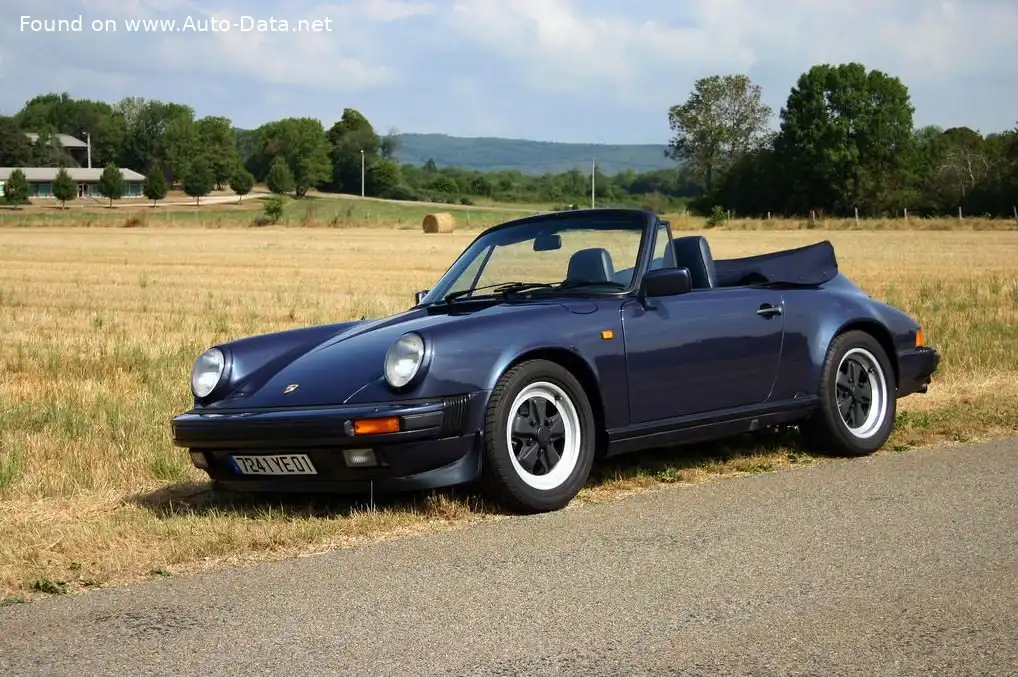
The Porsche 911 Cabriolet (G) 3.2 Carrera, produced between 1986 and 1989, represents a pivotal point in the evolution of Porsche’s iconic sports car. This generation, internally designated the 930, was the final iteration of the original 911 silhouette before a significant redesign. The 3.2 Carrera, with its 231 horsepower engine, offered a compelling blend of performance and open-air driving enjoyment, solidifying the 911’s reputation as a world-class sports car. It sat at the top of the Cabriolet range, offering the most potent engine option available in the open-top 911.
Technical Specifications
| Brand | Porsche |
| Model | 911 |
| Generation | 911 Cabriolet (G) |
| Type (Engine) | 3.2 Carrera (231 Hp) |
| Start of production | 1986 |
| End of production | 1989 |
| Powertrain Architecture | Internal Combustion engine |
| Body type | Cabriolet |
| Seats | 4 |
| Doors | 2 |
| Fuel consumption (urban) | 13.6 l/100 km (17.3 US mpg) |
| Fuel consumption (extra urban) | 6.8 l/100 km (34.6 US mpg) |
| Fuel Type | Petrol (Gasoline) |
| Acceleration 0 – 100 km/h | 6.1 sec |
| Acceleration 0 – 62 mph | 6.1 sec |
| Acceleration 0 – 60 mph | 5.8 sec |
| Maximum speed | 245 km/h (152.24 mph) |
| Power | 231 Hp @ 5900 rpm |
| Torque | 284 Nm @ 4800 rpm (209.47 lb.-ft. @ 4800 rpm) |
| Engine layout | Rear, Longitudinal |
| Engine Model/Code | 930.20 |
| Engine displacement | 3164 cm3 (193.08 cu. in.) |
| Number of cylinders | 6 |
| Engine configuration | Boxer |
| Cylinder Bore | 95 mm (3.74 in.) |
| Piston Stroke | 74.4 mm (2.93 in.) |
| Compression ratio | 10.3:1 |
| Number of valves per cylinder | 2 |
| Fuel injection system | Multi-port manifold injection |
| Engine aspiration | Naturally aspirated engine |
| Valvetrain | SOHC |
| Engine oil capacity | 10 l (10.57 US qt | 8.8 UK qt) |
| Fuel tank capacity | 85 l (22.45 US gal | 18.7 UK gal) |
| Length | 4291 mm (168.94 in.) |
| Width | 1652 mm (65.04 in.) |
| Height | 1320 mm (51.97 in.) |
| Wheelbase | 2272 mm (89.45 in.) |
| Front track | 1372 mm (54.02 in.) |
| Rear track | 1405 mm (55.31 in.) |
| Drag coefficient (Cd) | 0.39 |
| Drivetrain Architecture | Rear wheel drive |
| Number of gears | 5 gears, manual transmission |
| Front suspension | Independent type McPherson, Wishbone |
| Rear suspension | Independent coil spring, Trailing arm |
| Front brakes | Ventilated discs |
| Rear brakes | Ventilated discs |
| Steering type | Steering rack and pinion |
| Tires size | Front: 195/65 R15, Rear: 215/60 R15 |
| Wheel rims size | Front: 6J x 15, Rear: 7J x 15 |
Powertrain & Engine Architecture
The heart of the 911 3.2 Carrera is its 3.2-liter, naturally aspirated flat-six engine, designated the 930.20. This engine represented a significant upgrade over the earlier 3.0-liter versions, offering increased displacement and refined engine management. The 3.2-liter engine utilized Bosch Motronic fuel injection, a sophisticated system for its time, which precisely controlled fuel delivery and ignition timing. This resulted in improved performance, drivability, and emissions. The engine’s boxer configuration, with opposing cylinders, contributed to a low center of gravity, enhancing handling characteristics. The 3.2 Carrera exclusively came with a 5-speed manual transmission, known for its precise shifts and robust construction. This transmission was integral to the driving experience, allowing drivers to fully exploit the engine’s power.
Driving Characteristics
The 911 3.2 Carrera offered a uniquely engaging driving experience. The rear-engine layout and manual transmission demanded a skilled driver, but rewarded them with exceptional handling and responsiveness. Acceleration from 0 to 60 mph was achieved in around 5.8 seconds, and the car could reach a top speed of 152 mph. The engine delivered a broad torque curve, providing ample power throughout the rev range. While not as brutally fast as some contemporary sports cars, the 911’s performance was more than adequate for spirited driving on both the road and the track. The car’s steering was precise and communicative, providing excellent feedback to the driver. The suspension, while firm, offered a reasonable level of comfort for everyday use.
Equipment & Trim Levels
The 911 3.2 Carrera Cabriolet was relatively well-equipped for its time, though options were plentiful. Standard features included leather upholstery, power windows, and a basic sound system. Many examples were equipped with optional features such as a limited-slip differential, sport suspension, and upgraded audio systems. The interior design was functional and driver-focused, with clear instrumentation and comfortable seats. The Cabriolet top was manually operated, adding to the sense of connection with the driving experience. The interior trim was typically finished in black or gray leather, with various color options available through the Porsche customization program.
Chassis & Braking
The 911 3.2 Carrera featured a robust chassis with independent suspension at all four wheels. The front suspension utilized McPherson struts and wishbones, while the rear suspension employed trailing arms and torsion bars. This setup provided excellent handling and stability. The braking system consisted of ventilated disc brakes at all four corners, offering strong stopping power. The car’s relatively light weight, combined with the effective braking system, ensured confident deceleration. The steering was a rack-and-pinion system, providing precise and responsive control.
Market Reception & Comparison
The 911 3.2 Carrera was widely praised by automotive critics for its performance, handling, and iconic design. It was considered a benchmark sports car, offering a unique driving experience that few competitors could match. Compared to earlier 911 models, the 3.2 Carrera offered improved refinement and usability. It was also more reliable than some of its predecessors. Against rivals such as the Chevrolet Corvette and the Ferrari 328, the 911 offered a different character – more focused on handling and driver involvement than outright speed. Fuel economy was reasonable for a sports car of its era, averaging around 17 mpg in city driving and 35 mpg on the highway.
Legacy
The Porsche 911 3.2 Carrera Cabriolet remains a highly sought-after classic car today. Its combination of performance, style, and open-air driving enjoyment has made it a favorite among collectors and enthusiasts. The 3.2-liter engine is known for its reliability and durability, and well-maintained examples can provide years of trouble-free driving. The car’s iconic design and timeless appeal ensure its continued popularity in the used car market. Values have steadily increased in recent years, reflecting the growing demand for classic Porsche models. The 911 3.2 Carrera represents a high point in the evolution of the 911, and a testament to Porsche’s engineering excellence.