Technical Specifications
| Brand | Dacia |
| Model | Logan |
| Generation | Logan II MCV (facelift 2017) |
| Type (Engine) | 1.5 dCi (95 Hp) |
| Start of production | 2018 |
| End of production | September, 2020 |
| Powertrain Architecture | Internal Combustion engine |
| Body type | Station wagon (estate) |
| Seats | 5 |
| Doors | 5 |
| Fuel consumption (combined) | 4.5-4.6 l/100 km (52.3 – 51.1 US mpg, 62.8 – 61.4 UK mpg, 22.2 – 21.7 km/l) |
| CO2 emissions | 97 g/km |
| Fuel Type | Diesel |
| Acceleration 0 – 100 km/h | 12.4 sec |
| Acceleration 0 – 62 mph | 12.4 sec |
| Acceleration 0 – 60 mph | 11.8 sec |
| Maximum speed | 179 km/h (111.23 mph) |
| Emission standard | Euro 6d-TEMP |
| Weight-to-power ratio | 12.5 kg/Hp, 79.8 Hp/tonne |
| Weight-to-torque ratio | 5.4 kg/Nm, 184.7 Nm/tonne |
| Power | 95 Hp @ 3750 rpm |
| Power per litre | 65 Hp/l |
| Torque | 220 Nm @ 1750 rpm (162.26 lb.-ft. @ 1750 rpm) |
| Engine layout | Front, Transverse |
| Engine Model/Code | K9K 872 |
| Engine displacement | 1461 cm3 (89.16 cu. in.) |
| Number of cylinders | 4 |
| Engine configuration | Inline |
| Cylinder Bore | 76 mm (2.99 in.) |
| Piston Stroke | 80.5 mm (3.17 in.) |
| Compression ratio | 15.5:1 |
| Number of valves per cylinder | 2 |
| Fuel injection system | Diesel Commonrail |
| Engine aspiration | Turbocharger, Intercooler |
| Engine oil capacity | 5.7 l (6.02 US qt | 5.02 UK qt) |
| Coolant | 4.5 l (4.76 US qt | 3.96 UK qt) |
| Kerb Weight | 1191 kg (2625.71 lbs.) |
| Max. weight | 1704 kg (3756.68 lbs.) |
| Max load | 513 kg (1130.97 lbs.) |
| Trunk (boot) space – minimum | 573 l (20.24 cu. ft.) |
| Trunk (boot) space – maximum | 1518 l (53.61 cu. ft.) |
| Fuel tank capacity | 50 l (13.21 US gal | 11 UK gal) |
| AdBlue tank | 14.4 l (3.8 US gal | 3.17 UK gal) |
| Permitted trailer load with brakes (12%) | 810 kg (1785.74 lbs.) |
| Permitted trailer load without brakes | 650 kg (1433 lbs.) |
| Length | 4501 mm (177.2 in.) |
| Width | 1733 mm (68.23 in.) |
| Width including mirrors | 1994 mm (78.5 in.) |
| Height | 1552 mm (61.1 in.) |
| Wheelbase | 2635 mm (103.74 in.) |
| Front track | 1497 mm (58.94 in.) |
| Rear (Back) track | 1486 mm (58.5 in.) |
| Front overhang | 827 mm (32.56 in.) |
| Rear overhang | 1039 mm (40.91 in.) |
| Ride height (ground clearance) | 128 mm (5.04 in.) |
| Minimum turning circle | 10.72 m (35.17 ft.) |
| Drivetrain Architecture | The Internal combustion engine (ICE) drives the front wheels of the vehicle. |
| Drive wheel | Front wheel drive |
| Number of gears and type of gearbox | 5 gears, manual transmission |
| Front suspension | Independent type McPherson |
| Rear suspension | Semi-independent, coil spring |
| Front brakes | Ventilated discs |
| Rear brakes | Drum |
| Assisting systems | ABS (Anti-lock braking system) |
| Steering type | Steering rack and pinion |
| Power steering | Electric Steering |
| Tires size | 185/65 R15 |
| Wheel rims size | 15 |
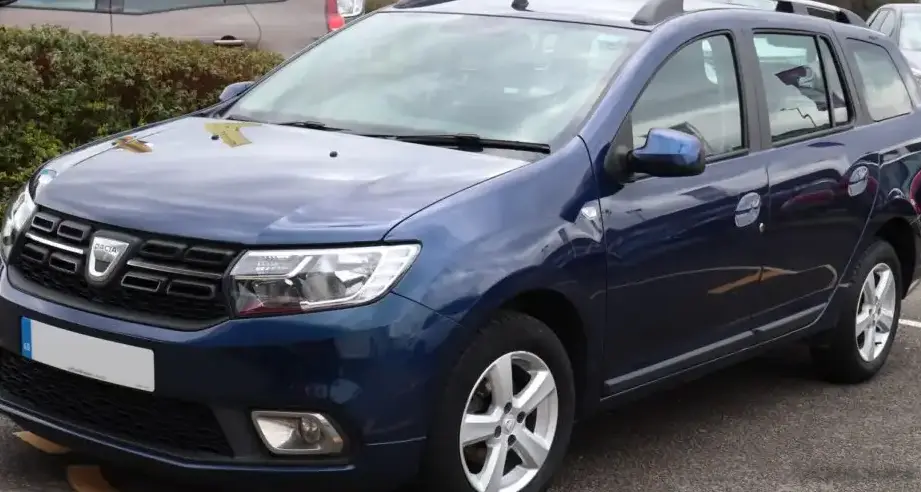
The Dacia Logan II MCV 1.5 dCi 95 hp, produced from 2018-2020, is a five-door station wagon representing the facelifted version of the second-generation Logan MCV. Built on the 1HX0/A3 platform, it aimed to provide affordable and practical transportation, particularly in European markets. This variant was designed to appeal to buyers seeking a spacious vehicle with reasonable fuel economy, making it suitable for both family use and light commercial applications. The 95 hp output positioned it as a balanced option, offering sufficient power for everyday driving without the higher running costs associated with the more potent engine choices.
Powertrain & Engine Architecture
At the heart of this Logan MCV variant lies the Renault-sourced K9K 872 1.5-liter inline-four diesel engine. This engine is a well-established unit, known for its robustness and fuel efficiency. It features a turbocharger with an intercooler to enhance power output and a diesel commonrail fuel injection system for precise fuel delivery. The engine produces 95 horsepower at 3750 rpm and 220 Nm (162 lb-ft) of torque at 1750 rpm. The engine utilizes a two-valve per cylinder configuration and a compression ratio of 15.5:1. The engine is transversely mounted at the front of the vehicle. The 5-speed manual transmission was the standard offering for this trim level, providing a balance between fuel economy and drivability. The transmission’s gear ratios are tuned for maximizing fuel efficiency and providing adequate acceleration in typical driving conditions.
Driving Characteristics
The 1.5 dCi 95 hp engine, paired with the 5-speed manual transmission, delivers adequate performance for everyday driving. Acceleration from 0-100 km/h (0-62 mph) takes approximately 12.4 seconds, and the top speed is around 179 km/h (111 mph). While not particularly sporty, the engine provides sufficient torque for comfortable cruising and overtaking maneuvers. The gear ratios are relatively long, prioritizing fuel economy over rapid acceleration. Compared to higher-output diesel versions, this variant feels less responsive, particularly at higher speeds. However, the lower power output also contributes to improved fuel efficiency and reduced wear and tear on the engine and drivetrain. The manual transmission offers precise shifts, and the clutch is relatively light, making it easy to operate in urban traffic.
Equipment & Trim Levels
The Logan II MCV 1.5 dCi 95 hp typically came equipped with a reasonable level of standard features, focusing on practicality and value. These included power steering, central locking, electric front windows, and an adjustable steering column. Safety features such as ABS (Anti-lock Braking System) and driver/passenger airbags were also standard. Interior upholstery was typically cloth, with a durable and functional design. Optional extras included air conditioning, a radio/CD player, and alloy wheels. Higher trim levels offered additional features such as rear electric windows, a trip computer, and upgraded interior trim.
Chassis & Braking
The Logan II MCV features a McPherson strut independent suspension at the front and a semi-independent coil spring suspension at the rear. This setup provides a comfortable ride quality, although it is not particularly sporty. The front brakes are ventilated discs, while the rear brakes are drums. This configuration is typical for vehicles in this price segment. The steering is a rack and pinion system with electric power assistance, providing light and precise steering feel. The tires are typically 185/65 R15, offering a good balance between comfort and grip.
Market Reception & Comparison
The Dacia Logan II MCV 1.5 dCi 95 hp was generally well-received by critics for its practicality, affordability, and fuel efficiency. It was often praised as a sensible choice for buyers seeking a spacious and economical station wagon. Compared to the higher-output diesel variants, this model offered a lower purchase price and reduced running costs, but at the expense of performance. The 1.5 dCi engine proved to be reliable, although regular maintenance is essential to ensure long-term durability. Fuel economy figures of 4.5-4.6 l/100 km (52.3-51.1 US mpg) were competitive within its class.
Legacy
The Dacia Logan II MCV 1.5 dCi 95 hp has established a reputation as a reliable and affordable workhorse. On the used car market, these models are often available at very attractive prices. The K9K engine, while requiring regular servicing, is known for its longevity. Common issues include diesel particulate filter (DPF) problems, particularly on vehicles that have primarily been used for short journeys. However, with proper maintenance, this variant can provide many years of dependable service. Its enduring appeal lies in its combination of practicality, affordability, and fuel efficiency, making it a popular choice for budget-conscious buyers.