
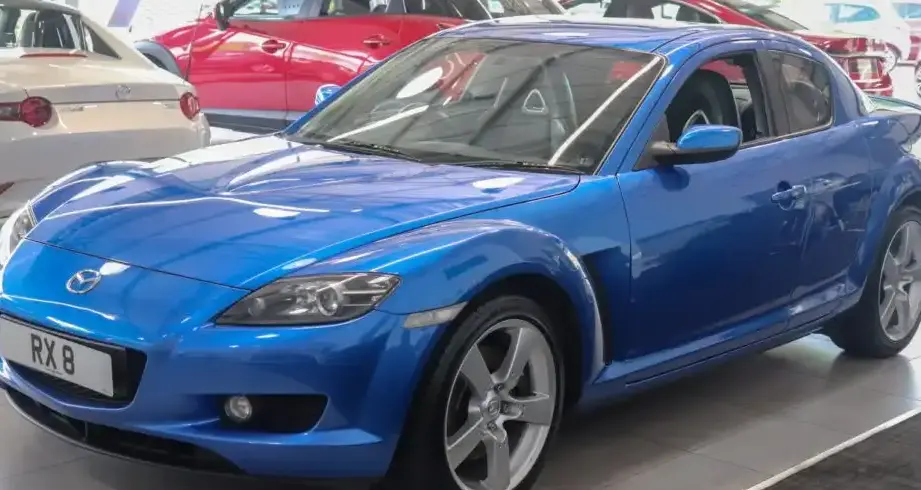
The Mazda RX-8, produced from 2003 to 2009, represented a unique approach to the sports coupe market. Distinguished by its rotary engine, the RX-8 aimed to blend sporty handling with reasonable everyday usability. This article focuses on the most common configuration: the 1.3-liter Wankel rotary engine producing 250 horsepower. This variant served as the performance benchmark for the RX-8 lineup, positioned above the naturally aspirated base models and below any potential forced induction or limited-edition versions. The RX-8 was primarily marketed in North America, Europe, and Japan, offering a distinctive alternative to traditional piston-engine sports cars.
Technical Specifications
| Brand | Mazda |
| Model | RX-8 |
| Generation | RX-8 |
| Type (Engine) | 1.3 Wankel (250 Hp) |
| Start of production | 2003 |
| End of production | 2009 |
| Powertrain Architecture | Internal Combustion engine |
| Body type | Coupe |
| Seats | 4 |
| Doors | 4 |
| Fuel consumption (urban) | 15.8 l/100 km (14.9 US mpg, 17.9 UK mpg, 6.3 km/l) |
| Fuel consumption (extra urban) | 8.9 l/100 km (26.4 US mpg, 31.7 UK mpg, 11.2 km/l) |
| Fuel consumption (combined) | 11.4 l/100 km (20.6 US mpg, 24.8 UK mpg, 8.8 km/l) |
| Fuel Type | Petrol (Gasoline) |
| Acceleration 0 – 100 km/h | 6.5 sec |
| Acceleration 0 – 62 mph | 6.5 sec |
| Acceleration 0 – 60 mph | 6.2 sec |
| Maximum speed | 250 km/h (155.34 mph) |
| Weight-to-power ratio | 5.4 kg/Hp, 185.9 Hp/tonne |
| Weight-to-torque ratio | 6.2 kg/Nm, 160.6 Nm/tonne |
| Power | 250 Hp @ 8500 rpm |
| Power per litre | 191.1 Hp/l |
| Torque | 216 Nm @ 7500 rpm (159.31 lb.-ft. @ 7500 rpm) |
| Engine layout | Front, Longitudinal |
| Engine Model/Code | 13B-MSP |
| Engine displacement | 1308 cm3 (79.82 cu. in.) |
| Number of cylinders | 2 |
| Engine configuration | Rotary (Wankel) |
| Compression ratio | 10:1 |
| Fuel injection system | Multi-port manifold injection |
| Engine aspiration | Naturally aspirated engine |
| Engine oil capacity | 4.4 l (4.65 US qt | 3.87 UK qt) |
| Coolant capacity | 10 l (10.57 US qt | 8.8 UK qt) |
| Kerb Weight | 1345 kg (2965.22 lbs) |
| Max. weight | 1820 kg (4012.41 lbs) |
| Max load | 475 kg (1047.2 lbs) |
| Trunk (boot) space – minimum | 290 l (10.24 cu. ft.) |
| Fuel tank capacity | 61 l (16.11 US gal | 13.42 UK gal) |
| Length | 4325 mm (170.28 in) |
| Width | 1780 mm (70.08 in) |
| Height | 1330 mm (52.36 in) |
| Wheelbase | 2700 mm (106.3 in) |
| Front track | 1490 mm (58.66 in) |
| Rear track | 1500 mm (59.06 in) |
| Drivetrain Architecture | Rear wheel drive |
| Drive wheel | Rear wheel drive |
| Number of gears | 6 gears, manual transmission |
| Front suspension | Spring Strut |
| Rear suspension | Coil spring |
| Front brakes | Ventilated discs |
| Rear brakes | Disc |
| Assisting systems | ABS (Anti-lock braking system) |
| Steering type | Steering rack and pinion |
| Tires size | 245/45 R18 |
| Wheel rims size | 18 |
The Mazda RX-8, launched in 2003, was a four-seat sports coupe designed to revive the spirit of the iconic RX-7. Unlike its predecessor, the RX-8 adopted a unique “freestyle door” configuration – rear-hinged back doors – to improve access to the rear seats. The core of the RX-8’s appeal, however, remained its rotary engine. The 250 hp version, utilizing the 13B-MSP engine code, was the most potent naturally aspirated offering in the RX-8 range throughout its production run. It was built on the 1HX0 platform, shared with other Mazda models like the Mazda3, but heavily modified to accommodate the rotary engine and rear-wheel-drive layout.
Powertrain & Engine Architecture
The heart of the RX-8 1.3 Wankel is the 13B-MSP rotary engine. Unlike traditional piston engines, the Wankel engine uses a triangular rotor spinning within a specially shaped housing to generate power. This design allows for a compact and lightweight engine capable of high RPMs. The 13B-MSP features a displacement of 1308cc, achieved through two rotor chambers. It employs multi-port fuel injection and a compression ratio of 10:1. A key innovation was the Renesis design, eliminating side housings and directly sealing the rotor tips against the housing, improving efficiency and reducing emissions. The engine’s power output of 250 hp at 8500 rpm and 216 Nm (159.31 lb-ft) of torque at 7500 rpm was achieved through careful tuning of the intake and exhaust systems. The RX-8 exclusively offered a six-speed manual transmission, designed to handle the engine’s high-revving nature and deliver power effectively to the rear wheels.
Driving Characteristics
The RX-8 1.3 Wankel with a manual transmission offered a unique driving experience. The engine’s linear power delivery and willingness to rev were its defining characteristics. While peak torque was relatively low compared to similarly powered piston engines, the engine’s responsiveness and high redline (over 9000 rpm) encouraged spirited driving. The six-speed gearbox was well-matched to the engine, providing close ratios for maximizing performance. Acceleration from 0-60 mph took approximately 6.2 seconds, and the car could reach a top speed of 155 mph. Compared to lower-powered RX-8 variants, the 250 hp model felt significantly more energetic, particularly at higher speeds. However, it lacked the low-end grunt of turbocharged competitors. The rear-wheel-drive layout contributed to balanced handling, making the RX-8 enjoyable on winding roads.
Equipment & Trim Levels
The RX-8 250 hp variant typically came with a relatively well-equipped standard package. Interior features included sport seats, a leather-wrapped steering wheel, and a basic audio system. Air conditioning and power windows were standard. Optional extras included a Bose premium sound system, leather upholstery, and a sunroof. The dashboard layout was driver-focused, with clear instrumentation and logically placed controls. The “freestyle” doors, while visually distinctive, didn’t dramatically alter the interior space but did make access to the rear seats easier than in a traditional coupe. Trim levels varied slightly by market, but generally, the 250 hp model represented a mid-range offering, with more luxurious trims available with additional features.
Chassis & Braking
The RX-8’s chassis was designed to maximize rigidity and minimize weight. It featured a double-wishbone front suspension and a multi-link rear suspension, providing a comfortable yet controlled ride. The front brakes were ventilated discs, while the rear brakes were solid discs. Anti-lock braking system (ABS) was standard. The suspension tuning was geared towards sporty handling, with relatively firm damping and minimal body roll. The RX-8’s weight distribution was close to 50/50, contributing to its balanced handling characteristics. Stabilizer bars were fitted front and rear to further reduce body roll during cornering.
Market Reception & Comparison
The RX-8 1.3 Wankel received generally positive reviews from automotive critics. It was praised for its unique engine, engaging driving dynamics, and distinctive styling. However, the rotary engine’s fuel economy and oil consumption were frequently cited as drawbacks. Compared to other sports coupes of the era, such as the Honda S2000 or the Nissan 350Z, the RX-8 offered a different character. The S2000 prioritized high-revving performance and precise handling, while the 350Z offered more torque and a more affordable price point. The RX-8 carved out a niche for itself as a stylish and unique sports coupe with a devoted following. Fuel economy averaged around 20.6 US mpg combined, which was lower than many of its competitors.
Legacy
The Mazda RX-8, despite its relatively short production run, has gained a cult following among enthusiasts. The 13B-MSP engine, while requiring diligent maintenance (particularly oil top-ups), is known for its reliability when properly cared for. The RX-8’s unique driving experience and distinctive styling continue to appeal to those seeking an alternative to mainstream sports cars. On the used car market, RX-8s in good condition can command reasonable prices, but potential buyers should be aware of the rotary engine’s specific maintenance requirements. The RX-8 represents a bold and innovative chapter in Mazda’s history, and its legacy as a unique and engaging sports coupe endures.
