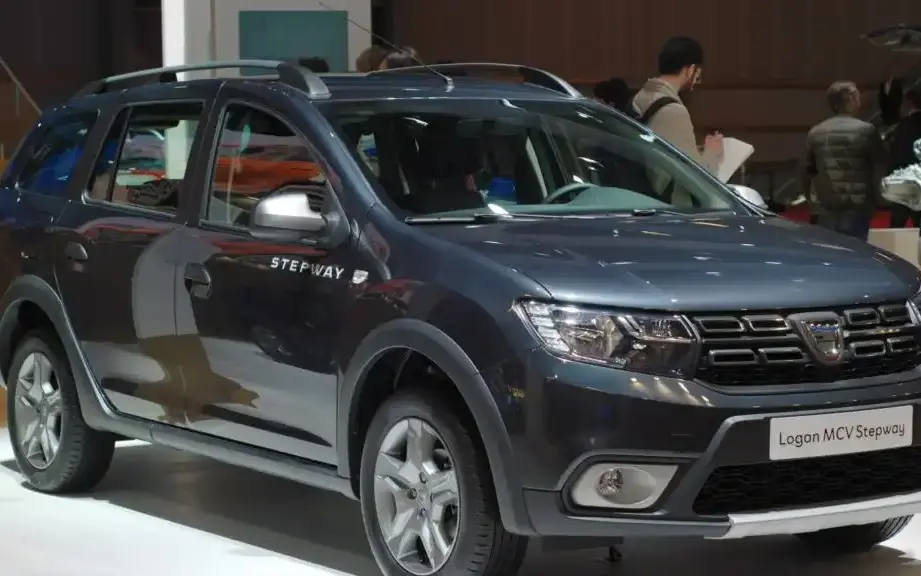
The Dacia Logan II MCV Stepway 0.9 TCe (90 hp) Easy-R, produced from 2017 to 2018, represents a specific configuration within the facelifted second generation of Dacia’s popular estate car. Positioned as an entry-level to mid-range option, this variant combined the rugged styling cues of the Stepway with a fuel-efficient, turbocharged three-cylinder engine and a simplified automated manual transmission. It was primarily aimed at buyers seeking an affordable, practical, and relatively economical family vehicle, particularly in European markets where Dacia established a strong presence as a budget-friendly brand. The Logan II MCV Stepway, in general, offered increased ground clearance and protective body cladding compared to the standard Logan MCV, enhancing its appeal to those desiring a vehicle capable of handling less-than-ideal road conditions.
Technical Specifications
| Brand | Dacia |
| Model | Logan |
| Generation | Logan II MCV Stepway (facelift 2017) |
| Type (Engine) | 0.9 TCe (90 Hp) Easy-R |
| Start of production | 2017 |
| End of production | 2018 |
| Powertrain Architecture | Internal Combustion engine |
| Body type | Station wagon (estate) |
| Seats | 5 |
| Doors | 5 |
| Fuel consumption (urban) | 5.7 l/100 km (41.3 US mpg, 49.6 UK mpg, 17.5 km/l) |
| Fuel consumption (extra urban) | 4.7 l/100 km (50 US mpg, 60.1 UK mpg, 21.3 km/l) |
| Fuel consumption (combined) | 5.1 l/100 km (46.1 US mpg, 55.4 UK mpg, 19.6 km/l) |
| CO2 emissions | 114 g/km |
| Fuel Type | Petrol (Gasoline) |
| Acceleration 0 – 100 km/h | 11.3 sec |
| Acceleration 0 – 62 mph | 11.3 sec |
| Acceleration 0 – 60 mph | 10.7 sec |
| Maximum speed | 169 km/h (105.01 mph) |
| Emission standard | Euro 6 |
| Weight-to-power ratio | 12.1 kg/Hp, 82.6 Hp/tonne |
| Weight-to-torque ratio | 7.8 kg/Nm, 128.4 Nm/tonne |
| Power | 90 Hp @ 5000 rpm |
| Torque | 140 Nm @ 2250 rpm (103.26 lb.-ft. @ 2250 rpm) |
| Engine layout | Front, Transverse |
| Engine Model/Code | H4B 408 |
| Engine displacement | 898 cm3 (54.8 cu. in.) |
| Number of cylinders | 3 |
| Engine configuration | Inline |
| Cylinder Bore | 72.2 mm (2.84 in.) |
| Piston Stroke | 73.1 mm (2.88 in.) |
| Compression ratio | 9.5:1 |
| Number of valves per cylinder | 4 |
| Fuel injection system | Multi-port manifold injection |
| Engine aspiration | Turbocharger, Intercooler |
| Valvetrain | DOHC |
| Engine oil capacity | 4.1 l (4.33 US qt | 3.61 UK qt) |
| Coolant capacity | 4.5 l (4.76 US qt | 3.96 UK qt) |
| Kerb Weight | 1090 kg (2403.04 lbs.) |
| Max. weight | 1610 kg (3549.44 lbs.) |
| Max load | 520 kg (1146.4 lbs.) |
| Trunk (boot) space – minimum | 573 l (20.24 cu. ft.) |
| Trunk (boot) space – maximum | 1518 l (53.61 cu. ft.) |
| Fuel tank capacity | 50 l (13.21 US gal | 11 UK gal) |
| Permitted trailer load with brakes (12%) | 1110 kg (2447.13 lbs.) |
| Permitted trailer load without brakes | 580 kg (1278.68 lbs.) |
| Length | 4528 mm (178.27 in.) |
| Width | 1761 mm (69.33 in.) |
| Width including mirrors | 1994 mm (78.5 in.) |
| Height | 1590 mm (62.6 in.) |
| Wheelbase | 2635 mm (103.74 in.) |
| Front track | 1491 mm (58.7 in.) |
| Rear track | 1481 mm (58.31 in.) |
| Front overhang | 846 mm (33.31 in.) |
| Rear overhang | 1047 mm (41.22 in.) |
| Ride height (ground clearance) | 174 mm (6.85 in.) |
| Minimum turning circle | 10.82 m (35.5 ft.) |
| Drivetrain Architecture | The Internal combustion engine (ICE) drives the front wheels of the vehicle. |
| Drive wheel | Front wheel drive |
| Number of gears and type of gearbox | 5 gears, automatic transmission Easy-R |
| Front suspension | Independent type McPherson |
| Rear suspension | Semi-independent, coil spring |
| Front brakes | Ventilated discs |
| Rear brakes | Drum |
| Assisting systems | ABS (Anti-lock braking system) |
| Steering type | Steering rack and pinion |
| Power steering | Electric Steering |
| Tires size | 205/55 R16 |
| Wheel rims size | 6.0J x 16 |
Powertrain & Engine Architecture
The heart of this Logan Stepway variant is the Renault-Nissan Alliance’s H4B 408 engine, a 0.9-liter turbocharged three-cylinder petrol unit. This engine, part of the ‘TCe’ family, utilizes a single-scroll turbocharger with an intercooler to boost power and efficiency. Fuel is delivered via multi-point fuel injection, and the engine features a double overhead camshaft (DOHC) valvetrain with four valves per cylinder. The 90 horsepower output is achieved at 5000 rpm, while peak torque of 140 Nm (103 lb-ft) is available from 2250 rpm. The engine’s compact size and lightweight construction contribute to the vehicle’s overall efficiency.
Paired with the engine is the ‘Easy-R’ automated manual transmission, a five-speed unit. This transmission is essentially a conventional manual gearbox with robotic actuators controlling the clutch and gear changes. While offering some of the convenience of an automatic, it’s known for being less smooth and responsive than traditional torque-converter automatics. It prioritizes fuel economy over rapid shifts.
Driving Characteristics
The 0.9 TCe engine, while adequate for everyday driving, doesn’t offer blistering performance. The 0-100 km/h (0-62 mph) time of 11.3 seconds reflects this. The Easy-R transmission contributes to a somewhat jerky driving experience, particularly during low-speed maneuvers and gear changes. The limited number of gears and the transmission’s programming prioritize fuel efficiency, meaning the engine often operates at higher revs to maintain momentum. Compared to higher-output versions of the Logan MCV, such as those with diesel engines, this variant feels noticeably slower, especially when fully loaded. However, its lighter weight helps to mitigate some of the performance deficit.
Equipment & Trim Levels
The Stepway trim level, even in its base configuration with the 0.9 TCe engine, included features like air conditioning, power steering, electric front windows, and a basic audio system. Safety equipment typically included ABS brakes, driver and passenger airbags, and seatbelt pretensioners. Optional extras could include alloy wheels, rear parking sensors, and a more advanced infotainment system. Interior upholstery was typically cloth, with a functional, if somewhat basic, dashboard layout. The Stepway trim also added distinctive exterior styling elements, such as raised suspension, roof rails, and protective body cladding.
Chassis & Braking
The Logan II MCV Stepway utilizes a McPherson strut front suspension and a semi-independent coil spring rear suspension. This setup provides a reasonable balance between ride comfort and handling. The front brakes are ventilated discs, offering adequate stopping power, while the rear brakes are drums, a cost-saving measure common in this segment. The Stepway’s increased ride height, compared to the standard Logan MCV, improves its ability to cope with rough roads and uneven surfaces.
Market Reception & Comparison
The Dacia Logan II MCV Stepway 0.9 TCe Easy-R was generally well-received as an affordable and practical family car. Critics praised its spacious interior, fuel efficiency, and low running costs. However, the Easy-R transmission was often criticized for its lack of smoothness and responsiveness. Compared to the 1.5 dCi diesel variants, the 0.9 TCe offered lower torque and slightly slower acceleration, but it was quieter and produced fewer emissions. Against competitors like the Skoda Fabia Estate or Renault Clio Estate, the Logan Stepway offered a more affordable price point, albeit with a less refined driving experience.
Legacy
The H4B 408 engine, while generally reliable, has been known to exhibit occasional issues with the turbocharger and fuel injectors. The Easy-R transmission, due to its complex electromechanical components, can be prone to failures, and repairs can be costly. However, with regular maintenance, these powertrains can provide years of reliable service. On the used car market, the Logan II MCV Stepway 0.9 TCe Easy-R remains a popular choice for budget-conscious buyers seeking a practical and spacious estate car. Its affordability and relatively low running costs continue to make it an attractive option, despite its somewhat compromised driving experience.