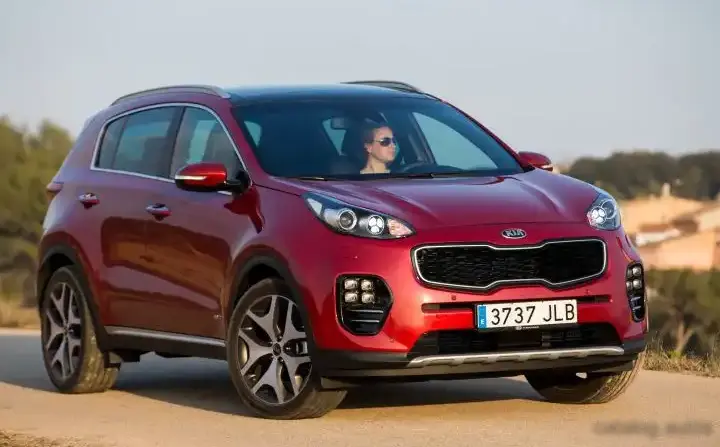
The Kia Sportage IV 1.6 GDI, producing 132 horsepower, was a key variant in the fourth generation of Kia’s popular compact SUV, sold from 2016 to 2018. Positioned as an entry-level offering in many markets, it provided a more accessible price point for buyers interested in the Sportage’s styling and practicality. This version played a significant role in expanding the Sportage’s appeal to a wider customer base, particularly those prioritizing fuel efficiency and affordability over outright performance. It was part of the globally successful Sportage IV series (QL), built on the platform shared with the Hyundai Tucson.
Technical Specifications
| Brand | Kia |
| Model | Sportage |
| Generation | Sportage IV |
| Type (Engine) | 1.6 GDI (132 Hp) |
| Start of production | 2016 |
| End of production | 2018 |
| Powertrain Architecture | Internal Combustion engine |
| Body type | SUV |
| Seats | 5 |
| Doors | 5 |
| Fuel consumption (economy) – urban (NEDC) | 8.6 l/100 km (27.4 US mpg, 32.8 UK mpg, 11.6 km/l) |
| Fuel consumption (economy) – extra urban (NEDC) | 5.6 l/100 km (42 US mpg, 50.4 UK mpg, 17.9 km/l) |
| Fuel consumption (economy) – combined (NEDC) | 6.7 l/100 km (35.1 US mpg, 42.2 UK mpg, 14.9 km/l) |
| CO2 emissions (NEDC) | 156 g/km |
| Fuel Type | Petrol (Gasoline) |
| Acceleration 0 – 100 km/h | 11.5 sec |
| Acceleration 0 – 62 mph | 11.5 sec |
| Acceleration 0 – 60 mph | 10.9 sec |
| Maximum speed | 182 km/h (113.09 mph) |
| Emission standard | Euro 6 b |
| Weight-to-power ratio | 10 kg/Hp, 99.8 Hp/tonne |
| Weight-to-torque ratio | 8.2 kg/Nm, 121.8 Nm/tonne |
| Power | 132 Hp @ 6300 rpm |
| Power per litre | 83 Hp/l |
| Torque | 161 Nm @ 4850 rpm (118.75 lb.-ft. @ 4850 rpm) |
| Engine layout | Front, Transverse |
| Engine Model/Code | Gamma II / G4FD |
| Engine displacement | 1591 cm3 (97.09 cu. in.) |
| Number of cylinders | 4 |
| Engine configuration | Inline |
| Cylinder Bore | 77 mm (3.03 in.) |
| Piston Stroke | 85.4 mm (3.36 in.) |
| Compression ratio | 11:1 |
| Number of valves per cylinder | 4 |
| Fuel injection system | Direct injection |
| Engine aspiration | Naturally aspirated engine |
| Valvetrain | DOHC |
| Engine oil capacity | 3.6 l (3.8 US qt | 3.17 UK qt) |
| Coolant | 7.5 l (7.93 US qt | 6.6 UK qt) |
| Kerb Weight | 1322-1396 kg (2914.51 – 3077.65 lbs.) |
| Max. weight | 1895 kg (4177.76 lbs.) |
| Max load | 499-573 kg (1100.11 – 1263.25 lbs.) |
| Trunk (boot) space – minimum | 491 l (17.34 cu. ft.) |
| Trunk (boot) space – maximum | 1492 l (52.69 cu. ft.) |
| Fuel tank capacity | 62 l (16.38 US gal | 13.64 UK gal) |
| Max. roof load | 100 kg (220.46 lbs.) |
| Permitted trailer load with brakes (12%) | 1400 kg (3086.47 lbs.) |
| Permitted trailer load without brakes | 650 kg (1433 lbs.) |
| Permitted towbar download | 100 kg (220.46 lbs.) |
| Length | 4480 mm (176.38 in.) |
| Width | 1855 mm (73.03 in.) |
| Width including mirrors | 2085 mm (82.09 in.) |
| Height | 1645 mm (64.76 in.) |
| Wheelbase | 2670 mm (105.12 in.) |
| Front track | 1609-1625 mm (63.35 – 63.98 in.) |
| Rear (Back) track | 1620-1636 mm (63.78 – 64.41 in.) |
| Front overhang | 910 mm (35.83 in.) |
| Rear overhang | 900 mm (35.43 in.) |
| Ride height (ground clearance) | 172 mm (6.77 in.) |
| Minimum turning circle (turning diameter) | 10.6 m (34.78 ft.) |
| Approach angle | 16.7° |
| Departure angle | 23.9° |
| Ramp-over (brakeover) angle | 18.6° |
| Drivetrain Architecture | The Internal combustion engine (ICE) drives the front wheels of the vehicle. |
| Drive wheel | Front wheel drive |
| Number of gears and type of gearbox | 6 gears, manual transmission |
| Front suspension | Independent, type McPherson with coil spring and anti-roll bar |
| Rear suspension | Independent multi-link spring suspension with stabilizer |
| Front brakes | Ventilated discs, 305 mm |
| Rear brakes | Disc, 302 mm |
| Assisting systems | ABS (Anti-lock braking system) |
| Steering type | Steering rack and pinion |
| Power steering | Electric Steering |
| Tires size | 215/70 R16; 225/60 R17; 245/45 R19 |
| Wheel rims size | 6.5J x 16; 7J x 17; 7.5J x 19 |
Powertrain & Engine Architecture
The Sportage 1.6 GDI utilized Kia’s Gamma II engine family, specifically the G4FD code. This 1.6-liter inline-four engine featured direct fuel injection (GDI), a key technology for improving both power and fuel economy. The direct injection system allowed for more precise fuel delivery, resulting in a more complete combustion process. The engine employed a dual continuously variable valve timing (D-CVVT) system, optimizing valve timing for enhanced performance across the rev range. The engine’s architecture was relatively simple, contributing to its reliability. The 6-speed manual transmission was standard, designed to efficiently transfer power to the front wheels. The transmission’s gear ratios were tuned for a balance between acceleration and fuel efficiency, prioritizing everyday drivability over sporty performance.
Driving Characteristics
The 132 hp output and front-wheel-drive configuration of this Sportage variant resulted in a driving experience focused on comfort and economy. Acceleration was adequate for typical commuting and highway merging, but not particularly brisk. The 0-60 mph time of around 10.9 seconds reflects this. Compared to higher-output versions of the Sportage, such as those with the 1.6 T-GDI turbo engine or the diesel options, the 1.6 GDI felt noticeably less powerful. The manual transmission offered a reasonable level of driver engagement, but the gear ratios were spaced to prioritize fuel efficiency rather than aggressive acceleration. The suspension provided a comfortable ride, absorbing bumps and imperfections in the road well, but didn’t offer the same level of handling precision as sportier trims.
Equipment & Trim Levels
The 1.6 GDI typically served as the base trim level in many markets. Standard equipment generally included air conditioning, power windows and locks, a basic audio system with USB connectivity, and steel wheels with wheel covers. Safety features such as ABS, electronic stability control, and multiple airbags were also standard. Optional extras often included alloy wheels, a touchscreen infotainment system with navigation, rear parking sensors, and a sunroof. Interior upholstery was typically cloth, with a functional but not luxurious design. The dashboard layout was straightforward and user-friendly.
Chassis & Braking
The Sportage IV utilized a McPherson strut front suspension and a multi-link rear suspension. This setup provided a good balance between ride comfort and handling. The front suspension incorporated a stabilizer bar to reduce body roll during cornering. Braking duties were handled by ventilated discs at the front and solid discs at the rear. The braking system was adequate for the vehicle’s weight and performance, but lacked the stopping power of higher-spec models with larger brakes. The steering was electrically assisted, providing light and easy steering feel.
Market Reception & Comparison
The Kia Sportage 1.6 GDI was generally well-received as an affordable and practical SUV. Critics praised its fuel efficiency and comfortable ride, but noted its lack of outright performance. Compared to the more powerful engine options in the Sportage lineup, the 1.6 GDI offered a lower price point but sacrificed acceleration and overall driving excitement. The diesel variants, while more expensive, provided superior fuel economy and torque. The 1.6 GDI’s fuel economy figures of around 35.1 US mpg combined were competitive within its class.
Legacy
The 1.6 GDI engine, while not known for being exceptionally robust, has proven to be reasonably reliable in the Sportage IV. Common issues, when they arise, often relate to the direct injection system, such as carbon buildup on the intake valves. Regular maintenance, including the use of quality fuel and oil, is crucial for ensuring long-term reliability. In the used car market, the 1.6 GDI Sportage represents a good value proposition for buyers seeking an affordable and practical SUV. Its lower purchase price and reasonable running costs make it an attractive option for budget-conscious consumers.