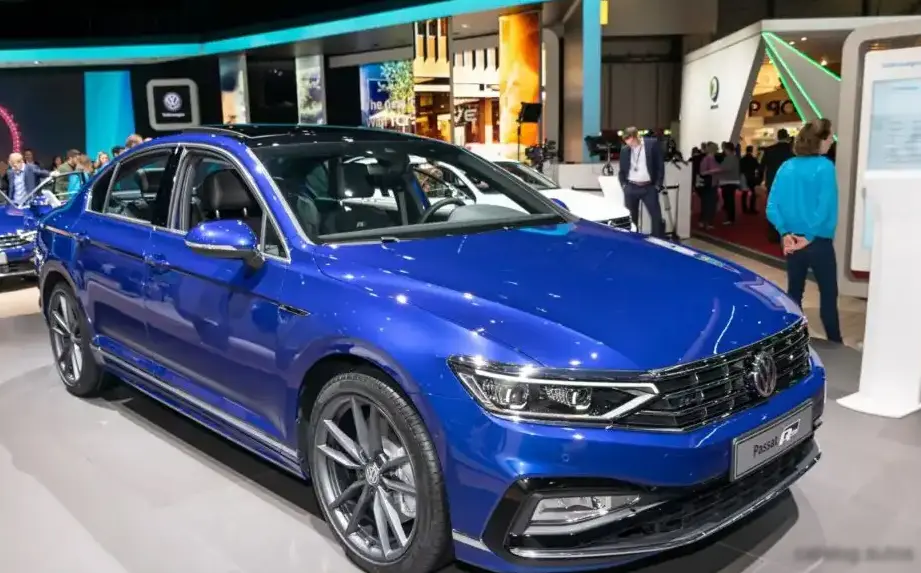
The Volkswagen Passat B8 facelift, introduced in September 2019 and produced through 2021, represented a significant refresh of the eighth-generation Passat. Among the engine options available, the 1.5 TSI (150 hp) with a six-speed manual transmission occupied a crucial position as a balance between fuel efficiency, performance, and affordability. This variant aimed to appeal to a broad customer base seeking a comfortable and practical mid-size sedan. It served as a stepping stone between the base engine options and the more powerful, and often more expensive, 2.0 TSI models. The B8 facelift brought updated styling, enhanced technology, and refined powertrains to the Passat lineup, solidifying its position as a popular choice in the European market.
Technical Specifications
| Brand | Volkswagen |
| Model | Passat |
| Generation | Passat (B8, facelift 2019) |
| Type (Engine) | 1.5 TSI (150 Hp) ACT |
| Start of production | September, 2019 |
| End of production | 2021 |
| Powertrain Architecture | Internal Combustion engine |
| Body type | Sedan |
| Seats | 5 |
| Doors | 4 |
| Fuel consumption at Low speed (WLTP) | 7.9-8.0 l/100 km (29.8 – 29.4 US mpg, 35.8 – 35.3 UK mpg, 12.7 – 12.5 km/l) |
| Fuel consumption at Medium speed (WLTP) | 5.7-5.8 l/100 km (41.3 – 40.6 US mpg, 49.6 – 48.7 UK mpg, 17.5 – 17.2 km/l) |
| Fuel consumption at high speed (WLTP) | 5.0-5.1 l/100 km (47 – 46.1 US mpg, 56.5 – 55.4 UK mpg, 20 – 19.6 km/l) |
| Fuel consumption at very high speed (WLTP) | 5.9-6.0 l/100 km (39.9 – 39.2 US mpg, 47.9 – 47.1 UK mpg, 16.9 – 16.7 km/l) |
| Combined fuel consumption (WLTP) | 5.8-5.9 l/100 km (40.6 – 39.9 US mpg, 48.7 – 47.9 UK mpg, 17.2 – 16.9 km/l) |
| CO2 emissions (WLTP) | 133-135 g/km |
| Fuel consumption (economy) – urban (NEDC) | 6.7-6.8 l/100 km (35.1 – 34.6 US mpg, 42.2 – 41.5 UK mpg, 14.9 – 14.7 km/l) |
| Fuel consumption (economy) – extra urban (NEDC) | 4.2-4.4 l/100 km (56 – 53.5 US mpg, 67.3 – 64.2 UK mpg, 23.8 – 22.7 km/l) |
| Fuel consumption (economy) – combined (NEDC) | 5.1-5.3 l/100 km (46.1 – 44.4 US mpg, 55.4 – 53.3 UK mpg, 19.6 – 18.9 km/l) |
| CO2 emissions (NEDC) | 117-122 g/km |
| Fuel Type | Petrol (Gasoline) |
| Acceleration 0 – 100 km/h | 8.7 sec |
| Acceleration 0 – 62 mph | 8.7 sec |
| Acceleration 0 – 60 mph | 8.3 sec |
| Maximum speed | 220 km/h (136.7 mph) |
| Emission standard | EURO 6d – TEMP – EVAP – ISC |
| Weight-to-power ratio | 9 kg/Hp, 111.1 Hp/tonne |
| Weight-to-torque ratio | 5.4 kg/Nm, 185.2 Nm/tonne |
| Power | 150 Hp @ 5000-6000 rpm |
| Power per litre | 100.1 Hp/l |
| Torque | 250 Nm @ 1500-3500 rpm (184.39 lb.-ft. @ 1500-3500 rpm) |
| Engine layout | Front, Transverse |
| Engine Model/Code | DPCA |
| Engine displacement | 1498 cm3 (91.41 cu. in.) |
| Number of cylinders | 4 |
| Engine configuration | Inline |
| Number of valves per cylinder | 4 |
| Fuel injection system | Direct injection |
| Engine aspiration | Turbocharger, Intercooler |
| Engine oil capacity | 4.3 l (4.54 US qt | 3.78 UK qt) |
| Kerb Weight | 1350 kg (2976.24 lbs.) |
| Max. weight | 1980 kg (4365.15 lbs.) |
| Max load | 630 kg (1388.91 lbs.) |
| Trunk (boot) space – minimum | 586 l (20.69 cu. ft.) |
| Trunk (boot) space – maximum | 1152 l (40.68 cu. ft.) |
| Fuel tank capacity | 66 l (17.44 US gal | 14.52 UK gal) |
| Max. roof load | 100 kg (220.46 lbs.) |
| Permitted trailer load with brakes (8%) | 1900 kg (4188.78 lbs.) |
| Permitted trailer load with brakes (12%) | 1600 kg (3527.4 lbs.) |
| Permitted trailer load without brakes | 710 kg (1565.28 lbs.) |
| Permitted towbar download | 90 kg (198.42 lbs.) |
| Length | 4775-4873 mm (187.99 – 191.85 in.) |
| Width | 1832 mm (72.13 in.) |
| Width including mirrors | 2083 mm (82.01 in.) |
| Height | 1483 mm (58.39 in.) |
| Wheelbase | 2786 mm (109.69 in.) |
| Front track | 1578-1586 mm (62.13 – 62.44 in.) |
| Rear (Back) track | 1564-1572 mm (61.57 – 61.89 in.) |
| Minimum turning circle (turning diameter) | 11.7 m (38.39 ft.) |
| Drivetrain Architecture | The Internal combustion engine (ICE) drives the front wheels of the vehicle. |
| Drive wheel | Front wheel drive |
| Number of gears and type of gearbox | 6 gears, manual transmission |
| Front brakes | Ventilated discs |
| Rear brakes | Disc |
| Assisting systems | ABS (Anti-lock braking system) |
| Steering type | Steering rack and pinion |
| Power steering | Electric Steering |
| Tires size | 215/60 R16; 215/55 R17 |
| Wheel rims size | 6.5 J x 16; 7J x 17 |
INTRODUCTION
The Volkswagen Passat B8 facelift, specifically the 1.5 TSI (150 hp) variant, was a key offering in the Passat range from 2019 to 2021. Built on the MQB platform (specifically the A3 iteration), this model aimed to provide a compelling blend of efficiency, comfort, and technology. Positioned as a mid-range option, it sat below the more powerful 2.0 TSI engines and above the entry-level 1.6 TDI diesel. The facelift brought a refreshed exterior design, an upgraded interior with modern infotainment systems, and advancements in driver-assistance technologies. This variant was primarily targeted at European markets, where fuel economy and practicality are highly valued.
Powertrain & Engine Architecture
The heart of this Passat variant is the DPCA engine, a 1.5-liter turbocharged four-cylinder gasoline engine. This engine is part of Volkswagen’s EA211 family and features direct fuel injection and variable valve timing on both the intake and exhaust sides. A key technology employed is Active Cylinder Management (ACT), which allows the engine to deactivate two cylinders under light load conditions to improve fuel efficiency. The turbocharger, combined with intercooling, provides a responsive power delivery. The engine produces 150 horsepower at 5000-6000 rpm and 250 Nm (184 lb-ft) of torque between 1500-3500 rpm. This power is delivered through a six-speed manual transmission, offering precise gear changes and a more engaging driving experience compared to the optional DSG dual-clutch transmission. The engine’s layout is front-transverse, a common configuration for front-wheel-drive vehicles.
Driving Characteristics
The 1.5 TSI (150 hp) Passat offers a comfortable and refined driving experience. While not overtly sporty, the engine provides sufficient power for everyday driving and overtaking maneuvers. Acceleration from 0 to 100 km/h (0-62 mph) takes approximately 8.7 seconds. The six-speed manual transmission allows for good control over the engine’s power band, and the gear ratios are well-suited for both city and highway driving. Compared to the higher-output 2.0 TSI models, this variant feels less urgent in its acceleration, but it compensates with improved fuel economy. The ACT system is largely seamless in operation, and the transition between four and two cylinders is barely noticeable. The suspension is tuned for comfort, absorbing bumps and imperfections in the road effectively. The steering is precise and provides adequate feedback.
Equipment & Trim Levels
The 1.5 TSI (150 hp) Passat typically came equipped with a generous amount of standard features. These included air conditioning, a touchscreen infotainment system with Apple CarPlay and Android Auto compatibility, Bluetooth connectivity, and a suite of safety features such as ABS, ESC, and multiple airbags. Higher trim levels offered upgrades such as leather upholstery, heated front seats, a larger touchscreen display, a premium sound system, and advanced driver-assistance systems like adaptive cruise control and lane-keeping assist. Interior upholstery was typically cloth on base models, with leather options available on higher trims. Dashboard configurations were consistent across the range, featuring a modern and ergonomic design.
Chassis & Braking
The Passat B8 facelift utilizes a MacPherson strut front suspension and a multi-link rear suspension, providing a good balance between ride comfort and handling. The chassis is designed to minimize weight while maximizing rigidity. The braking system consists of ventilated discs at the front and solid discs at the rear. ABS (Anti-lock Braking System) is standard, ensuring safe and controlled braking in various conditions. The steering system is an electric power steering system, offering precise and responsive steering feel. Wheel sizes typically ranged from 16 to 17 inches, depending on the trim level.
Market Reception & Comparison
The 1.5 TSI (150 hp) Passat was generally well-received by automotive critics. It was praised for its fuel efficiency, comfortable ride, and spacious interior. However, some reviewers noted that the engine could feel slightly underpowered when fully loaded or driving uphill. Compared to the 1.6 TDI diesel, the 1.5 TSI offered a more refined driving experience and slightly better performance, but at the cost of slightly higher fuel consumption. Compared to the 2.0 TSI models, it provided a more affordable entry point into the Passat range, albeit with less power. Fuel economy figures were competitive, with combined WLTP figures ranging from 5.8 to 5.9 l/100 km (40.6 – 39.9 US mpg).
Legacy
The 1.5 TSI engine has proven to be a reliable and durable powertrain. While some early versions of the engine experienced issues with particulate filter clogging, these were largely addressed through software updates. The Passat B8 facelift, including the 1.5 TSI variant, remains a popular choice in the used car market due to its practicality, comfort, and relatively low running costs. The combination of a fuel-efficient engine, a spacious interior, and a comfortable ride makes it a compelling option for families and commuters alike. Its continued presence in the used car market is a testament to its overall quality and reliability.