The Toyota Corolla Wagon VI (E90) 1.8 D (CE90): A Pillar of Practicality and Durability
The Toyota Corolla has long stood as a global automotive icon, synonymous with reliability, efficiency, and widespread accessibility. Among its many iterations, the sixth-generation Corolla, internally designated E90, holds a significant place in the model’s storied history. Produced from 1987 to 1992, the E90 generation continued to build upon the Corolla’s reputation for dependable transportation, offering a diverse range of body styles and powertrains to cater to a global audience. This article specifically focuses on the Toyota Corolla Wagon VI (E90) 1.8 D (CE90), a five-door station wagon variant powered by a robust and economical diesel engine, which served as a workhorse for families and businesses across numerous markets, particularly in Europe and Asia, where diesel power was a more prevalent choice for everyday motoring.
The E90 Corolla represented a maturation of the compact car segment, bringing more refined driving dynamics and improved aerodynamics compared to its predecessors. The wagon variant, often referred to as an “estate” in many international markets, was particularly valued for its enhanced cargo capacity and versatility, making it a popular choice for those requiring more utility than a sedan or hatchback could offer. The 1.8 D (CE90) model, with its naturally aspirated diesel engine, epitomized the pragmatic approach to motoring, prioritizing longevity, fuel economy, and low running costs over outright performance.
Engineering and Performance: The 1.8 D (CE90) Powertrain
At the heart of the Toyota Corolla Wagon VI (E90) 1.8 D (CE90) lay the 1C-L diesel engine, a testament to Toyota’s commitment to durability and efficiency. This naturally aspirated, four-cylinder internal combustion engine displaced 1.8 liters, delivering a modest but highly usable 64 horsepower. In an era before common rail injection and widespread turbocharging in passenger car diesels, the 1C-L was characterized by its straightforward design and robust construction, factors that contributed significantly to its legendary reliability.
While 64 horsepower might seem modest by today’s standards, it was entirely adequate for the vehicle’s intended purpose. The engine’s power delivery was linear and predictable, with a focus on torque at lower RPMs, which is ideal for hauling cargo or navigating city traffic. Unlike many contemporary gasoline engines that required higher revolutions to produce peak power, the diesel engine offered a more relaxed driving experience, particularly when cruising. Its naturally aspirated nature meant a simpler mechanical setup, reducing potential points of failure and contributing to easier maintenance. This made the 1.8 D (CE90) a favorite among drivers who valued long-term ownership and minimal workshop visits.
Fuel economy was another significant advantage of this diesel powertrain. With a 50-liter (approximately 13.21 US gallons) fuel tank, the Corolla 1.8 D (CE90) offered an impressive cruising range, making it a practical choice for long commutes or family road trips. The engine’s design also favored longevity, with many examples of the 1C-L engine accumulating hundreds of thousands of miles with proper maintenance, a testament to Toyota’s engineering philosophy of building vehicles that last. Engine oil capacity stood at 4.3 liters (4.54 US quarts), and the cooling system required 7.3 liters (7.71 US quarts) of coolant, indicating a well-engineered system designed for efficient thermal management.
Design and Features: Form Follows Function
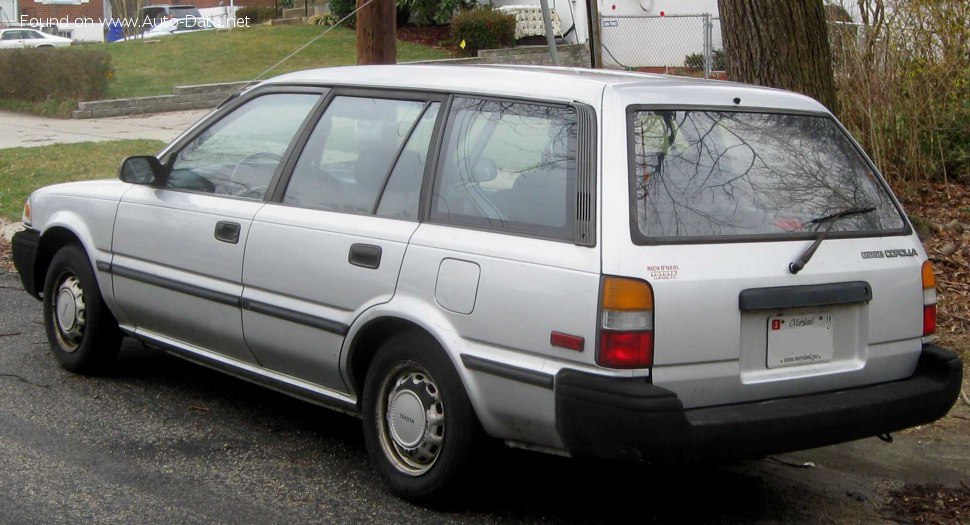
The design of the Toyota Corolla Wagon VI (E90) was a clear embodiment of the “form follows function” principle. As a five-door, five-seat station wagon, its primary objective was to offer maximum utility and practicality within a compact footprint. The E90 generation adopted a smoother, more aerodynamic aesthetic than its predecessors, featuring flush-mounted headlights and a more rounded profile, characteristics that were becoming standard in automotive design during the late 1980s. This not only contributed to a more modern appearance but also improved fuel efficiency and reduced wind noise.
The station wagon body style was the ultimate expression of versatility for the E90 Corolla. With five doors, including a large rear hatch, loading and unloading cargo was exceptionally easy. The rear seats typically featured a split-folding design, allowing owners to configure the interior to accommodate a wide array of cargo, from groceries to sports equipment, or even larger items like furniture. The interior, while not luxurious, was designed with durability and ergonomics in mind. Hard-wearing fabrics, robust plastics, and a logical control layout characterized the cabin, ensuring that the car could withstand the rigors of family life or commercial use.
Features common in the Toyota Corolla Wagon VI (E90) of this era included manual windows, a basic heating and ventilation system, and often a simple AM/FM radio. Power steering was sometimes an option, enhancing maneuverability. Safety features, while rudimentary by today’s standards, included three-point seatbelts for front occupants and lap belts for rear passengers, along with a body structure designed to offer a degree of occupant protection. The overall build quality was high, with tight panel gaps and a solid feel that contributed to the Corolla’s reputation for being a well-engineered and reliable vehicle.
Technical Specifications
| Category | Specification |
|---|---|
| General Information | |
| Brand | Toyota |
| Model | Corolla |
| Generation | Corolla Wagon VI (E90) |
| Type (Engine) | 1.8 D (CE90) (64 Hp) |
| Start of Production | 1987 year |
| End of Production | 1992 year |
| Powertrain Architecture | Internal Combustion Engine |
| Body Type | Station wagon (estate) |
| Seats | 5 |
| Doors | 5 |
| Performance Specs | |
| Fuel Type | Diesel |
| Power | 64 Hp |
| Engine Model/Code | 1C-L |
| Engine Aspiration | Naturally aspirated engine |
| Engine Oil Capacity | 4.3 l (4.54 US qt) |
| Coolant Capacity | 7.3 l (7.71 US qt) |
| Space, Volume and Weights | |
| Fuel Tank Capacity | 50 l (13.21 US gal) |
Legacy and Market Impact
The Toyota Corolla Wagon VI (E90) 1.8 D (CE90) carved out a significant niche in the global automotive market, particularly in regions where diesel fuel was cost-effective and vehicle longevity was paramount. Its legacy is deeply intertwined with Toyota’s overarching reputation for producing incredibly reliable and durable vehicles. In an era when many competitors were grappling with issues of rust, electrical failures, or engine reliability, the E90 Corolla stood out as a beacon of dependability.
Competitors in its segment included a wide array of compact cars from other global manufacturers. In Europe, it contended with popular models like the Ford Escort (and its wagon variant), the Volkswagen Golf/Jetta (and their estate versions), the Opel Kadett/Astra, and the Peugeot 309. In Asian markets, it faced rivals such as the Honda Civic, Nissan Sunny/Sentra, and Mazda Familia. What set the Corolla 1.8 D (CE90) apart was its specific blend of Toyota’s renowned build quality, the practicality of a station wagon, and the exceptional fuel economy and long-term durability of its diesel engine. While perhaps not the most exciting car to drive, its bulletproof reliability meant lower ownership costs, higher resale values, and a loyal customer base that appreciated its no-nonsense approach to transportation.
The E90 generation, and particularly the wagon variant, solidified the Corolla’s position as a global sales phenomenon. It was a vehicle that could effortlessly transition from a family hauler to a commercial fleet vehicle, performing reliably day in and day out. Its impact is still felt today, as many examples of the E90 Corolla, including the diesel wagons, continue to operate in various parts of the world, a testament to their inherent quality and the care of their owners. The Toyota Corolla Wagon VI (E90) 1.8 D (CE90) is remembered not for groundbreaking innovation or thrilling performance, but for its unwavering commitment to utility, economy, and the unyielding reliability that has become a hallmark of the Toyota brand.