The Seat Ibiza IV (facelift 2012) 1.2 12V (70 Hp): A European B-Segment Contender
The Seat Ibiza IV (facelift 2012) 1.2 12V (70 Hp) represents a crucial iteration of Seat’s popular subcompact (B-segment) hatchback, a model series that has long served as a cornerstone of the Spanish automaker’s lineup. Launched in 2012 as a refresh of the fourth-generation Ibiza, this particular variant offered an economical and practical solution for European drivers seeking a stylish, efficient, and agile city car. While Seat vehicles are not sold in the United States, the Ibiza has established itself as a significant player in markets across Europe, Latin America, and parts of Asia, embodying Seat’s youthful and sporty brand identity within the Volkswagen Group.
The fourth generation Ibiza, initially introduced in 2008, received a mid-cycle refresh for the 2012 model year, bringing updated styling, enhanced interior materials, and revised powertrain options. The 1.2 12V (70 Hp) model, produced from 2012 to 2015, was positioned as an entry-level gasoline option, focusing on affordability and low running costs. Its five-door hatchback body style provided a blend of compact exterior dimensions for urban maneuverability and sufficient interior space for everyday practicality, making it a highly competitive offering in its crowded segment.
Engine and Performance of the Seat Ibiza IV (facelift 2012) 1.2 12V (70 Hp)
At the heart of the Seat Ibiza IV (facelift 2012) 1.2 12V (70 Hp) lies a naturally aspirated 1.2-liter (1198 cm³, or 73.11 cu. in.) inline three-cylinder gasoline engine, known internally by the codes CGPA and CJLB. This compact powerplant was engineered for efficiency and reliability, typical of Volkswagen Group engines of its era. It produces a modest but adequate 70 horsepower at 5400 rpm, which is well-suited for urban driving and moderate highway speeds. Torque output stands at 112 Nm (82.61 lb.-ft.) delivered at a relatively low 3000 rpm, ensuring reasonable responsiveness from a standstill and in stop-and-go traffic.
Power is directed to the front wheels via a five-speed manual transmission, a common setup for B-segment vehicles prioritizing driver engagement and fuel economy. The drivetrain architecture is a conventional front-engine, front-wheel-drive layout, providing predictable handling characteristics. While the 0 to 60 mph acceleration time of 13.2 seconds (calculated by Auto-Data.net) and a top speed of 101.28 mph (163 km/h) might not impress performance enthusiasts, they are perfectly acceptable for the car’s intended purpose as an economical daily driver. The three-cylinder configuration, with four valves per cylinder and multi-port manifold injection, contributes to its respectable fuel economy figures: 33.1 US mpg in the city, 53.5 US mpg on the highway, and a combined average of 43.6 US mpg. With CO2 emissions of 125 g/km, it met the Euro 5 emission standard, reflecting its focus on environmental responsibility for its time.
Design and Features
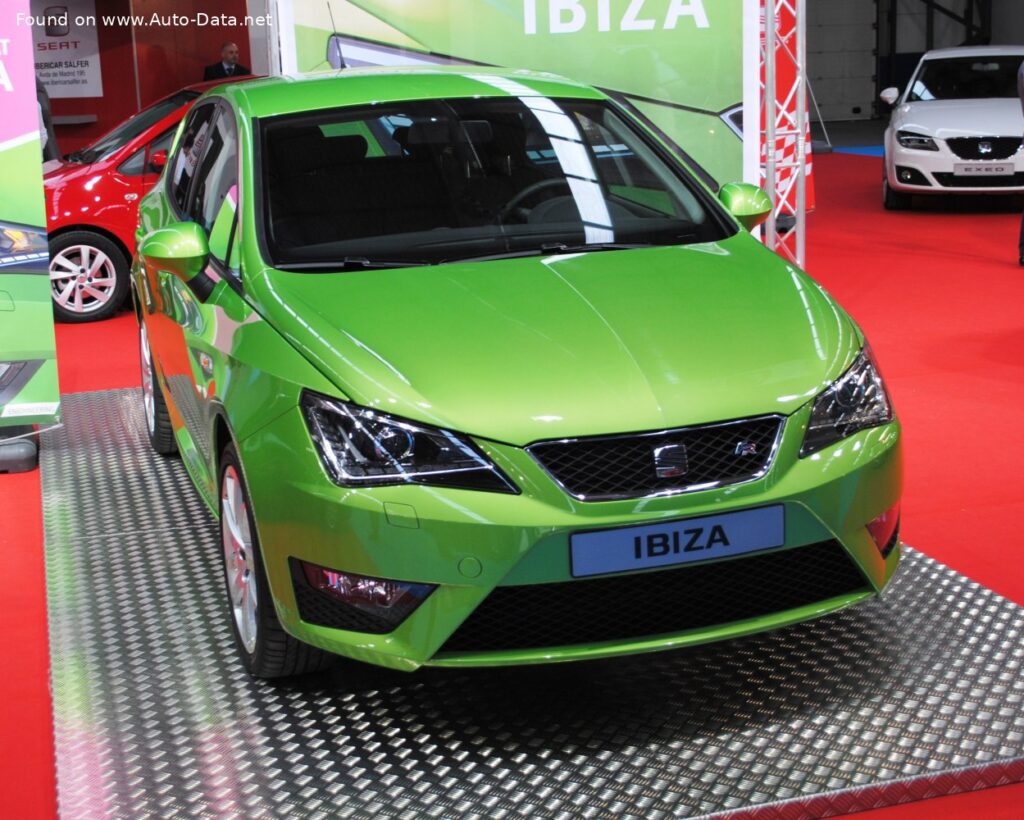
The 2012 facelift brought a sharper, more contemporary aesthetic to the fourth-generation Ibiza, aligning it with Seat’s evolving design language. The exterior featured a redesigned front fascia with a more angular grille and updated headlights that incorporated LED daytime running lights on higher trims, giving the car a more aggressive and modern look. The five-door hatchback body type offered a practical solution, balancing a compact footprint with accessible rear seating and cargo capacity. Measuring 159.88 inches (4061 mm) in length, 66.65 inches (1693 mm) in width, and 56.89 inches (1445 mm) in height, the Ibiza was perfectly sized for navigating crowded European city streets and parking in tight spaces.
Inside, the facelift addressed earlier criticisms regarding material quality, introducing softer-touch plastics and improved trim finishes. The cabin was designed to be ergonomic and user-friendly, with a clear instrument cluster and well-placed controls. Seating for five passengers was standard, though the rear bench was more comfortable for two adults on longer journeys. The trunk offered a respectable 10.31 cu. ft. (292 liters) of cargo space, expandable by folding down the rear seats, which was competitive for its segment. Key features for safety and convenience included an Anti-lock Braking System (ABS) as standard, front ventilated disc brakes and rear drum brakes, and an electric power steering system that provided light and precise control for city driving. The car rode on 175/70 R14 tires mounted on 5J x 14 wheel rims, a practical choice for comfort and cost-effectiveness.
Technical Specifications
The following table details the comprehensive technical specifications for the Seat Ibiza IV (facelift 2012) 1.2 12V (70 Hp):
| Category | Specification | US Equivalent |
|---|---|---|
| Brand | Seat | |
| Model | Ibiza | |
| Generation | Ibiza IV (facelift 2012) | |
| Type (Engine) | 1.2 12V (70 Hp) | |
| Production Start | 2012 | |
| Production End | 2015 | |
| Powertrain Architecture | Internal Combustion Engine | |
| Body Type | Hatchback | |
| Seats | 5 | |
| Doors | 5 | |
| Performance Specifications | ||
| Fuel Consumption (City) | 7.1 l/100 km | 33.1 US mpg |
| Fuel Consumption (Highway) | 4.4 l/100 km | 53.5 US mpg |
| Fuel Consumption (Combined) | 5.4 l/100 km | 43.6 US mpg |
| CO2 Emissions | 125 g/km | |
| Fuel Type | Petrol (Gasoline) | |
| Acceleration 0-60 mph | 13.2 sec | |
| Maximum Speed | 163 km/h | 101.28 mph |
| Emission Standard | Euro 5 | |
| Weight-to-Power Ratio | 15 kg/Hp | 33.07 lbs/Hp |
| Weight-to-Torque Ratio | 9.4 kg/Nm | 20.72 lbs/Nm |
| Engine Specifications | ||
| Power | 70 Hp @ 5400 rpm | |
| Power per liter | 58.4 Hp/l | |
| Torque | 112 Nm @ 3000 rpm | 82.61 lb.-ft. @ 3000 rpm |
| Engine Layout | Front, Transverse | |
| Engine Model/Code | CGPA, CJLB | |
| Engine Displacement | 1198 cm³ | 73.11 cu. in. |
| Number of Cylinders | 3 | Inline |
| Cylinder Bore | 76.5 mm | 3.01 in. |
| Piston Stroke | 86.9 mm | 3.42 in. |
| Compression Ratio | 10.5:1 | |
| Valves per Cylinder | 4 | |
| Fuel Injection System | Multi-port manifold injection | |
| Engine Aspiration | Naturally aspirated | |
| Engine Oil Capacity | 3 l | 3.17 US qt |
| Engine Oil Specification | Not Specified | |
| Coolant Capacity | 5.6 l | 5.92 US qt |
| Dimensions, Space, and Weights | ||
| Kerb Weight | 1049 kg | 2312.65 lbs. |
| Max. Weight (GVWR) | 1540 kg | 3395.12 lbs. |
| Max Load | 491 kg | 1082.47 lbs. |
| Trunk (Boot) Space – min | 292 l | 10.31 cu. ft. |
| Fuel Tank Capacity | 45 l | 11.89 US gal |
| Length | 4061 mm | 159.88 in. |
| Width | 1693 mm | 66.65 in. |
| Height | 1445 mm | 56.89 in. |
| Wheelbase | 2469 mm | 97.2 in. |
| Front Track | 1465 mm | 57.68 in. |
| Rear Track | 1457 mm | 57.36 in. |
| Minimum Turning Circle | 10.48 m | 34.38 ft. |
| Drivetrain, Brakes, and Suspension | ||
| Drivetrain Architecture | Front-wheel drive, Internal Combustion Engine | |
| Drive Wheel | Front Wheel Drive | |
| Gearbox Type | 5 gears, manual transmission | |
| Front Suspension | Independent, McPherson with coil spring and anti-roll bar | |
| Rear Suspension | Hydraulic elements | |
| Front Brakes | Ventilated discs | |
| Rear Brakes | Drum | |
| Assisting Systems | ABS (Anti-lock Braking System) | |
| Steering Type | Steering rack and pinion | |
| Power Steering | Electric Steering | |
| Tire Size | 175/70 R14 | |
| Wheel Rims Size | 5J x 14 | |
Legacy and Market Impact
The Seat Ibiza has long been a vital model for the Spanish brand, and the fourth-generation facelift, particularly the Seat Ibiza IV (facelift 2012) 1.2 12V (70 Hp), continued this tradition. In the fiercely competitive European B-segment, the Ibiza carved out a niche as a more emotional and sporty alternative to its platform-sharing sibling, the Volkswagen Polo, while offering a more upmarket feel than the Škoda Fabia. Its main competitors included established rivals such as the Ford Fiesta, Renault Clio, Opel Corsa (Vauxhall Corsa in the UK), Peugeot 208, and the Fiat Punto.
The Ibiza’s reputation was built on its dynamic styling, engaging driving characteristics (for its class), and the perceived reliability and build quality derived from its Volkswagen Group underpinnings. The 1.2 12V (70 Hp) engine variant, while not a powerhouse, was highly valued for its low purchase price, excellent fuel economy, and affordable running costs, making it an attractive option for first-time buyers, urban commuters, and small families. It played a significant role in Seat’s sales volumes, contributing to the brand’s image as a producer of stylish, accessible, and fun-to-drive vehicles.
Despite not being available in the North American market, the Ibiza’s influence in its primary European market cannot be overstated. It helped cement Seat’s identity within the VW Group as the “passion brand,” offering a more youthful and expressive alternative to the more conservative Volkswagen line. The 2012 facelift ensured the Ibiza remained fresh and competitive against newer entrants, extending the lifecycle of a highly successful generation. Its blend of practical five-door hatchback utility, efficient powertrain, and distinctive design ensured its continued popularity throughout its production run, solidifying its place as a significant chapter in Seat’s history and a well-regarded option in the European subcompact segment.