The Toyota Corolla Wagon VI (E90): A Global Workhorse of Unwavering Reliability
The Toyota Corolla, a name synonymous with automotive ubiquity and dependability, has graced roads worldwide across numerous generations. Among its many iterations, the Sixth Generation, internally designated E90, holds a significant place, particularly in its practical station wagon form. The Toyota Corolla Wagon VI (E90), produced between 1989 and 1992, represented a pivotal moment for Toyota, solidifying its reputation for building robust, economical, and long-lasting vehicles. While gasoline-powered variants were common across most markets, the 1.8 D (CE90) model, with its modest 67 horsepower diesel engine, carved out a niche as an exceptionally frugal and durable option, especially popular in European and Asian markets where diesel power was, and often still is, highly valued for its efficiency and torque characteristics in everyday driving.
This particular variant of the E90 Corolla Wagon exemplifies Toyota’s engineering philosophy of the late 1980s and early 1990s: build quality, practicality, and an unwavering focus on reliability. It wasn’t designed to be a performance machine or a luxury cruiser, but rather an honest, no-nonsense family hauler or commercial fleet vehicle, capable of enduring years of demanding service with minimal fuss. Its compact dimensions, combined with a surprisingly spacious interior for its class, made it a versatile choice for a wide array of customers, from small businesses needing a reliable delivery vehicle to families seeking an economical and spacious daily driver.
Engine and Performance: The Enduring Heart of the Toyota Corolla Wagon VI (E90)
At the core of the Toyota Corolla Wagon VI (E90) 1.8 D (CE90) lay the venerable 1C-L engine, a naturally aspirated 1.8-liter diesel powerplant. This engine, producing a modest 67 horsepower, was not built for blistering acceleration or high-speed thrills. Instead, its design prioritized fuel efficiency, longevity, and low-end torque, making it perfectly suited for the demands of urban commuting and long-distance cruising on less demanding roads. The lack of turbocharging meant a simpler, more robust engine design, inherently less prone to the complexities and potential failure points associated with forced induction systems of the era.
The 1C-L diesel engine was renowned for its impressive fuel economy, a critical factor for buyers in markets with high fuel prices. While specific torque figures are not provided, naturally aspirated diesels of this displacement and power output typically delivered ample low-end grunt, making the wagon feel surprisingly capable when laden with cargo or passengers. This characteristic, combined with Toyota’s meticulous engineering, ensured that the powertrain was not only economical but also remarkably durable, often achieving hundreds of thousands of miles with proper maintenance. The engine’s straightforward design also meant that maintenance and repairs were generally simpler and less costly, contributing to the vehicle’s overall appeal as an economical choice.
Design and Features: Practicality Personified
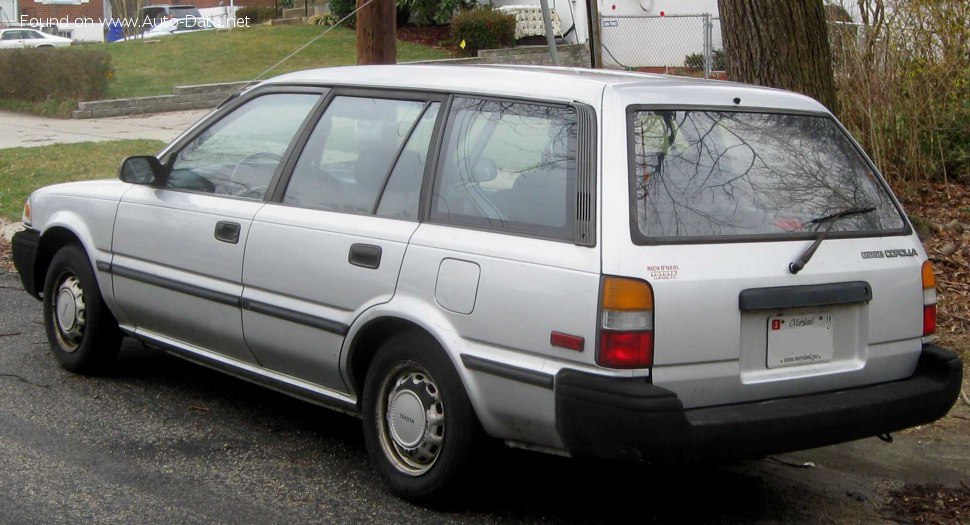
The design of the Toyota Corolla Wagon VI (E90) was a testament to the functional aesthetic prevalent in the late 1980s. Its five-door station wagon body style was characterized by clean, unpretentious lines that prioritized interior volume and utility. While not flashy, the E90’s design was aerodynamic for its time, contributing to its fuel efficiency and stability on the highway. The five-seat configuration offered comfortable seating for a family, while the expansive cargo area, easily accessible via a large rear hatch, was a key selling point for those needing to transport goods or luggage.
Inside, the Corolla Wagon VI (E90) offered a practical and durable cabin. Materials were chosen for their longevity and ease of cleaning, rather than luxurious feel. Ergonomics were straightforward, with all controls logically placed and easy to operate. Features, typical for a compact car of its era, included manual windows, basic climate control, and a simple audio system. Safety features were rudimentary by today’s standards, primarily focusing on passive measures such as seatbelts and a sturdy body structure. However, the E90’s inherent reliability and predictable handling characteristics contributed to its overall safety profile, inspiring confidence in its drivers. The emphasis was squarely on providing a dependable, comfortable, and highly functional vehicle that could withstand the rigors of daily use without complaint.
Technical Specifications: Toyota Corolla Wagon VI (E90) 1.8 D (CE90) (67 Hp)
| Category | Specification |
|---|---|
| Brand | Toyota |
| Model | Corolla |
| Generation | Corolla Wagon VI (E90) |
| Engine Type (Specific) | 1.8 D (CE90) (67 Hp) |
| Start of Production | 1989 year |
| End of Production | 1992 year |
| Powertrain Architecture | Internal Combustion engine |
| Body Type | Station wagon (estate) |
| Seats | 5 |
| Doors | 5 |
| Fuel Type | Diesel |
| Power | 67 Hp |
| Engine Model/Code | 1C-L |
| Engine Aspiration | Naturally aspirated engine |
| Engine Oil Capacity | 4.3 liters (4.54 US qt) |
| Coolant Capacity | 7.3 liters (7.71 US qt) |
| Fuel Tank Capacity | 50 liters (13.21 US gal) |
Legacy and Market Impact: The Enduring Spirit of the Toyota Corolla
The Toyota Corolla Wagon VI (E90) 1.8 D (CE90) played a crucial role in reinforcing Toyota’s global market presence, particularly in regions where practical, economical vehicles were paramount. While the diesel wagon variant was not a mainstream offering in the United States, its impact was profound in Europe, parts of Asia, and Australia, where it competed fiercely with local compact wagons such as the Ford Escort Wagon, Opel Kadett/Astra Wagon, and Volkswagen Golf Variant. Its primary competitive advantage lay in its almost legendary reliability and low running costs, often outlasting its rivals and maintaining higher resale values.
The E90 generation, including its wagon and diesel variants, further cemented the Corolla’s reputation as the “car that just won’t quit.” This generation was instrumental in establishing the benchmarks for quality, durability, and value that Toyota vehicles are still known for today. Its mechanical simplicity, coupled with meticulous manufacturing standards, meant that many E90 Corollas are still on the road today, a testament to their inherent robustness. For many, it was their first experience with a car that required little more than routine maintenance, fostering a deep loyalty to the Toyota brand.
The legacy of the Toyota Corolla Wagon VI (E90) extends beyond mere sales figures; it represents a philosophy of automotive engineering focused on the user’s practical needs. It was a vehicle designed to serve faithfully, year after year, without demanding excessive attention or expense. Its historical significance lies in its contribution to Toyota’s global image as a producer of dependable, high-quality, and economical vehicles, paving the way for the brand’s continued success in the compact and family car segments worldwide. It remains a beloved classic for enthusiasts and a symbol of an era when automotive reliability was paramount.