The Seat Ibiza IV (facelift 2012) 1.2 TDI (75 Hp): A European Supermini Champion
The Seat Ibiza IV (facelift 2012) 1.2 TDI (75 Hp) represents a significant iteration of Seat’s popular subcompact car, a model that has long been a cornerstone of the Spanish automaker’s lineup. Unveiled in 2012, this facelifted version of the fourth-generation Ibiza brought refreshed styling, enhanced features, and a continued focus on efficiency, particularly with its economical diesel powertrain. As a product of the Volkswagen Group, Seat positions the Ibiza as a more youthful and “emotion-driven” alternative to its platform siblings like the Volkswagen Polo and Skoda Fabia, primarily targeting the competitive European supermini segment.
While the Seat brand is not officially sold in the United States, the Ibiza has played a crucial role in Europe, offering a blend of sharp design, practical five-door hatchback utility, and cost-effective operation. The 1.2 TDI (75 Hp) variant, specifically, was engineered to appeal to buyers prioritizing exceptional fuel economy and low emissions, making it a compelling choice for urban commuters and those seeking an affordable yet stylish daily driver. Its compact dimensions, combined with a surprisingly spacious interior for its class, cemented its status as a versatile option in its primary markets from its production start in 2012 until its conclusion in 2015.
Engine & Performance: The Efficient Heart of the Seat Ibiza IV (facelift 2012) 1.2 TDI (75 Hp)
At the core of the Seat Ibiza IV (facelift 2012) 1.2 TDI (75 Hp) is a meticulously engineered 1.2-liter (1199 cm³ or 73.17 cu. in.) three-cylinder diesel engine. This powerplant, designated with the internal code CFWA, exemplifies the Volkswagen Group’s commitment to efficiency and reduced environmental impact, especially prevalent in the European market during its production era. The inline-three configuration, while sometimes associated with a characteristic thrum, was chosen for its inherent fuel-saving advantages and compact packaging.
Despite its modest displacement, the 1.2 TDI engine delivers a respectable 75 horsepower at 4200 rpm. More significantly for a diesel engine, it generates a robust 132.76 lb.-ft. (180 Nm) of torque, available at a low 2000 rpm. This ample low-end torque is crucial for responsive acceleration in city driving and provides a relaxed cruising experience on highways. The power is delivered to the front wheels via a smooth-shifting 5-speed manual transmission, a setup optimized for both driver engagement and fuel economy.
The engine’s advanced common rail fuel injection system, coupled with a turbocharger and intercooler, ensures efficient combustion and strong performance for its size. This sophisticated setup contributes to the vehicle’s impressive fuel efficiency figures: an estimated 51.1 US mpg in urban conditions, a remarkable 71.3 US mpg on the extra-urban cycle, and a combined average of 61.9 US mpg. Such figures were instrumental in making the Ibiza 1.2 TDI a highly attractive proposition in markets where fuel costs are a significant consideration.
Performance-wise, the Ibiza 1.2 TDI is designed for practicality rather than outright speed. It accelerates from 0 to 60 mph in a calculated 13.2 seconds (0-100 km/h in 13.9 seconds) and can reach a top speed of 104.39 mph (168 km/h). These figures are perfectly adequate for its intended use as a city car and compact highway cruiser. Furthermore, the engine complies with the Euro 5 emissions standard, emitting just 99 g/km of CO2, aided by a standard particulate filter, underscoring its environmentally conscious design.
Design & Features: Practicality Meets Spanish Flair
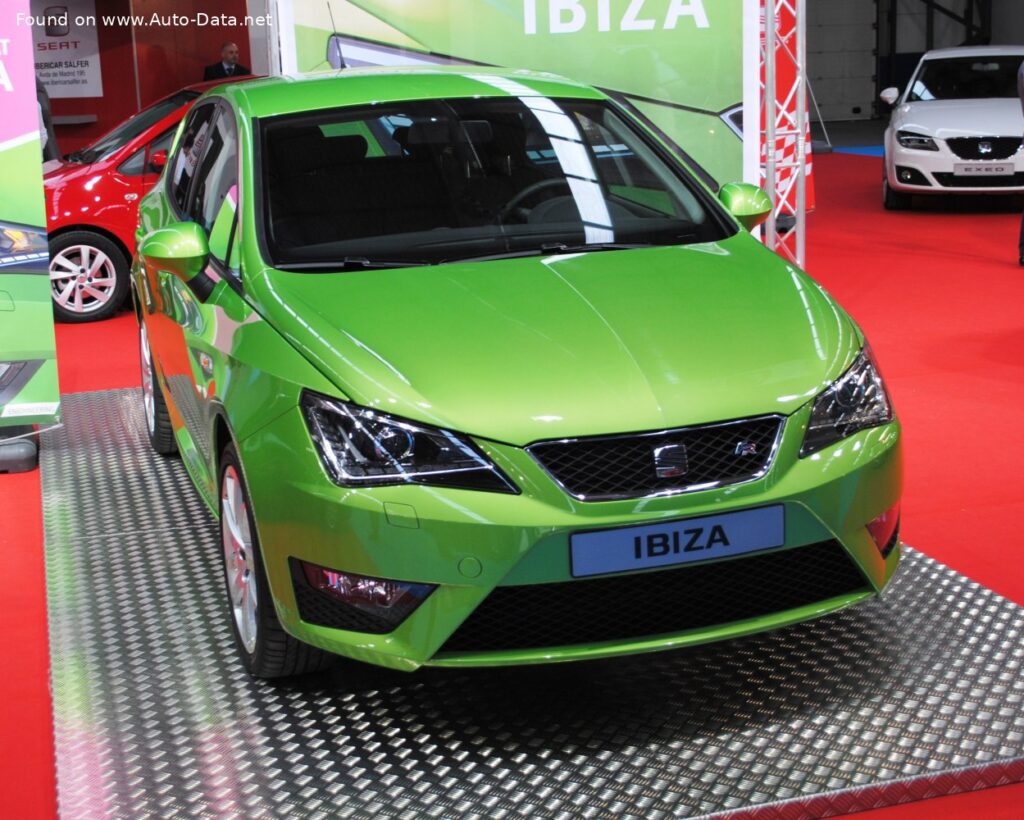
The Seat Ibiza IV (facelift 2012) adopted a refreshed aesthetic that further sharpened its already distinctive lines. As a five-door hatchback, it offered a practical and versatile body style, ideal for small families or individuals needing flexible cargo and passenger space. The facelift introduced updated headlights, a revised grille, and subtle bumper changes, bringing the Ibiza more in line with Seat’s evolving “auto emoción” design language. This gave the car a more aggressive and contemporary look, reinforcing its sporty image within the supermini segment.
Measuring 159.88 inches (4061 mm) in length, 66.65 inches (1693 mm) in width, and 56.89 inches (1445 mm) in height, with a wheelbase of 97.2 inches (2469 mm), the Ibiza IV strikes a balance between compact maneuverability and interior room. The relatively long wheelbase for its class contributed to a stable ride and maximized cabin space, allowing for comfortable seating for five occupants. The trunk offers a practical 10.31 cubic feet (292 liters) of cargo capacity, expandable by folding down the rear seats, making it suitable for groceries, luggage, or urban errands.
Inside, the Ibiza’s cabin was designed with ergonomics and functionality in mind. While specific infotainment details are not provided, typical features for a 2012 European supermini would include options for air conditioning, power windows, and a basic audio system, with higher trims offering more advanced connectivity. Safety was also a key consideration, with standard features including an Anti-lock Braking System (ABS) and a robust chassis. The front suspension utilized an independent McPherson strut design with coil springs and an anti-roll bar, while the rear featured hydraulic elements, providing a comfortable yet engaging ride. Braking was handled by ventilated discs at the front and drum brakes at the rear, a common and effective setup for vehicles in this class. The electric power steering system offered light and precise control, enhancing maneuverability in tight urban environments. The vehicle could be fitted with various tire sizes, from 175/70 R14 to 215/45 R16, paired with corresponding wheel sizes, allowing for different levels of grip and aesthetic appeal.
Technical Specifications
| Category | Specification | US Equivalent |
|---|---|---|
| Brand | Seat | |
| Model | Ibiza | |
| Generation | Ibiza IV (facelift 2012) | |
| Type (Engine) | 1.2 TDI (75 Hp) | |
| Start of Production | 2012 year | |
| End of Production | 2015 year | |
| Powertrain Architecture | Internal Combustion engine | |
| Body Type | Hatchback | |
| Seats | 5 | |
| Doors | 5 | |
Performance Specs |
||
| Fuel Consumption (Urban) | 4.6 l/100 km | 51.1 US mpg |
| Fuel Consumption (Extra Urban) | 3.3 l/100 km | 71.3 US mpg |
| Fuel Consumption (Combined) | 3.8 l/100 km | 61.9 US mpg |
| CO2 Emissions | 99 g/km | |
| Fuel Type | Diesel | |
| Acceleration 0 – 60 mph | 13.2 sec | |
| Acceleration 0 – 100 km/h | 13.9 sec | |
| Maximum Speed | 168 km/h | 104.39 mph |
| Emission Standard | Euro 5 | |
| Weight-to-Power Ratio | 15.1 kg/Hp | 66.1 Hp/tonne |
| Weight-to-Torque Ratio | 6.3 kg/Nm | 158.6 Nm/tonne |
Engine Specs |
||
| Power | 75 Hp @ 4200 rpm | |
| Power per Liter | 62.6 Hp/l | |
| Torque | 180 Nm @ 2000 rpm | 132.76 lb.-ft. @ 2000 rpm |
| Engine Layout | Front, Transverse | |
| Engine Model/Code | CFWA | |
| Engine Displacement | 1199 cm³ | 73.17 cu. in. |
| Number of Cylinders | 3 | Inline |
| Engine Configuration | Inline | |
| Cylinder Bore | 79.5 mm | 3.13 in. |
| Piston Stroke | 80.5 mm | 3.17 in. |
| Compression Ratio | 16.5:1 | |
| Valves per Cylinder | 4 | |
| Fuel Injection System | Diesel Commonrail | |
| Engine Aspiration | Turbocharger, Intercooler | |
| Engine Oil Capacity | 4.3 l | 4.54 US qt |
| Engine Oil Specification | Not specified | |
| Coolant Capacity | 8 l | 8.45 US qt |
| Engine Systems | Particulate filter | |
Space, Volume and Weights |
||
| Kerb Weight | 1135 kg | 2502.25 lbs. |
| Max. Weight | 1630 kg | 3593.53 lbs. |
| Max Load | 495 kg | 1091.29 lbs. |
| Trunk (boot) Space – Minimum | 292 l | 10.31 cu. ft. |
| Fuel Tank Capacity | 45 l | 11.89 US gal |
Dimensions |
||
| Length | 4061 mm | 159.88 in. |
| Width | 1693 mm | 66.65 in. |
| Height | 1445 mm | 56.89 in. |
| Wheelbase | 2469 mm | 97.2 in. |
| Front Track | 1465 mm | 57.68 in. |
| Rear (Back) Track | 1457 mm | 57.36 in. |
| Minimum Turning Circle | 10.48 m | 34.38 ft. |
Drivetrain, Brakes and Suspension Specs |
||
| Drivetrain Architecture | Internal combustion engine drives front wheels | |
| Drive Wheel | Front-wheel drive | |
| Number of Gears & Type | 5 gears, manual transmission | |
| Front Suspension | Independent, McPherson with coil spring and anti-roll bar | |
| Rear Suspension | Hydraulic elements | |
| Front Brakes | Ventilated discs | |
| Rear Brakes | Drum | |
| Assisting Systems | ABS (Anti-lock braking system) | |
| Steering Type | Steering rack and pinion | |
| Power Steering | Electric Steering | |
| Tires Size | 175/70 R14; 185/60 R15; 215/45 R16 | |
| Wheel Rims Size | 5J x 14; 6J x 15; 7J x 16 | |
Legacy & Market Impact of the Seat Ibiza IV (facelift 2012)
The Seat Ibiza IV (facelift 2012) 1.2 TDI (75 Hp) carved out a significant niche for itself in the highly competitive European supermini market. Seat, as the “Spanish Volkswagen,” has historically aimed to inject more passion and dynamism into its vehicles compared to its more conservative German and Czech siblings. The Ibiza, particularly in its refreshed fourth-generation guise, successfully embodied this philosophy, offering a visually appealing package that stood out from the crowd.
Its reputation was built on a foundation of reliability, cost-effectiveness, and a surprisingly engaging driving experience for a car of its class. The 1.2 TDI (75 Hp) variant, in particular, was lauded for its exceptional fuel economy and low CO2 emissions, which translated directly into lower running costs and favorable tax implications in many European countries. This made it an attractive option for a diverse demographic, from young professionals and students seeking an economical yet stylish first car, to small families and urban dwellers needing a practical and maneuverable vehicle for daily commutes.
The Ibiza faced stiff competition from a host of well-established rivals. Key competitors included its Volkswagen Group stablemates, the Volkswagen Polo and Skoda Fabia, which shared much of its underlying engineering. Beyond the VW Group, it contended with popular models such as the Ford Fiesta, Renault Clio, Peugeot 208, and Opel Corsa. What allowed the Ibiza to differentiate itself was its distinct styling and a slightly sportier suspension tune, giving it a more agile feel than some of its peers, aligning with Seat’s “auto emoción” mantra.
Its historical significance lies in its role as a volume seller for Seat, consistently ranking among the brand’s best-selling models. The Ibiza’s success helped solidify Seat’s position within the Volkswagen Group as a brand capable of delivering stylish, practical, and efficient vehicles that resonate with a younger, more design-conscious audience. The 2012 facelift ensured the model remained fresh and competitive during its later production years, contributing to its enduring legacy as a versatile and economical choice in the European automotive landscape. Its presence on European roads continues to be a testament to its robust engineering and market relevance in an era increasingly focused on efficiency and compact versatility.