Toyota Corolla Wagon VII (E100): A Global Workhorse of Practicality
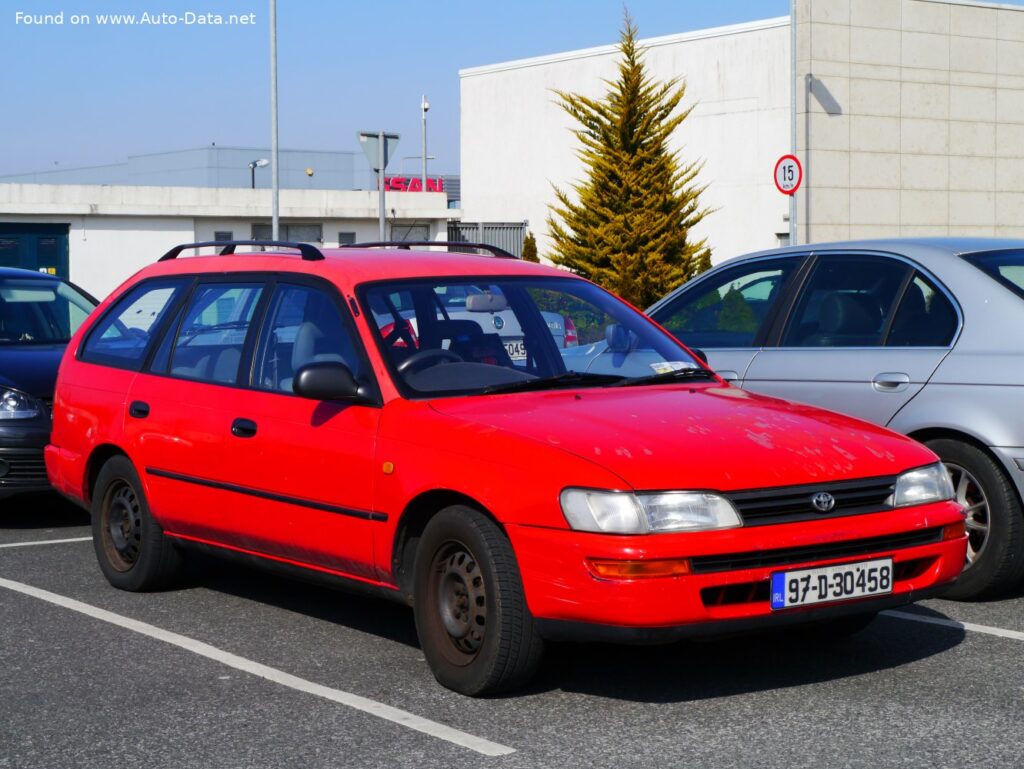
The Toyota Corolla Wagon VII (E100) represents a significant chapter in the storied history of one of the world’s most enduring automotive nameplates. Produced from 1992 to 1997, the seventh-generation Corolla, internally designated E100, continued Toyota’s tradition of building reliable, economical, and practical vehicles for a global audience. While the sedan and hatchback variants saw widespread success in numerous markets, including North America, the station wagon (or “estate” in many parts of the world) version, particularly with the 1.3-liter engine configuration, carved out a strong niche in European and Asian markets where its blend of compact dimensions and versatile cargo capacity was highly valued. This particular variant, the 1.3 i XLI 16V with 88 horsepower, exemplified the E100 generation’s commitment to efficiency and everyday usability, offering a no-frills approach to family transport and utility.
The E100 generation marked a slight departure in design philosophy from its predecessors, adopting a more rounded, aerodynamic aesthetic that was in vogue during the early 1990s. Despite its modest powertrain in this specific guise, the Corolla Wagon maintained the brand’s reputation for exceptional build quality and longevity, making it a popular choice for budget-conscious buyers and fleets alike. Its presence, though less prominent in the North American landscape compared to its sedan siblings, was nonetheless a testament to the Corolla’s adaptability and global appeal.
Engine and Performance: Efficient and Dependable
At the heart of the Toyota Corolla Wagon VII (E100) 1.3 i XLI 16V lies Toyota’s venerable 2E-E engine, a naturally aspirated inline four-cylinder unit designed for both durability and fuel efficiency. With an engine displacement of 1299 cubic centimeters (79.27 cubic inches), this powerplant delivered a modest but entirely adequate 88 horsepower at 6000 rpm. Its multi-port manifold injection system ensured precise fuel delivery, contributing to its reliable operation and respectable fuel economy figures for the era. The engine’s power per liter stood at 67.7 horsepower, a solid figure for a non-turbocharged small-displacement engine of the early 90s.
Torque output was rated at 123 Nm (90.72 lb.-ft.) at 4400 rpm, providing sufficient pulling power for daily commuting and light hauling. Mated to a 5-speed manual transmission, the front-wheel-drive Corolla Wagon offered a direct and engaging driving experience, characteristic of compact cars from this period. Performance figures, while not exhilarating, were perfectly acceptable for its class: acceleration from 0 to 60 mph was achieved in a calculated 10.9 seconds, with a top speed of 108.74 mph (175 km/h). Fuel economy was a strong suit, with a combined rating of 34.1 US mpg (6.9 liters per 100 km), making it an economical choice for families and individuals prioritizing low running costs.
The engine’s layout, front and transverse, was typical for front-wheel-drive vehicles, optimizing cabin space and weight distribution. With a compression ratio of 10.5:1 and a DOHC (Dual Overhead Camshaft) valvetrain with four valves per cylinder, the 2E-E engine showcased Toyota’s engineering prowess in extracting efficiency and smooth operation from a compact package. Its robust construction and straightforward design contributed significantly to the Corolla’s legendary reputation for reliability, often allowing these vehicles to accumulate hundreds of thousands of miles with proper maintenance.
Design and Features: Practicality Personified
The design of the Toyota Corolla Wagon VII (E100) was driven by practicality and function, embodying the essence of a compact station wagon. Its five-door, five-seat configuration offered versatile passenger and cargo solutions. Measuring 167.72 inches (4260 mm) in length, 66.34 inches (1685 mm) in width, and 57.48 inches (1460 mm) in height, the E100 Wagon struck a balance between exterior compactness and interior spaciousness. The wheelbase of 97.05 inches (2465 mm) contributed to a stable ride and decent interior room for its class.
A key highlight of the wagon body style was its cargo capacity. With the rear seats in place, the trunk offered 13.91 cubic feet (394 liters) of space, which could expand significantly to 25.18 cubic feet (713 liters) when the rear seats were folded down. This flexibility made it an ideal vehicle for families, small businesses, or anyone needing to transport more than just passengers. The design, while not overtly stylish, was clean and functional, with large windows providing excellent visibility—a crucial safety and convenience feature.
From a features standpoint, the 1.3 i XLI 16V trim level offered a sensible array of equipment for the early 1990s. While not laden with luxury, it provided essential comforts and safety considerations. The inclusion of ABS (Anti-lock Braking System) as an assisting system was a significant safety enhancement for the era, improving braking control in emergency situations. The steering system utilized a rack and pinion setup with hydraulic power steering, offering predictable handling and ease of maneuverability. The suspension system, featuring spring struts at both the front and rear, provided a comfortable ride quality well-suited for varied road conditions. Braking duties were handled by ventilated discs at the front and reliable drum brakes at the rear, a common and effective setup for vehicles of this segment.
Technical Specifications
| Category | Specification | US Equivalent / Notes |
|---|---|---|
| General Information | ||
| Brand | Toyota | |
| Model | Corolla | |
| Generation | Corolla Wagon VII (E100) | |
| Type (Engine) | 1.3 i XLI 16V (88 Hp) | |
| Start of production | 1992 year | |
| End of production | 1997 year | |
| Powertrain Architecture | Internal Combustion engine | |
| Body type | Station wagon (estate) | |
| Seats | 5 | |
| Doors | 5 | |
| Performance Specs | ||
| Fuel consumption (combined) | 6.9 l/100 km | 34.1 US mpg |
| Fuel Type | Petrol (Gasoline) | |
| Acceleration 0 – 60 mph (Calculated) | 10.9 sec | |
| Maximum speed | 175 km/h | 108.74 mph |
| Weight-to-power ratio | 11.8 kg/Hp | 85 Hp/tonne |
| Engine Specs | ||
| Power | 88 Hp @ 6000 rpm | |
| Power per liter | 67.7 Hp/l | |
| Torque | 123 Nm @ 4400 rpm | 90.72 lb.-ft. @ 4400 rpm |
| Engine layout | Front, Transverse | |
| Engine Model/Code | 2E-E | |
| Engine displacement | 1299 cm3 | 79.27 cu. in. (1.3 Liters) |
| Number of cylinders | 4 | Inline configuration |
| Cylinder Bore | 75 mm | 2.95 in. |
| Piston Stroke | 73.5 mm | 2.89 in. |
| Compression ratio | 10.5:1 | |
| Number of valves per cylinder | 4 | Total 16 valves |
| Fuel injection system | Multi-port manifold injection | |
| Engine aspiration | Naturally aspirated engine | |
| Valvetrain | DOHC | Dual Overhead Camshaft |
| Engine oil capacity | 3.2 l | 3.38 US qt |
| Coolant | 5 l | 5.28 US qt |
| Space, Volume and Weights | ||
| Kerb Weight | 1035 kg | 2281.78 lbs. |
| Max. weight (GVWR) | 1555 kg | 3428.19 lbs. |
| Max load | 520 kg | 1146.4 lbs. |
| Trunk (boot) space – minimum | 394 l | 13.91 cu. ft. |
| Trunk (boot) space – maximum | 713 l | 25.18 cu. ft. |
| Fuel tank capacity | 50 l | 13.21 US gal |
| Dimensions | ||
| Length | 4260 mm | 167.72 in. |
| Width | 1685 mm | 66.34 in. |
| Height | 1460 mm | 57.48 in. |
| Wheelbase | 2465 mm | 97.05 in. |
| Front track | 1460 mm | 57.48 in. |
| Rear (Back) track | 1450 mm | 57.09 in. |
| Drivetrain, Brakes and Suspension Specs | ||
| Drivetrain Architecture | Front wheel drive (ICE drives front wheels) | |
| Drive wheel | Front wheel drive | |
| Number of gears and type of gearbox | 5 gears, manual transmission | |
| Front suspension | Spring Strut | |
| Rear suspension | Spring Strut | |
| Front brakes | Ventilated discs | |
| Rear brakes | Drum | |
| Assisting systems | ABS (Anti-lock braking system) | |
| Steering type | Steering rack and pinion | |
| Power steering | Hydraulic Steering | |
| Tires size | 165/70 R14 T |
Legacy and Market Impact
The Toyota Corolla, in all its iterations, is globally renowned for its unwavering reliability, and the E100 generation was no exception. The Toyota Corolla Wagon VII (E100), particularly with the 1.3-liter engine, solidified this reputation in markets where durability and low running costs were paramount. While not a high-volume seller in the United States in this specific wagon configuration, its impact was profound across Europe, Asia, and other regions, where it competed fiercely with other compact wagons of the era.
In its primary markets, the E100 Corolla Wagon faced competition from European stalwarts like the Opel Astra Caravan, Ford Escort Estate, and Volkswagen Golf Variant, as well as other Japanese rivals such as the Honda Civic Shuttle/Wagon and Nissan Sunny/Sentra Wagon. What set the Corolla apart was its consistent quality, exceptional longevity, and straightforward engineering. Owners appreciated its fuss-free ownership experience, minimal maintenance requirements, and the strong resale value that Toyota vehicles traditionally commanded.
The 1.3 i XLI 16V variant was particularly attractive to buyers seeking maximum fuel efficiency without sacrificing too much in terms of practicality. It was a common sight as a family car, a fleet vehicle, or even a light commercial transport in many countries. Its relatively simple mechanicals meant repairs were often straightforward and parts widely available, further contributing to its appeal as a long-term investment.
Today, the E100 Corolla Wagon, especially models like the 1.3 i XLI 16V, holds a special place as a testament to Toyota’s commitment to building vehicles that reliably serve their owners for decades. It’s not a collector’s item in the traditional sense, but rather a cherished example of automotive engineering focused on practicality and enduring quality. Its legacy is one of silent competence, a car that simply got the job done, day in and day out, cementing the Corolla’s status as a global icon of dependable transportation.