
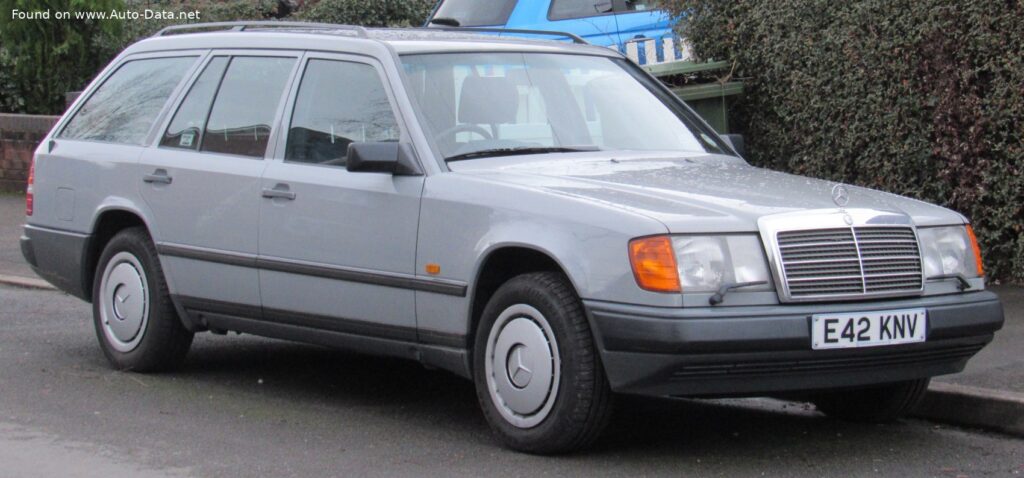
As an international automotive expert, I present a detailed analysis of the Mercedes-Benz S124 200 TD (75 Hp), a vehicle that embodies the brand’s commitment to durability, practicality, and understated luxury during a pivotal era. This particular model, a robust station wagon variant of the iconic W124 chassis, was a staple in European markets, renowned for its bulletproof reliability and utilitarian design. While not officially imported to the United States in this specific configuration, the W124 series profoundly influenced global automotive standards, and the S124 200 TD (75 Hp) represents a significant chapter in its storied history, especially in regions where diesel power and wagon versatility were highly valued.
The Mercedes-Benz S124 200 TD (75 Hp): A European Workhorse
The Mercedes-Benz S124 200 TD (75 Hp) belongs to the S124 generation, the station wagon (estate) iteration of the legendary W124 series. Produced for a brief period from February 1989 to August 1989, this model represents an important, albeit entry-level, offering within Mercedes-Benz’s highly regarded executive car lineup. Positioned as a practical and economical choice, particularly for families and businesses across Europe, the S124 200 TD combined the W124’s renowned build quality and sophisticated engineering with the added utility of a spacious wagon body and the efficiency of a naturally aspirated diesel engine. Its design prioritized longevity, comfort, and cargo capacity, making it a ubiquitous sight on European roads and a testament to Mercedes-Benz’s engineering prowess during the late 1980s.
Engine and Performance
At the heart of the Mercedes-Benz S124 200 TD (75 Hp) is the OM 601 D 20 / 601.912 engine, a 2.0-liter (1997 cubic centimeters or 121.86 cubic inches) naturally aspirated inline-four diesel powerplant. This engine delivered a modest 75 horsepower at 4600 rpm, with a peak torque of 126 Nm (92.93 lb.-ft.) available between 2700 and 3550 rpm. Power was transferred to the rear wheels via a 5-speed manual transmission, emphasizing driver engagement and fuel efficiency. While these figures might seem modest by today’s standards, they were entirely adequate for the car’s intended purpose: reliable, economical transportation rather than outright speed.
The performance metrics reflect this focus on practicality over sportiness. The S124 200 TD accelerated from 0 to 60 mph in a leisurely 20.6 seconds, with a top speed of 93.21 mph (150 km/h). Fuel economy was a strong suit, with an urban consumption rating of 27 US mpg (8.7 l/100 km) and an impressive extra-urban figure of 43.6 US mpg (5.4 l/100 km). This efficiency, combined with a generous 19.02 US gallon (72-liter) fuel tank, provided excellent range, a crucial factor for long-distance European travel. The engine’s robust construction, featuring a compression ratio of 22:1 and a precombustion chamber injection system, contributed to its legendary durability and ability to withstand hundreds of thousands of miles of service.
Design and Features
The Mercedes-Benz S124 200 TD (75 Hp) retained the timeless and elegant design language of the W124 series, characterized by its clean lines, functional aesthetics, and exceptional build quality. The station wagon body, known as “T-Modell” in Germany, offered significant practicality with its five doors and seating for five occupants. Measuring 187.6 inches in length, 68.5 inches in width, and 58.66 inches in height, with a substantial 110.24-inch wheelbase, the S124 provided ample interior space and a cavernous cargo area, making it ideal for families and commercial use.
Beyond its spacious interior, the S124 boasted a range of advanced features for its time, underscoring Mercedes-Benz’s commitment to safety and comfort. Standard safety equipment included ABS (Anti-lock Braking System), a significant innovation in the late 1980s, providing enhanced braking control. The vehicle featured a sophisticated suspension setup, with a wishbone front suspension and an independent multi-link rear suspension, contributing to its renowned ride comfort and stable handling. Hydraulic power steering, utilizing a cone worm with recirculation balls type, ensured effortless maneuverability. Braking was handled by disc brakes on both the front and rear axles. The car rode on 195/65 R15 tires mounted on 6.5J x 15 wheel rims, providing a balance of comfort and road holding.
The interior, while not overtly luxurious in this entry-level trim, was meticulously crafted with high-quality materials, built to last. The ergonomic layout, comfortable seating, and excellent visibility contributed to a refined driving experience, typical of Mercedes-Benz vehicles of this era. The S124’s design was not just about aesthetics; every element was engineered for functionality, durability, and ease of maintenance, contributing to its reputation as an exceptionally well-built machine.
Technical Specifications
The following table details the technical specifications for the Mercedes-Benz S124 200 TD (75 Hp):
| Category | Specification |
|---|---|
| Brand | Mercedes-Benz |
| Model | W124 |
| Generation | S124 |
| Type (Engine) | 200 TD (75 Hp) |
| Start of Production | February, 1989 |
| End of Production | August, 1989 |
| Powertrain Architecture | Internal Combustion engine |
| Body type | Station wagon (estate) |
| Seats | 5 |
| Doors | 5 |
| Performance Specs | |
| Fuel consumption (economy) – urban | 8.7 l/100 km (27 US mpg) |
| Fuel consumption (economy) – extra urban | 5.4 l/100 km (43.6 US mpg) |
| Fuel Type | Diesel |
| Acceleration 0 – 60 mph | 20.6 sec |
| Maximum speed | 150 km/h (93.21 mph) |
| Weight-to-power ratio | 19.1 kg/Hp (52.4 Hp/tonne) |
| Weight-to-torque ratio | 11.3 kg/Nm (88.1 Nm/tonne) |
| Engine Specs | |
| Power | 75 Hp @ 4600 rpm |
| Power per liter | 37.6 Hp/l |
| Torque | 126 Nm @ 2700-3550 rpm (92.93 lb.-ft.) |
| Engine layout | Front, Longitudinal |
| Engine Model/Code | OM 601 D 20 / 601.912 |
| Engine displacement | 1997 cm3 (121.86 cu. in.) |
| Number of cylinders | 4 |
| Engine configuration | Inline |
| Cylinder Bore | 87 mm (3.43 in.) |
| Piston Stroke | 84 mm (3.31 in.) |
| Compression ratio | 22:1 |
| Number of valves per cylinder | 2 |
| Fuel injection system | Precombustion chamber injection |
| Engine aspiration | Naturally aspirated engine |
| Valvetrain | SOHC |
| Engine oil capacity | 6.5 l (6.87 US qt) |
| Engine oil specification | Specification not provided |
| Coolant | 8.5 l (8.98 US qt) |
| Space, Volume and Weights | |
| Kerb Weight | 1430 kg (3152.61 lbs.) |
| Max. weight | 2050 kg (4519.48 lbs.) |
| Max load | 620 kg (1366.87 lbs.) |
| Fuel tank capacity | 72 l (19.02 US gal) |
| Dimensions | |
| Length | 4765 mm (187.6 in.) |
| Width | 1740 mm (68.5 in.) |
| Height | 1490 mm (58.66 in.) |
| Wheelbase | 2800 mm (110.24 in.) |
| Front track | 1497 mm (58.94 in.) |
| Rear (Back) track | 1488 mm (58.58 in.) |
| Drivetrain, Brakes and Suspension Specs | |
| Drivetrain Architecture | The Internal combustion engine (ICE) drives the rear wheels of the vehicle. |
| Drive wheel | Rear wheel drive |
| Number of gears and type of gearbox | 5 gears, manual transmission |
| Front suspension | Wishbone |
| Rear suspension | Independent multi-link suspension |
| Front brakes | Disc |
| Rear brakes | Disc |
| Assisting systems | ABS (Anti-lock braking system) |
| Steering type | Cone worm with recirculation balls |
| Power steering | Hydraulic Steering |
| Tires size | Front wheel tires: 195/65 R15, Rear wheel tires: 195/65 R15 |
| Wheel rims size | Front wheel rims: 6.5J x 15, Rear wheel rims: 6.5J x 15 |
Legacy and Market Impact
The Mercedes-Benz S124, and the W124 series as a whole, holds a revered place in automotive history, often cited as one of the last “over-engineered” Mercedes-Benz models. The 200 TD variant, in particular, solidified its reputation in European markets as an incredibly durable, reliable, and cost-effective vehicle to own and operate. Its brief production run in 1989 highlights its position as an early iteration within the S124’s lifespan, setting the stage for more powerful and refined diesel engines that would follow.
In its primary markets, the S124 200 TD competed against other premium European wagons such as the BMW 5-Series Touring (E34), the Audi 100 Avant, and the Volvo 740/940 Estate. While these rivals offered varying degrees of sportiness or quirky practicality, the Mercedes-Benz stood out for its unparalleled build quality, comfortable ride, and a sense of understated prestige. The OM 601 diesel engine, though not a powerhouse, was celebrated for its extreme longevity and fuel efficiency, making it a favorite among taxi operators, long-distance commuters, and families needing a dependable workhorse.
Today, the Mercedes-Benz S124 200 TD (75 Hp) is increasingly recognized as a modern classic. Its robust mechanicals and timeless design ensure that many examples are still on the road, often with exceptionally high mileage, a testament to their engineering integrity. The enduring appeal of the W124 chassis, coupled with the practical advantages of the S124 wagon, has fostered a strong enthusiast following. For collectors and aficionados seeking a classic Mercedes-Benz that embodies the brand’s golden era of engineering without the complexity of later models, the S124 200 TD remains a highly desirable and historically significant vehicle, representing a benchmark for reliability and utility in the premium segment.
