
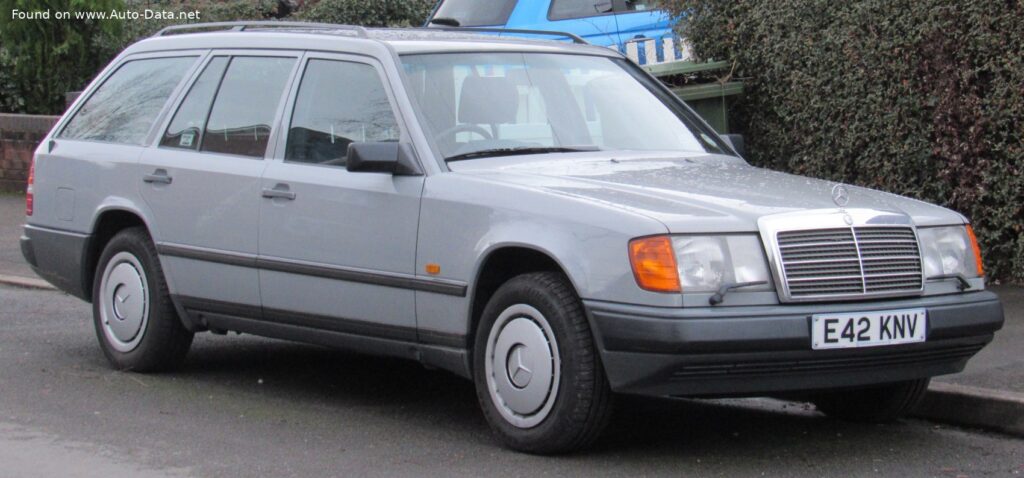
The Mercedes-Benz S124 200 TD (75 Hp) Automatic: A Pillar of European Utility
The Mercedes-Benz W124 series, produced from 1984 to 1995, stands as a testament to German engineering prowess, renowned globally for its exceptional build quality, durability, and timeless design. Within this esteemed lineage, the S124 designation represents the highly practical and versatile station wagon (estate) variant. Our focus here is on a specific, rather unique iteration: the Mercedes-Benz S124 200 TD (75 Hp) Automatic. Manufactured for a brief period between February and August of 1989, this model epitomized the brand’s commitment to robust, efficient, and comfortable motoring, particularly for the European market where diesel engines and wagons held significant sway. While not typically offered in the United States, this particular S124 200 TD played a crucial role as a reliable workhorse, family hauler, and even a popular choice for taxi fleets across the continent, embodying the virtues of longevity and economic operation in a premium package.
Driving the Mercedes-Benz S124 200 TD: Engine and Performance
At the heart of the Mercedes-Benz S124 200 TD lies a naturally aspirated 2.0-liter (1997 cm3 or 121.86 cubic inches) inline four-cylinder diesel engine, designated OM 601 D 20 / 601.912. This powerplant was engineered for endurance and fuel efficiency rather than exhilarating speed. It generated a modest 75 horsepower at 4600 revolutions per minute (rpm) and 92.93 lb-ft of torque, available between 2700 and 3550 rpm. Power was delivered to the rear wheels via a smooth-shifting 4-speed automatic transmission, a common choice for comfort and ease of driving in its era.
Given its output, the performance figures for the 200 TD were decidedly leisurely by modern standards. The vehicle accelerated from 0 to 60 mph in approximately 21.9 seconds, with a top speed of 90.1 mph (145 km/h). These numbers underscore its primary purpose as a comfortable cruiser for long distances and urban commuting, where reliability and low running costs were paramount. The engine’s design, featuring a precombustion chamber injection system and a SOHC valvetrain, contributed to its reputation for mechanical robustness and relatively quiet operation for a diesel of its time.
Fuel economy was a key selling point for the 200 TD. It achieved an urban fuel consumption rate of 27.7 US mpg (8.5 liters/100 km) and an impressive extra-urban (highway) figure of 37.3 US mpg (6.3 liters/100 km). With a generous 19.02 US gallon (72 liter) fuel tank, this allowed for considerable range between fill-ups, a highly desirable trait for both private owners and commercial operators. The vehicle’s weight-to-power ratio of 19.1 kg/Hp (52.4 Hp/tonne) further illustrates its focus on practicality over raw performance, prioritizing longevity and economy in its powertrain architecture.
Design & Features of the Mercedes-Benz S124
The S124 wagon, or “T-Model” as it was known in Germany, shared the same fundamental design principles as its W124 sedan sibling: elegant, understated, and built to last. With a length of 187.6 inches (4765 mm), a width of 68.5 inches (1740 mm), and a height of 58.66 inches (1490 mm), the S124 offered a substantial road presence and an exceptionally spacious interior. The five-door, five-seat configuration provided ample room for passengers and a highly adaptable cargo area, making it an ideal family vehicle or a practical business tool. Its wheelbase of 110.24 inches (2800 mm) contributed significantly to its stable ride and generous cabin
