
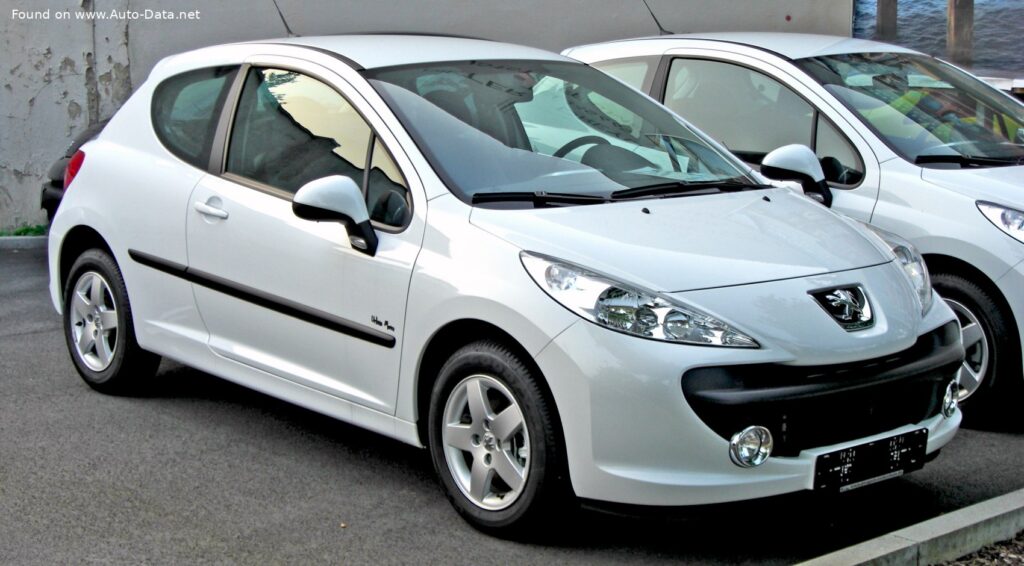
The Peugeot 207 1.6 i 16V (110 Hp): A European Subcompact Standard-Bearer (2006-2009)
The Peugeot 207, specifically the 1.6 i 16V (110 Hp) variant produced between 2006 and 2009, represented a pivotal model in the French automaker’s lineup. Succeeding the immensely popular Peugeot 206, the 207 was designed to elevate the brand’s presence in the fiercely competitive European B-segment (subcompact car market). While never officially imported for sale in the United States, the Peugeot 207 was a ubiquitous sight across Europe and other international markets, prized for its contemporary styling, engaging driving dynamics, and practical hatchback form factor. This particular iteration, powered by a robust 1.6-liter gasoline engine, offered a compelling blend of performance and fuel efficiency, making it a strong contender against its rivals.
Engine and Performance: The Heart of the Peugeot 207
At the core of this particular Peugeot 207 model was the brand’s well-regarded NFU TU5JP4 engine. This naturally aspirated, 1.6-liter (1587 cm3 or 96.84 cu. in.) inline four-cylinder powerplant was designed for a balance of power delivery and everyday usability. Featuring a 16-valve configuration and multi-port manifold injection, the engine produced a respectable 110 horsepower at 5750 rpm. This output translated to a power per liter figure of 69.3 horsepower per liter, indicating a healthy specific output for a non-turbocharged engine of its era.
Torque output stood at 108.42 lb.-ft. (147 Nm), peaking at 4000 rpm, providing ample pulling power for city driving and highway cruising. The engine’s front, transverse layout, combined with a five-speed manual transmission, directed power efficiently to the front wheels. This drivetrain architecture, a common setup for subcompact vehicles, contributed to both the car’s dynamic handling and its practical packaging.
In terms of outright performance, the Peugeot 207 1.6 i 16V (110 Hp) was capable of accelerating from 0 to 60 mph in a brisk 10.1 seconds, with a top speed reaching 120.55 mph. These figures positioned it well within its class, offering enough zest for enthusiastic driving while remaining economical. Fuel efficiency was a key consideration in the European market, and this model delivered a combined fuel consumption rating of 33.6 US mpg (7 l/100 km). Urban driving saw figures around 25.3 US mpg, while extra-urban cruising could achieve an impressive 42 US mpg, making it an economical choice for various driving conditions.
Design and Features: European Flair Meets Practicality
The Peugeot 207 debuted with a design language that was a clear evolution from its predecessor, the 206. Its hatchback body style was available in both 3-door and 5-door configurations, offering versatility for different customer needs. With a length of 158.66 inches, a width of 67.72 inches, and a height of 57.95 inches, the 207 possessed a substantial road presence for a B-segment vehicle, appearing more robust and planted than many of its rivals. The 100-inch wheelbase contributed to a stable ride and a surprisingly spacious cabin for its class.
Inside, the Peugeot 207 was designed to comfortably accommodate five occupants. The trunk (boot) offered a minimum of 9.53 cubic feet of cargo space, which could expand to a generous 32.6 cubic feet with the rear seats folded down, showcasing its practical utility for hauling groceries, luggage, or equipment. The vehicle’s aerodynamic profile, indicated by a drag coefficient (Cd) of 0.30, was commendable for a car of its size and class, contributing to both fuel efficiency and reduced wind noise at higher speeds.
Underneath, the 207 featured an independent McPherson strut front suspension with coil springs and an anti-roll bar, providing precise steering and good road holding. The rear utilized a semi-independent setup with coil springs and an elastic beam, a cost-effective and space-efficient solution common in subcompacts. Braking performance was handled by ventilated discs at the front and drum brakes at the rear, supplemented by an Anti-lock Braking System (ABS) for enhanced safety. The rack-and-pinion steering system, coupled with 185/65 R15 tires, offered a balanced feel, making the 207 enjoyable to maneuver in urban environments and stable on the open road.
Technical Specifications: Peugeot 207 1.6 i 16V (110 Hp)
The following table details the comprehensive technical specifications for the Peugeot 207 1.6 i 16V (110 Hp) model produced between 2006 and 2009:
| Category | Specification |
|---|---|
| Brand | Peugeot |
| Model | 207 |
| Generation | 207 |
| Type (Engine) | 1.6 i 16V (110 Hp) |
| Start of Production | 2006 year |
| End of Production | 2009 year |
| Powertrain Architecture | Internal Combustion engine |
| Body Type | Hatchback |
| Seats | 5 |
| Doors | 3-5 |
| Fuel Consumption (Urban) | 25.3 US mpg (9.3 l/100 km) |
| Fuel Consumption (Extra Urban) | 42 US mpg (5.6 l/100 km) |
| Fuel Consumption (Combined) | 33.6 US mpg (7 l/100 km) |
| Fuel Type | Petrol (Gasoline) |
| Acceleration 0 – 60 mph | 10.1 sec |
| Maximum Speed | 120.55 mph (194 km/h) |
| Weight-to-Power Ratio | 11 kg/Hp, 90.7 Hp/tonne |
| Weight-to-Torque Ratio | 8.3 kg/Nm, 121.2 Nm/tonne |
| Power | 110 Hp @ 5750 rpm |
| Power per Liter | 69.3 Hp/l |
| Torque | 108.42 lb.-ft. (147 Nm) @ 4000 rpm |
| Engine Layout | Front, Transverse |
| Engine Model/Code | NFU TU5JP4 |
| Engine Displacement | 1.6 l (1587 cm3 / 96.84 cu. in.) |
| Number of Cylinders | 4 |
| Engine Configuration | Inline |
| Cylinder Bore | 3.07 in. (78 mm) |
| Piston Stroke | 3.27 in. (83 mm) |
| Compression Ratio | 11:1 |
| Number of Valves per Cylinder | 4 |
| Fuel Injection System | Multi-port manifold injection |
| Engine Aspiration | Naturally aspirated engine |
| Engine Oil Capacity | 3.43 US qt (3.25 l) |
| Coolant Capacity | 7.29 US qt (6.9 l) |
| Kerb Weight | 2674.21 lbs (1213 kg) |
| Max. Weight | 3681.72 lbs (1670 kg) |
| Max Load | 1007.51 lbs (457 kg) |
| Trunk (Boot) Space – Minimum | 9.53 cu. ft. (270 l) |
| Trunk (Boot) Space – Maximum | 32.6 cu. ft. (923 l) |
| Fuel Tank Capacity | 13.21 US gal (50 l) |
| Length | 158.66 in. (4030 mm) |
| Width | 67.72 in. (1720 mm) |
| Width with Mirrors Folded | 71.57 in. (1818 mm) |
| Width Including Mirrors | 77.64 in. (1972 mm) |
| Height | 57.95 in. (1472 mm) |
| Wheelbase | 100 in. (2540 mm) |
| Front Track | 58.07 in. (1475 mm) |
| Rear (Back) Track | 57.72 in. (1466 mm) |
| Drag Coefficient (Cd) | 0.30 |
| Minimum Turning Circle | 34.12 ft. (10.4 m) |
| Drivetrain Architecture | The Internal combustion engine (ICE) drives the front wheels of the vehicle. |
| Drive Wheel | Front wheel drive |
| Number of Gears and Type of Gearbox | 5 gears, manual transmission |
| Front Suspension | Independent, type McPherson with coil spring and anti-roll bar |
| Rear Suspension | Semi-independent, coil spring, Elastic beam |
| Front Brakes | Ventilated discs |
| Rear Brakes | Drum |
| Assisting Systems | ABS (Anti-lock braking system) |
| Steering Type | Steering rack and pinion |
| Tires Size | 185/65 R15 |
Legacy and Market Impact: The Peugeot 207 in its Element
The Peugeot 207, particularly the 1.6 i 16V (110 Hp) variant, carved out a significant niche in the European automotive landscape. As the successor to the monumentally successful 206, it faced immense pressure to perform, and it largely delivered. The 207 built upon Peugeot’s reputation for producing small cars with a distinctive blend of style, comfort, and dynamic handling. Its robust build quality and refined interior for its class helped it stand out.
In its primary markets, the Peugeot 207 competed head-to-head with formidable rivals such as the Renault Clio, Ford Fiesta, Volkswagen Polo, Opel Corsa, and Fiat Punto. Against these strong contenders, the 207 often distinguished itself with its more assertive styling, particularly its large, distinctive headlights and wide grille, which gave it a more premium feel than some of its peers. Its ride comfort was frequently praised, soaking up road imperfections effectively, while still offering the engaging handling characteristics that Peugeot cars were known for.
The 1.6-liter engine variant was a popular choice, offering a sweet spot between the smaller, less powerful engines and the sportier, more expensive GTi models. It provided sufficient performance for both daily commutes and longer journeys, while maintaining reasonable running costs. The car’s overall reliability and strong safety ratings (for its time) further cemented its appeal to a broad demographic of buyers, from young professionals to small families.
While the Peugeot 207 was never a direct participant in the American market, its influence was felt globally through its design trends and technological advancements in the subcompact segment. It represented a strong period for Peugeot, demonstrating their ability to create desirable, practical, and fun-to-drive small cars that resonated with millions of customers outside of North America. The 207’s legacy is that of a successful and well-rounded B-segment vehicle that continued Peugeot’s tradition of excellence in compact car manufacturing, paving the way for future generations of their popular “2-series” models.
