
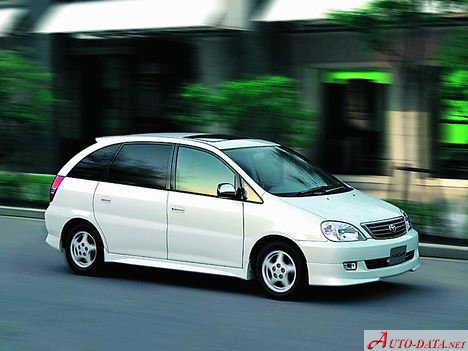
Toyota Nadia (SXN10) 2.0 i 16V D-4 (152 Hp): A Detailed Overview
The Toyota Nadia (SXN10) represents a unique and innovative approach to the compact minivan segment, primarily developed for the Japanese domestic market (JDM). Launched in 1998, the Nadia aimed to blend the practicality of a minivan with the driving dynamics and styling closer to a conventional sedan, distinguishing itself from more boxy competitors. The specific variant under review, the 2.0 i 16V D-4 (152 Hp), produced between 2001 and 2003, showcases Toyota’s commitment to advanced engine technology and versatile vehicle packaging during that era. This iteration of the Nadia, part of its first and only generation (SXN10), offered a compelling blend of performance, fuel efficiency, and interior flexibility, tailored to the demands of Japanese families seeking a capable and compact daily driver. While never officially sold in the United States, the Nadia exemplifies a particular design philosophy prevalent in the Japanese automotive landscape, focusing on maximizing interior space within compact exterior dimensions, a concept often referred to as “packaging efficiency.”
Engine and Performance: The Advanced 1AZ-FSE D-4 Powertrain
At the heart of the 2001-2003 Toyota Nadia (SXN10) 2.0 i 16V D-4 lies the sophisticated 1AZ-FSE engine, a 2.0-liter (1998 cm³ or 121.93 cu. in.) inline four-cylinder unit. This powerplant was notable for its use of Toyota’s D-4 direct injection system, an advanced technology for its time that optimized fuel delivery directly into the combustion chamber. This system allowed for precise control over the air-fuel mixture, leading to improved fuel economy and reduced emissions, while simultaneously enhancing power output. The naturally aspirated engine produced a healthy 152 horsepower at 6000 rpm, which was quite competitive for a compact minivan, providing ample power for both city driving and highway cruising.
Torque figures further underscore the engine’s capability, delivering 200 Nm (approximately 147.51 lb.-ft.) at 4000 rpm. This broad torque band ensured responsive acceleration and confident overtaking, even when the vehicle was fully loaded. The engine’s layout was front-transverse, driving the front wheels through a 4-speed automatic transmission. This setup, combined with a relatively low curb weight of 2910.1 lbs. (1320 kg), resulted in a respectable weight-to-power ratio of 8.7 kg/Hp (115.2 Hp/tonne) and a weight-to-torque ratio of 6.6 kg/Nm (151.5 Nm/tonne). The DOHC (Double Overhead Camshaft) valvetrain with four valves per cylinder further contributed to the engine’s efficiency and smooth operation. The 1AZ-FSE engine, with its 9.8:1 compression ratio and 86 mm bore and stroke, demonstrated Toyota’s engineering prowess in balancing performance with real-world usability and efficiency, making the Nadia a capable and economical family vehicle.
Design and Features: Practicality Meets Compact Form
The Toyota Nadia (SXN10) adopted a distinctive minivan body type, characterized by its five doors and seating for five occupants. Its design aimed to be more dynamic and less utilitarian than some of its contemporaries, featuring a somewhat sleek profile that attempted to blur the lines between a traditional station wagon and a full-sized minivan. With a length of 174.61 inches (4435 mm), a width of 66.73 inches (1695 mm), and a height of 63.98 inches (1625 mm), the Nadia was perfectly sized for navigating Japan’s often narrow urban streets while offering substantial interior volume. The generous 107.68-inch (2735 mm) wheelbase contributed significantly to passenger comfort and interior space, providing ample legroom for all five occupants.
Inside, the Nadia prioritized versatility and user-friendliness. The 810 liters (28.6 cu. ft.) of minimum trunk space was impressive for its class, allowing for considerable cargo capacity for groceries, luggage, or sporting equipment. The interior layout was designed with practicality in mind, offering various storage compartments and flexible seating configurations. From a safety standpoint, the Nadia was equipped with an Anti-lock Braking System (ABS), a crucial feature for enhancing control during emergency braking. The vehicle’s steering system comprised a hydraulic power steering rack and pinion, providing a comfortable and predictable driving experience. Suspension was handled by a wishbone setup at the front and coil springs at the rear, aiming for a balance between ride comfort and handling stability. Stopping power was provided by ventilated discs at the front and drum brakes at the rear, a common and effective combination for vehicles of this segment. The 195/60 R15 H tires further complemented its balanced ride and handling characteristics.
Technical Specifications: Toyota Nadia (SXN10) 2.0 i 16V D-4 (152 Hp)
| Category | Specification | Metric (US/UK) |
|---|---|---|
| General Information | ||
| Brand | Toyota | |
| Model | Nadia | |
| Generation | Nadia (SXN10) | |
| Type (Engine) | 2.0 i 16V D-4 (152 Hp) | |
| Start of production | 2001 year | |
| End of production | 2003 year | |
| Powertrain Architecture | Internal Combustion engine | |
| Body type | Minivan | |
| Seats | 5 | |
| Doors | 5 | |
| Performance Specs | ||
| Fuel Type | Petrol (Gasoline) | |
| Weight-to-power ratio | 8.7 kg/Hp | 115.2 Hp/tonne |
| Weight-to-torque ratio | 6.6 kg/Nm | 151.5 Nm/tonne |
| Engine Specs | ||
| Power | 152 Hp @ 6000 rpm | |
| Power per liter | 76.1 Hp/l | |
| Torque | 200 Nm @ 4000 rpm | 147.51 lb.-ft. @ 4000 rpm |
| Engine layout | Front, Transverse | |
| Engine Model/Code | 1AZ-FSE | |
| Engine displacement | 1998 cm³ | 2.0 l (121.93 cu. in.) |
| Number of cylinders | 4 | |
| Engine configuration | Inline | |
| Cylinder Bore | 86 mm | 3.39 in. |
| Piston Stroke | 86 mm | 3.39 in. |
| Compression ratio | 9.8:1 | |
| Number of valves per cylinder | 4 | |
| Fuel injection system | Direct injection | |
| Engine aspiration | Naturally aspirated engine | |
| Valvetrain | DOHC | |
| Engine oil capacity | 4.2 l | 4.44 US qt |
| Coolant | 5.9 l | 6.23 US qt |
| Space, Volume and Weights | ||
| Curb Weight | 1320 kg | 2910.1 lbs. |
| Max. weight | 1595 kg | 3516.37 lbs. |
| Max load | 275 kg | 606.27 lbs. |
| Trunk (boot) space – minimum | 810 l | 28.6 cu. ft. |
| Fuel tank capacity | 60 l | 15.85 US gal |
| Dimensions | ||
| Length | 4435 mm | 174.61 in. |
| Width | 1695 mm | 66.73 in. |
| Height | 1625 mm | 63.98 in. |
| Wheelbase | 2735 mm | 107.68 in. |
| Front track | 1470 mm | 57.87 in. |
| Rear (Back) track | 1450 mm | 57.09 in. |
| Drivetrain, Brakes and Suspension Specs | ||
| Drivetrain Architecture | The Internal combustion engine (ICE) drives the front wheels of the vehicle. | |
| Drive wheel | Front wheel drive | |
| Number of gears and type of gearbox | 4 gears, automatic transmission | |
| Front suspension | Wishbone | |
| Rear suspension | Coil spring | |
| Front brakes | Ventilated discs | |
| Rear brakes | Drum | |
| Assisting systems | ABS (Anti-lock braking system) | |
| Steering type | Steering rack and pinion | |
| Power steering | Hydraulic Steering | |
| Tires size | 195/60 R15 H | |
Legacy and Market Impact of the Toyota Nadia (SXN10)
The Toyota Nadia (SXN10) carved out a distinctive niche in the highly competitive Japanese domestic market during its production run from 1998 to 2003. Positioned as a “crossover” between a traditional minivan and a station wagon, it appealed to families who desired the practicality of extra space without the often-bulky appearance and driving dynamics of larger minivans. Its compact dimensions made it ideal for Japan’s urban environments, where parking and maneuverability are paramount, while its spacious interior and flexible seating offered genuine utility.
In terms of market impact, the Nadia faced stiff competition from other innovative compact family vehicles of the era. Key rivals included the Honda Stream, which similarly blended car-like driving with MPV utility, the Nissan Tino, and the Mazda Premacy (known as the Mazda5 in some markets later on). What set the Nadia apart, particularly the 2.0 i 16V D-4 variant, was its pioneering use of direct injection technology in a mainstream family vehicle. This 1AZ-FSE engine not only delivered a commendable balance of power and fuel efficiency but also showcased Toyota’s engineering leadership in developing clean and efficient powertrains. This technological edge contributed to the Nadia’s reputation for reliability and economical operation, hallmarks of the Toyota brand.
While the Nadia did not achieve the same widespread recognition as some of Toyota’s global models, its role in the Japanese market was significant. It represented an evolution in family transportation, moving away from purely utilitarian designs towards vehicles that offered more dynamic styling and advanced technology. Its legacy lies in demonstrating that practicality and efficiency could be harmoniously integrated with a more engaging driving experience and modern engine advancements, influencing subsequent compact MPV designs. Today, the Toyota Nadia is remembered as a testament to Toyota’s diverse product portfolio and its continuous innovation, even for models exclusively tailored to specific regional markets. Its robust engineering and practical design have ensured that many examples continue to serve their owners reliably, a testament to its enduring quality.

