Introduction: The Toyota Corolla Wagon VII (E100) 2.0 D (72 Hp)
The Toyota Corolla, a name synonymous with reliability and practicality across the globe, entered its seventh generation, the E100, in 1991. This iteration continued to build on the model’s reputation for dependable, economical transportation. While the sedan and hatchback variants were ubiquitous worldwide, the Toyota Corolla Wagon VII (E100) 2.0 D (72 Hp) represented a particularly pragmatic choice, especially in European and Asian markets where diesel engines and station wagons held significant appeal for their fuel efficiency and cargo-carrying capabilities. Produced from 1992 to 1997, this specific model served as a workhorse for families and businesses seeking a no-frills, durable vehicle with low running costs.
The E100 generation marked a period of evolution for the Corolla, moving towards a more rounded, aerodynamic aesthetic compared to its boxier predecessors. The wagon variant, in particular, emphasized utility, offering a versatile interior without sacrificing the compact footprint and renowned durability that defined the Corolla brand. The 2.0 D (72 Hp) powertrain, while modest in output by modern standards, was a testament to Toyota’s commitment to efficiency and longevity, perfectly aligning with the needs of its target demographic outside of the primary North American market, where diesel passenger cars were less common at the time.
Engine & Performance: The Robust 2.0 D Powerplant of the Toyota Corolla Wagon VII (E100)
At the heart of the Toyota Corolla Wagon VII (E100) 2.0 D (72 Hp) lay Toyota’s venerable 2C diesel engine. This naturally aspirated, inline-four cylinder unit, with a displacement of 1975 cubic centimeters (120.52 cu. in.), was engineered for endurance and fuel economy rather than outright speed. It delivered a modest 72 horsepower at 4600 revolutions per minute, a figure that, while not exhilarating, was perfectly adequate for daily driving and highway cruising when combined with the vehicle’s relatively light curb weight of 2502.25 pounds.
The engine’s torque output stood at 131 Newton-meters (96.62 lb.-ft.) at a low 2600 rpm. This characteristic low-end torque was crucial for a practical wagon, providing sufficient pulling power for hauling cargo or navigating city traffic without constant downshifting. The power was channeled through a five-speed manual transmission, offering drivers direct control and further optimizing fuel consumption. The powertrain architecture featured a front, transverse engine layout, driving the front wheels, a common and efficient setup for compact vehicles of its era.
Performance figures for the Toyota Corolla Wagon VII (E100) 2.0 D (72 Hp) reflected its utilitarian nature. Acceleration from 0 to 60 miles per hour was achieved in an estimated 13.4 seconds, with 0 to 62 mph (100 km/h) taking 14.1 seconds. The maximum speed topped out at 102.53 mph (165 km/h). These numbers clearly position the vehicle not as a performance contender but as a reliable, economical mode of transport. Fuel efficiency was a strong suit, with a combined economy rating of 40.6 US mpg (5.8 liters per 100 km), making it a highly attractive option for cost-conscious consumers in markets where diesel fuel was prevalent and often cheaper.
The 2C engine featured a compression ratio of 23:1 and utilized a precombustion chamber injection system, a common design for indirect injection diesels of the time, known for its smoother operation and quieter running compared to direct injection systems of the era. With a single overhead camshaft (OHC) valvetrain and four valves per cylinder, the engine was designed for straightforward maintenance and long-term durability, hallmarks of Toyota engineering.
Design & Features: Practicality and Enduring Form
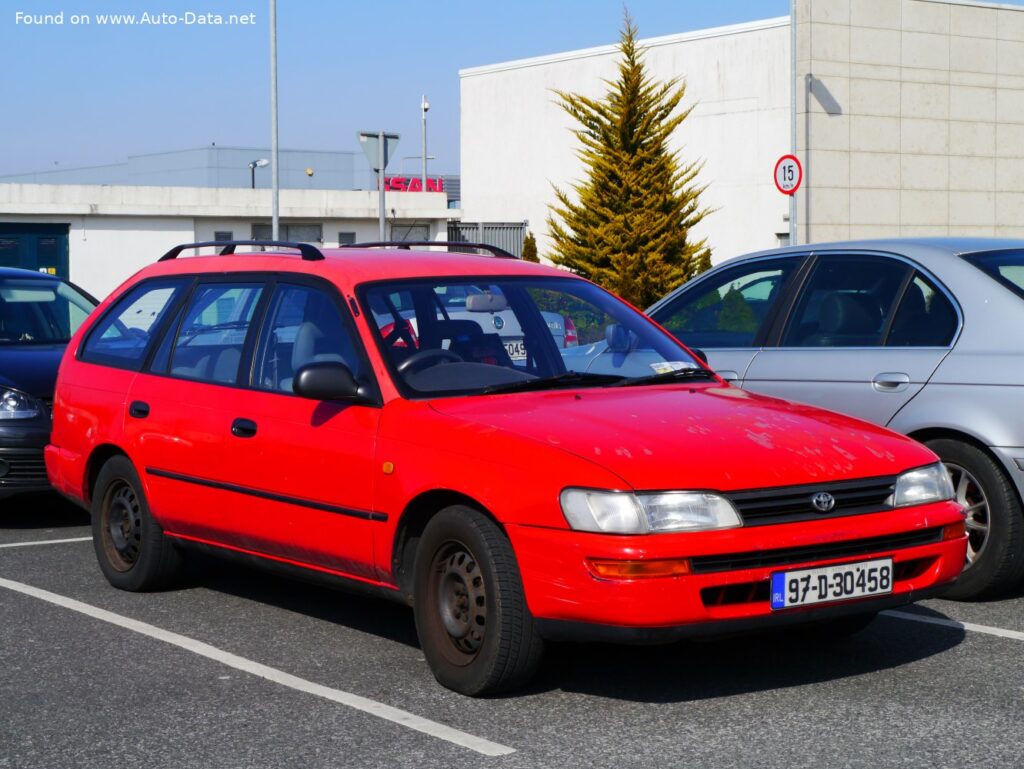
The Toyota Corolla Wagon VII (E100) presented a design that prioritized functionality and understated aesthetics. As a five-door station wagon (often referred to as an estate car in European markets), its primary appeal lay in its versatile cargo capacity and comfortable seating for five occupants. The E100 generation, while more rounded than its predecessors, maintained a sensible and unpretentious exterior, reflecting its role as a dependable family or fleet vehicle.
Measuring 167.72 inches in length, 66.34 inches in width, and 57.48 inches in height, the Corolla Wagon offered a compact footprint that was easy to maneuver in urban environments, yet provided a surprisingly spacious interior. The wheelbase of 97.05 inches contributed to a stable ride. The design was clean and functional, with large windows providing excellent visibility, a characteristic valued in family cars.
Inside, the Corolla Wagon focused on durability and user-friendliness. While not luxurious, the cabin was ergonomically designed, with straightforward controls and robust materials built to withstand years of use. The true highlight was its cargo area: a minimum trunk space of 13.91 cubic feet (394 liters) could expand to a generous 25.18 cubic feet (713 liters) with the rear seats folded down, making it highly capable for carrying luggage, groceries, or sports equipment. This flexibility was a key selling point for the wagon body style.
In terms of features and safety for its time, the Corolla Wagon VII (E100) offered a practical set of amenities. Hydraulic power steering was standard, making parking and low-speed maneuvers effortless. While basic by today’s standards, the inclusion of an Anti-lock Braking System (ABS) as an assisting system was a significant safety feature for the early 1990s, enhancing control during emergency braking. The front suspension utilized a spring strut design, while the rear also employed spring struts, providing a comfortable and predictable ride characteristic of the Corolla. Braking was handled by ventilated discs at the front and drum brakes at the rear, a common and effective setup for vehicles in its class.
Technical Specifications: Toyota Corolla Wagon VII (E100) 2.0 D (72 Hp)
| Category | Specification | Value |
|---|---|---|
| General Information | ||
| Brand | Toyota | |
| Model | Corolla | |
| Generation | Corolla Wagon VII (E100) | |
| Type (Engine) | 2.0 D (72 Hp) | |
| Start of Production | 1992 year | |
| End of Production | 1997 year | |
| Powertrain Architecture | Internal Combustion engine | |
| Body type | Station wagon (estate) | |
| Seats | 5 | |
| Doors | 5 | |
| Performance Specs | ||
| Fuel consumption (combined) | 5.8 l/100 km | 40.6 US mpg |
| Fuel Type | Diesel | |
| Acceleration 0 – 60 mph | 13.4 sec | |
| Acceleration 0 – 62 mph (0 – 100 km/h) | 14.1 sec | |
| Maximum speed | 165 km/h | 102.53 mph |
| Weight-to-power ratio | 15.8 kg/Hp | 63.4 Hp/tonne |
| Weight-to-torque ratio | 8.7 kg/Nm | 115.4 Nm/tonne |
| Engine Specs | ||
| Power | 72 Hp | @ 4600 rpm. |
| Power per liter | 36.5 Hp/l | |
| Torque | 131 Nm | 96.62 lb.-ft. @ 2600 rpm. |
| Engine layout | Front, Transverse | |
| Engine Model/Code | 2C | |
| Engine displacement | 1975 cm3 | 120.52 cu. in. |
| Number of cylinders | 4 | |
| Engine configuration | Inline | |
| Cylinder Bore | 86 mm | 3.39 in. |
| Piston Stroke | 85 mm | 3.35 in. |
| Compression ratio | 23:1 | |
| Number of valves per cylinder | 4 | |
| Fuel injection system | Precombustion chamber injection | |
| Engine aspiration | Naturally aspirated engine | |
| Valvetrain | OHC | |
| Engine oil capacity | 5.3 l | 5.6 US qt |
| Coolant capacity | 7.3 l | 7.71 US qt |
| Space, Volume and Weights | ||
| Kerb Weight | 1135 kg | 2502.25 lbs. |
| Max. weight | 1630 kg | 3593.53 lbs. |
| Max load | 495 kg | 1091.29 lbs. |
| Trunk (boot) space – minimum | 394 l | 13.91 cu. ft. |
| Trunk (boot) space – maximum | 713 l | 25.18 cu. ft. |
| Fuel tank capacity | 50 l | 13.21 US gal |
| Dimensions | ||
| Length | 4260 mm | 167.72 in. |
| Width | 1685 mm | 66.34 in. |
| Height | 1460 mm | 57.48 in. |
| Wheelbase | 2465 mm | 97.05 in. |
| Front track | 1460 mm | 57.48 in. |
| Rear (Back) track | 1450 mm | 57.09 in. |
| Drivetrain, Brakes and Suspension Specs | ||
| Drivetrain Architecture | The Internal combustion engine (ICE) drives the front wheels of the vehicle. | |
| Drive wheel | Front wheel drive | |
| Number of gears and type of gearbox | 5 gears, manual transmission | |
| Front suspension | Spring Strut | |
| Rear suspension | Spring Strut | |
| Front brakes | Ventilated discs | |
| Rear brakes | Drum | |
| Assisting systems | ABS (Anti-lock braking system) | |
| Steering type | Steering rack and pinion | |
| Power steering | Hydraulic Steering | |
| Tires size | 185/65 R14 T | |
Legacy & Market Impact: The Enduring Appeal of the Toyota Corolla Wagon VII (E100)
The Toyota Corolla Wagon VII (E100) 2.0 D (72 Hp) carved out a significant niche in its primary markets, particularly in Europe and parts of Asia, where its combination of diesel economy, Toyota reliability, and wagon practicality was highly valued. While the Corolla as a whole was a global bestseller, this specific diesel wagon variant was less common in North America, where gasoline engines and larger SUVs or minivans dominated the family vehicle segment.
In its target markets, the E100 Corolla Wagon faced stiff competition from European rivals known for their diesel powerplants and wagon offerings. Key competitors included the Volkswagen Golf Variant (Estate), Opel Astra Caravan (Vauxhall Astra Estate in the UK), and the Ford Escort Estate. What set the Corolla apart was its unparalleled reputation for reliability and low running costs. Toyota’s engineering philosophy of “Kaizen” (continuous improvement) and rigorous quality control meant that these vehicles were built to last, often outliving many of their contemporaries.
The 2C diesel engine, while not powerful, was incredibly robust and fuel-efficient, making the Corolla Wagon an economical choice for long-distance commuters, taxi services, and families who prioritized frugality over performance. Its ability to achieve over 40 US mpg was a significant advantage in an era of fluctuating fuel prices. The manual transmission further enhanced this efficiency and offered a direct, engaging driving experience that many drivers appreciated.
Today, the Toyota Corolla Wagon VII (E100) 2.0 D (72 Hp) is remembered as a testament to Toyota’s commitment to practical, durable, and economical transportation. Many examples of this generation, particularly the diesel variants, are still in active service around the world, a testament to their inherent quality and longevity. Its legacy is one of a dependable workhorse, a car that quietly and efficiently fulfilled its purpose without fanfare. It solidified the Corolla’s reputation as the “car for the world,” demonstrating how a well-engineered, no-nonsense vehicle could achieve widespread success by meeting the fundamental needs of drivers globally, albeit with regional adaptations like the diesel wagon to suit specific market demands.