The Opel Rekord E Caravan 2.1 D (60 Hp): A European Workhorse of the Late 1970s
The Opel Rekord E Caravan 2.1 D (60 Hp) represents a pivotal offering from German automaker Opel during a transformative period for the automotive industry. Launched in 1977 as part of the Rekord E generation, this particular variant, with its 2.1-liter diesel engine, was a testament to the growing demand for fuel efficiency and practicality in the European mid-size segment. While Opel, a subsidiary of General Motors at the time, was a familiar name across the Atlantic, the Rekord E Caravan was primarily designed for and sold within the European market, where it served as a reliable and economical family station wagon, or “estate” as it’s known across the pond.
The Rekord E series, produced from 1977 to 1986, marked a significant evolution for Opel’s long-running Rekord lineage, which had been a cornerstone of their model range since the 1950s. The Caravan body style, specifically, highlighted its utility-focused design, offering substantial cargo capacity alongside comfortable seating for five. The introduction of the 2.1 D engine in 1977, though short-lived in production until 1978, underscored Opel’s response to the energy crises of the 1970s, providing a robust and economical alternative to gasoline powertrains for families and businesses alike.
Engine and Performance of the Opel Rekord E Caravan
At the heart of the Opel Rekord E Caravan 2.1 D was a naturally aspirated, inline four-cylinder diesel engine, designated with the model code “21D.” With an engine displacement of 2068 cubic centimeters (approximately 2.1 liters or 126.2 cubic inches), this powerplant was engineered for durability and efficiency rather than outright speed. It produced a modest 60 horsepower at 4400 rpm, reflecting the typical power output for a diesel engine of its era and size. The power per liter stood at 29 hp/l, a respectable figure for a non-turbocharged diesel from the late 1970s.
More crucial for a vehicle of its intended purpose was its torque output. The 2.1 D engine delivered 118 Newton-meters (87.03 lb-ft) of torque at a relatively low 2500 rpm. This low-end torque was instrumental in providing adequate pulling power for a fully loaded station wagon, whether traversing city streets or cruising on the autobahn. The engine utilized a precombustion chamber injection system, a common technology for early indirect injection diesels, known for its smoother operation compared to direct injection systems of the time, albeit at a slight efficiency trade-off. The valvetrain was a Single Overhead Camshaft (SOHC) design with two valves per cylinder, a straightforward and reliable configuration.
Power was delivered to the rear wheels via a robust 4-speed manual transmission, a standard setup for family cars of this period. While a 4-speed gearbox might seem limited by modern standards, it was perfectly adequate for the Rekord’s performance envelope, emphasizing fuel economy over rapid acceleration. The vehicle’s top speed was approximately 135 km/h (83.89 mph), which, while not exhilarating, was sufficient for typical European highway speeds. Fuel economy was a key selling point, with a combined consumption rating of 8.1 liters per 100 kilometers, translating to an impressive 29 US miles per gallon. This efficiency was a significant factor for buyers navigating the high fuel prices of the late 1970s, making the diesel Rekord a financially sensible choice.
Design and Features
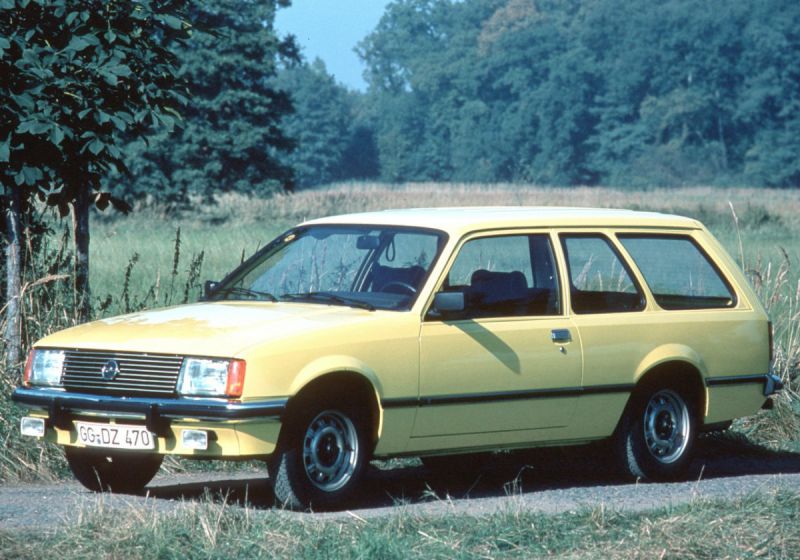
The Opel Rekord E Caravan embodied the functional and somewhat conservative design philosophy prevalent in European family cars of its time. Its body type was a classic station wagon (or estate), designed to maximize practicality and cargo volume. The Rekord E Caravan was offered with either 3 or 5 doors, providing flexibility for customers, with the 3-door variant often favored for commercial use or by those prioritizing maximum cargo access with fewer passenger doors. It comfortably seated five occupants, making it an ideal family vehicle.
Dimensionally, the Rekord E Caravan was a substantial vehicle for its segment, measuring 181.89 inches in length, 67.95 inches in width, and 57.87 inches in height. Its wheelbase of 105.04 inches contributed to a stable ride and generous interior space. The design featured clean lines and a relatively upright stance, typical of the era, which also contributed to its impressive cargo capacity. The minimum trunk space was a cavernous 881 liters (31.11 cubic feet), allowing families to carry luggage, groceries, or even bulky items with ease. This cargo versatility was a primary reason for the Rekord Caravan’s popularity.
The vehicle’s kerb weight of 2799.87 pounds (1270 kg) highlighted its solid construction, contributing to its reputation for durability. With a maximum permissible weight of 4166.74 pounds (1890 kg), it could carry a significant payload of 1366.87 pounds (620 kg). Furthermore, the Rekord E Caravan was capable of towing a braked trailer up to 2755.78 pounds (1250 kg) and an unbraked trailer up to 1444.03 pounds (655 kg), further emphasizing its utility. The large 18.49 US gallon (70-liter) fuel tank provided a substantial cruising range, a practical benefit for long-distance European travel.
In terms of handling, the Rekord E Caravan featured a minimum turning circle of 36.75 feet, making it reasonably maneuverable for its size. The drivetrain architecture, with its internal combustion engine driving the rear wheels, was a traditional and robust setup, offering predictable handling characteristics. Front brakes were ventilated discs, providing effective stopping power, while the rear utilized drum brakes, a common and cost-effective solution for family vehicles of the period. The drag coefficient (Cd) of 0.48 was typical for a station wagon of the late 1970s, reflecting the aerodynamic understanding and design priorities of the era.
Technical Specifications for the Opel Rekord E Caravan 2.1 D (60 Hp)
| Category | Specification |
|---|---|
| Brand | Opel |
| Model | Rekord |
| Generation | Rekord E Caravan |
| Type (Engine) | 2.1 D (60 Hp) |
| Production Start | 1977 |
| Production End | 1978 |
| Powertrain Architecture | Internal Combustion Engine |
| Body Type | Station wagon (estate) |
| Seats | 5 |
| Doors | 3-5 |
| Fuel Type | Diesel |
| Combined Fuel Economy | 29 US mpg (8.1 l/100 km) |
| Maximum Speed | 83.89 mph (135 km/h) |
| Power | 60 Hp @ 4400 rpm |
| Power per Liter | 29 Hp/l |
| Torque | 87.03 lb-ft (118 Nm) @ 2500 rpm |
| Engine Model/Code | 21D |
| Engine Displacement | 2.1 Liters (2068 cm3 / 126.2 cu. in.) |
| Number of Cylinders | 4 |
| Engine Configuration | Inline |
| Cylinder Bore | 3.46 in. (88 mm) |
| Piston Stroke | 3.35 in. (85 mm) |
| Compression Ratio | 22:1 |
| Valves per Cylinder | 2 |
| Fuel Injection System | Precombustion chamber injection |
| Engine Aspiration | Naturally aspirated |
| Valvetrain | SOHC |
| Kerb Weight | 2799.87 lbs (1270 kg) |
| Max. Weight | 4166.74 lbs (1890 kg) |
| Max Load | 1366.87 lbs (620 kg) |
| Trunk (Boot) Space – minimum | 31.11 cu. ft. (881 l) |
| Fuel Tank Capacity | 18.49 US gal (70 l) |
| Permitted Trailer Load (with brakes) | 2755.78 lbs (1250 kg) |
| Permitted Trailer Load (without brakes) | 1444.03 lbs (655 kg) |
| Length | 181.89 in. (4620 mm) |
| Width | 67.95 in. (1726 mm) |
| Height | 57.87 in. (1470 mm) |
| Wheelbase | 105.04 in. (2668 mm) |
| Front Track | 56.5 in. (1435 mm) |
| Rear Track | 55.59 in. (1412 mm) |
| Drag Coefficient (Cd) | 0.48 |
| Minimum Turning Circle | 36.75 ft (11.2 m) |
| Drive Wheel | Rear-wheel drive |
| Number of Gears & Type | 4 gears, manual transmission |
| Front Brakes | Ventilated discs |
| Rear Brakes | Drum |
Legacy and Market Impact
The Opel Rekord E Caravan, particularly its diesel variants like the 2.1 D, carved out a significant niche in the European automotive landscape. Its reputation was built on a foundation of reliability, practicality, and cost-effectiveness. In an era marked by fluctuating fuel prices and a growing awareness of running costs, the diesel Rekord offered a compelling proposition for families and fleet operators alike. It was often seen as a no-nonsense, dependable workhorse, capable of enduring the rigors of daily use, from long highway commutes to hauling goods for small businesses.
In its primary market, the Rekord E Caravan faced stiff competition from other European manufacturers. Key rivals included the Ford Granada, which offered a similar blend of space and comfort, and the Volkswagen Passat (B1 and later B2 generations), known for its more modern front-wheel-drive architecture. French competitors like the Peugeot 504 Break and Citroën CX Break also vied for market share, offering their unique takes on the family station wagon. More premium offerings such as the Volvo 240 Estate and the Mercedes-Benz W123 T-model (station wagon) existed, but the Rekord typically positioned itself as a more accessible, value-oriented alternative, bridging the gap between basic utility vehicles and aspirational luxury cars.
The Rekord E generation, including the Caravan, represented the culmination of Opel’s traditional rear-wheel-drive, mid-size philosophy before the widespread adoption of front-wheel drive in subsequent models. Its robust construction and straightforward mechanicals contributed to its longevity, and many examples remained on European roads for decades. The 2.1 D engine, despite its limited production run, played a crucial role in establishing Opel’s credentials in the diesel segment, paving the way for future, more advanced diesel offerings.
Historically, the Opel Rekord E Caravan is significant as a quintessential example of European family transport in the late 1970s and early 1980s. It embodied the practical needs of the time, offering ample space, decent fuel economy, and reliable performance in a package that was both affordable and understated. While not a performance icon, its enduring legacy is that of a faithful companion for countless European families, embodying the era’s automotive values of utility, endurance, and economic sensibility.