The Seat Ibiza IV (facelift 2012): A European Subcompact Powerhouse
The Seat Ibiza IV (facelift 2012) represents a significant iteration of Seat’s long-running and highly successful subcompact (B-segment) hatchback, a cornerstone model for the Spanish automaker, a subsidiary of the Volkswagen Group. Launched in 2012 as a refreshed version of the fourth-generation Ibiza, this model aimed to keep the popular city car competitive in the fiercely contested European market. The Ibiza, particularly in its 5-door hatchback configuration with the 1.2 TSI (105 Hp) engine paired with a DSG automatic transmission, offered a compelling blend of sporty design, efficient performance, and practical urban usability. While never officially sold in the United States, the Seat Ibiza is a ubiquitous sight on European roads, embodying Seat’s “auto emoción” philosophy with its dynamic styling and engaging driving characteristics.
This facelifted generation, produced from 2012 to 2015, integrated subtle yet effective design updates and technological enhancements to maintain its appeal. It continued the Ibiza’s legacy as a stylish and accessible entry into the Volkswagen Group’s family of small cars, often positioned as the more youth-oriented and spirited alternative to its platform siblings like the Volkswagen Polo and Skoda Fabia. The combination of a downsized turbocharged engine and a sophisticated dual-clutch transmission made this particular variant a standout for its segment, offering surprising performance alongside impressive fuel economy, a crucial factor for European consumers.
Engine and Performance: The Heart of the Seat Ibiza IV (facelift 2012)
At the core of this particular Seat Ibiza IV (facelift 2012) variant is the highly efficient 1.2-liter TSI engine. This inline four-cylinder gasoline (petrol) unit, designated with the engine code CBZB, exemplifies the trend of engine downsizing prevalent in the European automotive industry during this period. Despite its relatively small displacement of 1197 cubic centimeters (73.05 cu. in.), the engine benefits significantly from advanced technologies such as a turbocharger, intercooler, and direct fuel injection. These features enable it to produce a robust 105 horsepower at 5000 rpm, delivering a lively driving experience that belies its modest size.
Crucially, the 1.2 TSI engine generates a substantial 129.07 lb.-ft. (175 Nm) of torque, available across a broad rev range from just 1550 rpm up to 4100 rpm. This wide torque band is a hallmark of turbocharged engines and provides excellent low-end grunt, making the Ibiza feel responsive and eager in city traffic and on winding roads. The power-to-weight ratio stands at a respectable 94.2 horsepower per tonne, contributing to its agile character.
The powertrain is further enhanced by its pairing with a 7-speed DSG (Direct-Shift Gearbox) automatic transmission. Volkswagen Group’s renowned dual-clutch technology delivers exceptionally quick and smooth gear changes, offering the convenience of an automatic with the efficiency and engagement typically associated with a manual. This transmission plays a vital role in optimizing both performance and fuel economy.
In terms of outright performance, the Seat Ibiza IV (facelift 2012) 1.2 TSI (105 Hp) DSG is capable of accelerating from 0 to 60 mph in a brisk 9.2 seconds (0-100 km/h in 9.7 seconds), and it can reach a maximum speed of 118.06 mph (190 km/h). These figures position it as one of the more spirited options in its segment, offering ample power for both urban commuting and comfortable highway cruising.
Fuel efficiency was a key selling point for this model, aligning with strict European emissions standards. The combined fuel economy is an impressive 44.4 US mpg (5.3 liters per 100 km). In urban driving, it achieves 33.6 US mpg (7 liters per 100 km), while extra-urban (highway) driving sees figures as high as 53.5 US mpg (4.4 liters per 100 km). With CO2 emissions of 124 g/km, the vehicle met the Euro 5 emission standard, reflecting its commitment to environmental responsibility.
Design and Features
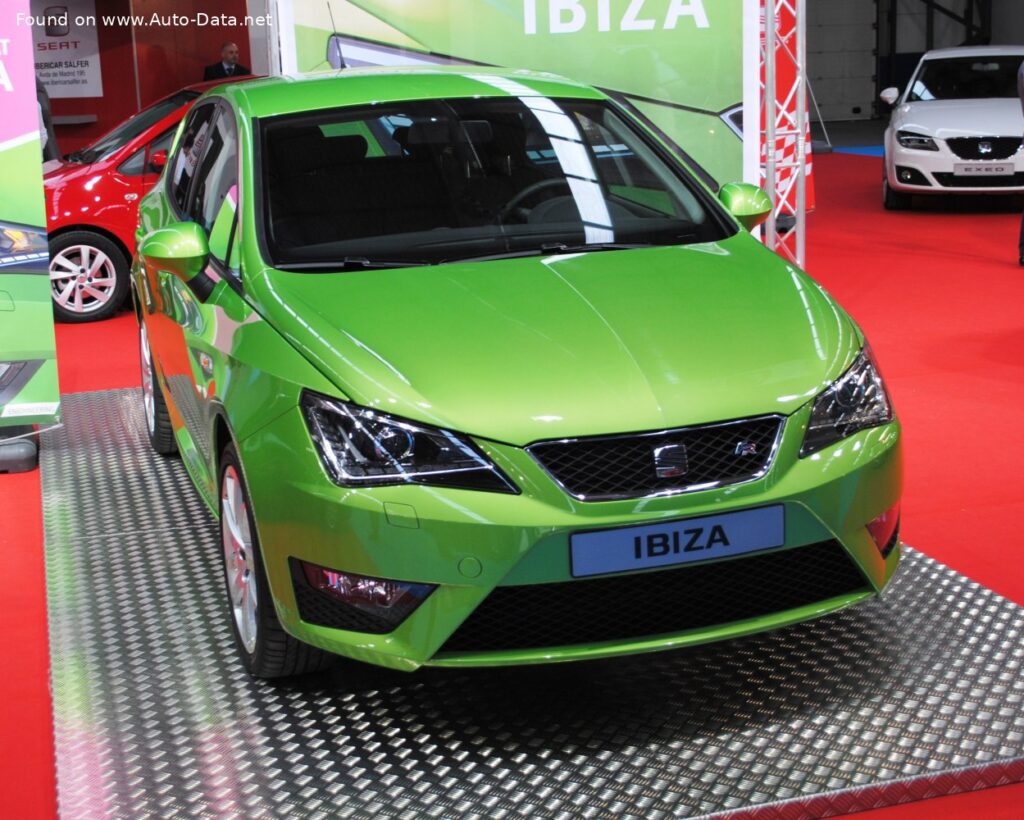
The Seat Ibiza IV (facelift 2012) retains the sporty and distinctive design language that has been a hallmark of the Ibiza line. As a 5-door hatchback, it offers a practical and versatile body style, making it ideal for young families or individuals needing flexible cargo and passenger space. The facelift introduced subtle but impactful revisions, including sharper headlights, a redesigned grille, and updated bumpers, giving the car a more modern and aggressive appearance that aligned with Seat’s evolving “Arrow Design” philosophy.
With a length of 159.88 inches (4061 mm), a width of 66.65 inches (1693 mm), and a height of 56.89 inches (1445 mm), the Ibiza maintains compact dimensions, making it highly maneuverable and easy to park in congested European cities. The wheelbase of 97.2 inches (2469 mm) contributes to a stable ride quality while ensuring adequate interior space for its class. The minimum turning circle of 34.38 feet (10.48 meters) further underscores its urban agility.
The interior is designed to accommodate five occupants comfortably, with a focus on ergonomics and functionality. While specific infotainment details are not provided, models of this era typically offered options for basic audio systems, air conditioning, and power windows. The trunk (boot) space provides 10.31 cubic feet (292 liters) of cargo volume, which is competitive for the subcompact segment and sufficient for daily errands or weekend trips. The fuel tank capacity is 11.89 US gallons (45 liters), providing a decent range given its excellent fuel economy.
Safety features for the Ibiza IV (facelift 2012) included essential systems like ABS (Anti-lock Braking System), which was standard. While not explicitly listed in the provided data, it is reasonable to assume that other passive safety features such as multiple airbags and electronic stability control (ESC) would have been available or standard, given the Euro 5 emissions standard and general safety expectations in Europe during this period. The braking system consists of ventilated discs at the front and disc brakes at the rear, providing confident stopping power. The suspension setup features an independent McPherson strut system with coil springs and an anti-roll bar at the front, paired with hydraulic elements at the rear, striking a balance between responsive handling and ride comfort. Hydraulic power steering with a rack and pinion system ensures precise and communicative steering feedback.
Technical Specifications
| Category | Specification |
|---|---|
| Brand | Seat |
| Model | Ibiza |
| Generation | Ibiza IV (facelift 2012) |
| Type (Engine) | 1.2 TSI (105 Hp) DSG |
| Production Start | 2012 |
| Production End | 2015 |
| Powertrain Architecture | Internal Combustion Engine |
| Body Type | Hatchback |
| Seats | 5 |
| Doors | 5 |
| Fuel Type | Petrol (Gasoline) |
| Fuel Consumption (Urban) | 33.6 US mpg (7 L/100 km) |
| Fuel Consumption (Extra-Urban) | 53.5 US mpg (4.4 L/100 km) |
| Fuel Consumption (Combined) | 44.4 US mpg (5.3 L/100 km) |
| CO2 Emissions | 124 g/km |
| Acceleration 0-60 mph | 9.2 sec |
| Maximum Speed | 118.06 mph (190 km/h) |
| Emission Standard | Euro 5 |
| Power | 105 Hp @ 5000 rpm |
| Power per Liter | 87.7 Hp/L |
| Torque | 129.07 lb.-ft. (175 Nm) @ 1550-4100 rpm |
| Engine Layout | Front, Transverse |
| Engine Model/Code | CBZB |
| Engine Displacement | 1.2 L (1197 cm3 / 73.05 cu. in.) |
| Number of Cylinders | 4 |
| Engine Configuration | Inline |
| Cylinder Bore | 2.8 in. (71 mm) |
| Piston Stroke | 2.98 in. (75.6 mm) |
| Compression Ratio | 10:1 |
| Valves per Cylinder | 2 |
| Fuel Injection System | Direct injection |
| Engine Aspiration | Turbocharger, Intercooler |
| Engine Oil Capacity | 4.12 US qt (3.9 L) |
| Coolant Capacity | 5.92 US qt (5.6 L) |
| Kerb Weight | 2458.15 lbs. (1115 kg) |
| Max. Weight | 3505.35 lbs. (1590 kg) |
| Max Load | 1047.2 lbs. (475 kg) |
| Trunk (Boot) Space – Minimum | 10.31 cu. ft. (292 L) |
| Fuel Tank Capacity | 11.89 US gal (45 L) |
| Length | 159.88 in. (4061 mm) |
| Width | 66.65 in. (1693 mm) |
| Height | 56.89 in. (1445 mm) |
| Wheelbase | 97.2 in. (2469 mm) |
| Front Track | 57.68 in. (1465 mm) |
| Rear Track | 57.36 in. (1457 mm) |
| Minimum Turning Circle | 34.38 ft. (10.48 m) |
| Drivetrain Architecture | Front-wheel drive, Internal Combustion Engine |
| Drive Wheel | Front wheel drive |
| Gearbox | 7 gears, automatic transmission DSG |
| Front Suspension | Independent, McPherson with coil spring and anti-roll bar |
| Rear Suspension | Hydraulic elements |
| Front Brakes | Ventilated discs |
| Rear Brakes | Disc |
| Assisting Systems | ABS (Anti-lock braking system) |
| Steering Type | Steering rack and pinion |
| Power Steering | Hydraulic Steering |
| Tire Sizes | 185/60 R15; 215/45 R16; 215/40 R17 |
| Wheel Rim Sizes | 6J x 15; 7J x 16; 7J x 17 |
Legacy and Market Impact of the Seat Ibiza IV (facelift 2012)
The Seat Ibiza IV (facelift 2012) played a crucial role in maintaining Seat’s competitive edge in the highly saturated European B-segment market. Its reputation was built on a foundation of appealing design, dynamic driving characteristics, and a strong value proposition within the Volkswagen Group. Seat has always aimed to be the more passionate and spirited brand within the German conglomerate, and the Ibiza consistently delivered on this promise, appealing to younger buyers and those seeking a more engaging driving experience than some of its more conservative rivals.
In its primary markets, the Ibiza faced formidable competition from a host of well-established models. Key rivals included its platform-mates, the Volkswagen Polo and Skoda Fabia, as well as external competitors such as the Ford Fiesta, Renault Clio, Peugeot 208, and Opel Corsa. The Ibiza distinguished itself with its sharp styling, particularly the updates introduced with the 2012 facelift, which gave it a more aggressive and contemporary look. Its “auto emoción” philosophy resonated with consumers who appreciated a car that was not only practical and efficient but also fun to drive.
The 1.2 TSI engine, combined with the DSG transmission, was a particularly impactful powertrain choice for the Ibiza. It perfectly encapsulated the automotive trends of the early 2010s: downsizing for efficiency without sacrificing performance. This combination offered a compelling balance of low running costs, respectable acceleration, and smooth operation, making it a popular choice for both urban commuters and those who frequently traveled longer distances. The Euro 5 emission standard compliance further solidified its standing as a modern, responsible vehicle.
Historically, the Ibiza lineage has been a cornerstone of Seat’s product portfolio since its inception in 1984. The fourth generation, and specifically its facelifted iteration, continued this legacy by offering a modern, well-packaged subcompact that remained relevant in a rapidly evolving market. Its success contributed significantly to Seat’s brand image as a producer of stylish, sporty, and technologically advanced vehicles. The design cues and engineering principles employed in the Ibiza IV also influenced subsequent Seat models, helping to shape the brand’s identity for the years to come. The Seat Ibiza IV (facelift 2012) ultimately carved out its niche as a vibrant and capable European subcompact, remembered for its blend of practicality, performance, and undeniable Spanish flair.