Introduction to the Rover 200 (XW) 220 Turbo
The Rover 200 (XW) generation, produced between 1989 and 1995, represented a significant chapter in the history of the British automotive manufacturer Rover. Developed in collaboration with Honda, the XW series was a compact family car positioned to compete in the highly contested European C-segment. While the majority of the range focused on practicality and refinement, Rover sought to inject a dose of high-performance excitement into its lineup with the introduction of the Rover 200 (XW) 220 Turbo (200 Hp). Launched in 1993 and produced until 1995, this specialized variant served as the performance flagship of the 200 series, embodying Rover’s ambition to challenge established hot hatch competitors from Germany and Japan. Exclusively sold in European markets, particularly the United Kingdom, the 220 Turbo was a potent, front-wheel-drive three-door hatchback designed for enthusiasts, offering a blend of surprising speed and traditional Rover sophistication.
Engine and Performance of the Rover 200 (XW) 220 Turbo
At the heart of the Rover 200 (XW) 220 Turbo lay a formidable powertrain, specifically Rover’s K-Series derived 2.0-liter, 16-valve turbocharged inline-four engine. This unit was a marvel for its time, especially in a compact car. With an engine displacement of 1994 cm3 (121.68 cu. in.), the engine was engineered for high output, featuring a double overhead camshaft (DOHC) valvetrain and multi-port manifold injection to ensure precise fuel delivery. The most significant aspect was the Garrett T25 turbocharger, which dramatically boosted the engine’s power output, transforming the car’s character from a modest family hatchback into a serious performance machine.
The result was an impressive 200 horsepower delivered at 6100 rpm, translating to a specific output of 100.3 horsepower per liter – a truly remarkable figure for a production car in the early 1990s. Torque was equally compelling, peaking at 174.8 lb.-ft. (237 Nm) at a low 2100 rpm, providing excellent mid-range acceleration and responsiveness, making it highly tractable in various driving conditions. This robust power was channeled to the front wheels via a slick-shifting 5-speed manual transmission, offering direct driver engagement and allowing the driver to fully exploit the engine’s potential.
Performance figures for the Rover 200 (XW) 220 Turbo were genuinely impressive. The car could rocket from 0 to 60 mph in a swift 6.2 seconds, making it one of the quickest hot hatches of its era and capable of embarrassing more expensive sports cars. Its top speed was rated at 146.02 mph (235 km/h), firmly placing it in contention with established performance benchmarks. The weight-to-power ratio stood at a competitive 6.1 kg/Hp (164.6 Hp/tonne), indicating the car’s agile nature despite its solid construction. Fuel economy, while not the primary focus for a performance vehicle, was respectable for its class, with a combined rating of 29.8 US mpg (7.9 l/100 km), dropping to 21.2 US mpg (11.1 l/100 km) in urban driving and improving to 37.9 US mpg (6.2 l/100 km) on the highway.
Design and Features of the Rover 200 (XW) 220 Turbo
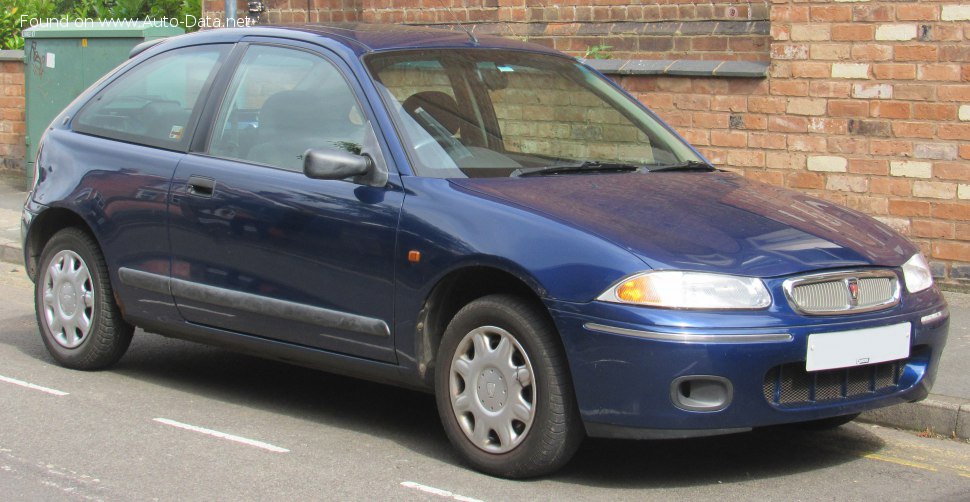
The Rover 200 (XW) 220 Turbo was available exclusively as a 3-door hatchback, emphasizing its sporty intentions and catering to a younger, enthusiast market. Its design, while largely based on the standard 200 series, featured subtle enhancements to denote its high-performance status without resorting to overly aggressive styling. These typically included unique alloy wheels, a more assertive front bumper, side skirts, and a discreet rear spoiler, all contributing to a purposeful yet refined appearance. The overall length measured 166.14 inches (4220 mm), with a width of 66.14 inches (1680 mm) and a height of 54.72 inches (1390 mm). The wheelbase of 100.39 inches (2550 mm) provided a stable platform for dynamic driving while maintaining a compact footprint.
Inside, the 220 Turbo offered seating for five, maintaining a degree of practicality despite its performance aspirations. The interior was typically Rover, featuring comfortable, supportive sport seats, a leather-wrapped steering wheel, and a dashboard layout that