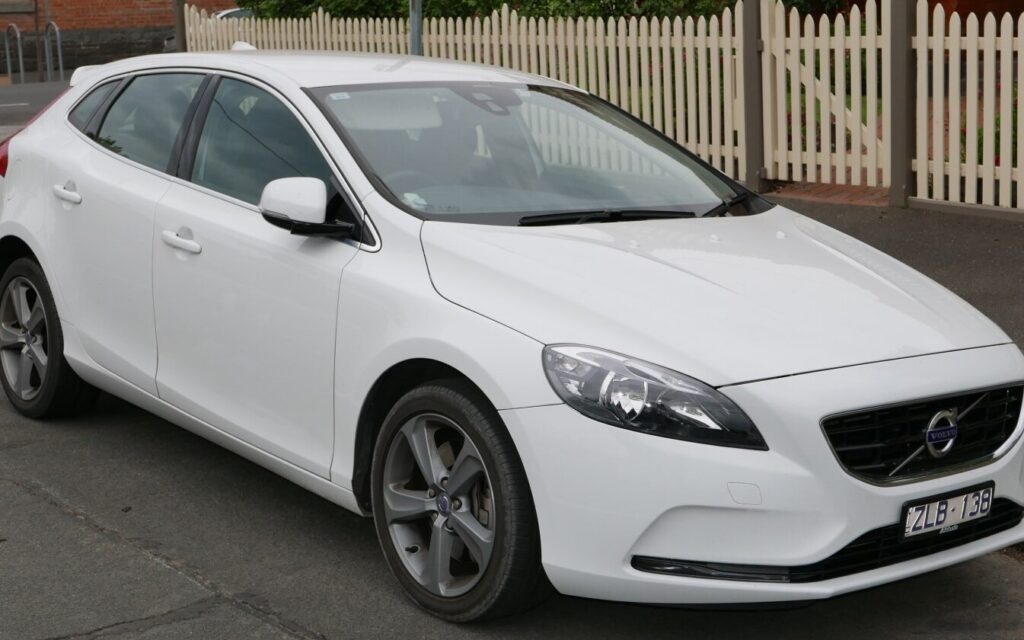
The Volvo V40 (facelift 2016): A Premium European Compact
The Volvo V40 (facelift 2016) represents the refreshed iteration of Volvo’s compact premium hatchback, a model primarily designed for and marketed in Europe and other international regions outside of the United States. Produced between 2018 and 2020 in this specific facelifted variant, the V40 was Volvo’s strong contender in the highly competitive C-segment, challenging established German rivals with its distinctive Scandinavian design, renowned safety features, and efficient powertrain options. This particular variant, the 2.0 D3 (150 Hp) Automatic, showcased Volvo’s commitment to refined diesel performance, offering a compelling blend of power, fuel economy, and environmental responsibility, perfectly tailored for the European market’s preferences at the time.
Positioned as a sophisticated alternative to mainstream hatchbacks, the V40 combined practical five-door utility with a premium interior and a driving experience that prioritized comfort and stability. While never officially sold in the North American market, the V40 played a crucial role in Volvo’s global portfolio, enhancing its brand image as a producer of stylish, safe, and technologically advanced vehicles, even in the compact segment. Its lifecycle spanned a period where Volvo was undergoing a significant transformation, introducing new design languages and powertrain strategies that would define its future models.
Powertrain and Performance of the Volvo V40 (facelift 2016) 2.0 D3
Under the hood of the Volvo V40 (facelift 2016) 2.0 D3 (150 Hp) Automatic lies a robust and efficient 2.0-liter (1969 cm3 or 120.16 cu. in.) D4204T16 inline-four diesel engine. This powerplant, a testament to Volvo’s engineering prowess, delivers a respectable 150 horsepower at 3750 rpm and a substantial 236.02 lb.-ft. of torque, available across a broad rev range from 1740 to 3000 rpm. This low-end torque is characteristic of modern diesel engines, providing excellent responsiveness and effortless acceleration, particularly in urban driving and highway cruising scenarios.
Power is transmitted to the front wheels via a smooth and responsive 6-speed automatic transmission, ensuring a refined driving experience. The V40 D3 can accelerate from 0 to 60 mph in a swift 8.1 seconds, with a top speed reaching 127.38 mph. These figures underscore its capability as a dynamic yet composed performer on European roads. Despite its strong performance, the V40 D3 excels in fuel efficiency, a critical factor for European buyers. It boasts a combined fuel economy of 50-52.3 US mpg (4.5-4.7 l/100 km), with extra-urban figures reaching an impressive 54.7-58.8 US mpg (4.0-4.3 l/100 km).
Environmentally conscious, the engine features a Diesel Commonrail fuel injection system, a turbocharger and intercooler for optimal air intake, and a DOHC valvetrain. Furthermore, it incorporates a particulate filter and meets stringent Euro 6d-Temp emission standards, with CO2 emissions ranging from 118-124 g/km. This commitment to efficiency and lower emissions made the V40 2.0 D3 a highly attractive option in markets with strict environmental regulations and high fuel prices.
Design, Features, and Volvo’s Safety Heritage
The Volvo V40 (facelift 2016) retained its sleek and athletic five-door hatchback body style, which was a hallmark of its design philosophy. Measuring 172.05 inches in length, 70.2 inches in width (80.35 inches including mirrors), and 56.65 inches in height, the V40 presented a compact yet substantial road presence. The 2016 facelift introduced key visual updates, most notably the “Thor’s Hammer” LED daytime running lights, which brought the V40 in line with Volvo’s newer, larger models like the XC90 and S90, giving it a fresh and modern appeal.
Inside, the V40 offered a typically Scandinavian interior – minimalist, elegant, and highly ergonomic. High-quality materials, comfortable seating for five occupants, and meticulous attention to detail were evident throughout the cabin. While the trunk space of 8.33 cu. ft. (236 liters) was adequate for daily use, it was slightly smaller than some rivals, reflecting its focus on sleek design over outright cargo capacity. However, Volvo’s reputation for practical and user-friendly interiors meant that every control was intuitively placed, and the overall ambiance was one of understated luxury.
As expected from a Volvo, safety was paramount. The V40 was built on a strong chassis featuring independent McPherson front suspension and independent coil spring rear suspension, providing a stable and predictable ride. Standard safety features included ABS (Anti-lock Braking System), and while not explicitly detailed in the raw data, Volvo models from this era typically offered a comprehensive suite of active and passive safety technologies, such as multiple airbags, City Safety (autonomous emergency braking), pedestrian detection, and various driver assistance systems, solidifying its status as one of the safest cars in its class.
Technical Specifications
| Feature | Specification |
|---|---|
| Brand | Volvo |
| Model | V40 |
| Generation | V40 (facelift 2016) |
| Type (Engine) | 2.0 D3 (150 Hp) Automatic |
| Start of Production | 2018 year |
| End of Production | 2020 year |
| Powertrain Architecture | Internal Combustion Engine |
| Body type | Hatchback |
| Seats | 5 |
| Doors | 5 |
| Performance Specs | |
| Fuel Consumption (Urban) | 5.2-5.5 l/100 km (42.8-45.2 US mpg) |
| Fuel Consumption (Extra Urban) | 4.0-4.3 l/100 km (54.7-58.8 US mpg) |
| Fuel Consumption (Combined) | 4.5-4.7 l/100 km (50-52.3 US mpg) |
| CO2 Emissions | 118-124 g/km |
| Fuel Type | Diesel |
| Acceleration 0 – 60 mph | 8.1 sec |
| Maximum Speed | 205 km/h (127.38 mph) |
| Braking 100 km/h – 0 | 37 m |
| Emission Standard | Euro 6d-Temp |
| Weight-to-Power Ratio | 10.5 kg/Hp (95.1 Hp/tonne) |
| Weight-to-Torque Ratio | 4.9 kg/Nm (202.9 Nm/tonne) |
| Engine Specs | |
| Power | 150 Hp @ 3750 rpm |
| Power per liter | 76.2 Hp/l |
| Torque | 320 Nm (236.02 lb.-ft.) @ 1740-3000 rpm |
| Maximum Engine Speed | 4500 rpm |
| Engine Layout | Front, Transverse |
| Engine Model/Code | D4204T16 |
| Engine Displacement | 1969 cm3 (2.0 l / 120.16 cu. in.) |
| Number of Cylinders | 4 |
| Engine Configuration | Inline |
| Cylinder Bore | 82 mm (3.23 in.) |
| Piston Stroke | 93.2 mm (3.67 in.) |
| Compression Ratio | 16:1 |
| Number of Valves per Cylinder | 4 |
| Fuel Injection System | Diesel Commonrail |
| Engine Aspiration | Turbocharger, Intercooler |
| Valvetrain | DOHC |
| Engine Oil Capacity | 5.2 l (5.49 US qt) |
| Coolant Capacity | 8 l (8.45 US qt) |
| Engine Systems | Particulate filter |
| Space, Volume and Weights | |
| Kerb Weight | 1577 kg (3476.69 lbs.) |
| Trunk (boot) space – minimum | 236 l (8.33 cu. ft.) |
| Fuel Tank Capacity | 62 l (16.38 US gal) |
| AdBlue Tank | 16.5 l (4.36 US gal) |
| Permitted Trailer Load with brakes (12%) | 1500 kg (3306.93 lbs.) |
| Permitted Trailer Load without brakes | 700 kg (1543.24 lbs.) |
| Dimensions | |
| Length | 4370 mm (172.05 in.) |
| Width | 1783 mm (70.2 in.) |
| Width with mirrors folded | 1857 mm (73.11 in.) |
| Width including mirrors | 2041 mm (80.35 in.) |
| Height | 1439 mm (56.65 in.) |
| Wheelbase | 2647 mm (104.21 in.) |
| Front Overhang | 908 mm (35.75 in.) |
| Rear Overhang | 815 mm (32.09 in.) |
| Drag Coefficient (Cd) | 0.29-0.32 |
| Minimum Turning Circle (Turning Diameter) | 12 m (39.37 ft.) |
| Drivetrain, Brakes and Suspension Specs | |
| Drivetrain Architecture | Front-wheel drive with Internal Combustion Engine |
| Drive Wheel | Front wheel drive |
| Number of Gears and Type of Gearbox | 6 gears, automatic transmission |
| Front Suspension | Independent, type McPherson with coil spring and anti-roll bar |
| Rear Suspension | Independent coil spring, Transverse stabilizer |
| Front Brakes | Disc |
| Rear Brakes | Disc, 280 mm |
| Assisting Systems | ABS (Anti-lock braking system) |
| Steering Type | Steering rack and pinion |
| Power Steering | Electric Steering |
Legacy and Market Positioning
The Volvo V40 (facelift 2016), particularly in its 2.0 D3 Automatic configuration, carved out a distinct niche for itself in the highly competitive European premium compact segment. It faced formidable rivals such as the Audi A3, BMW 1 Series, Mercedes-Benz A-Class, and the Volkswagen Golf, all of which offered their own blend of performance, luxury, and technology. The V40 differentiated itself through its unique Scandinavian aesthetic, an unwavering commitment to safety, and a focus on comfortable, refined driving dynamics rather than outright sporty aggression.
Its reputation was built on its solid build quality, premium interior finishes, and the peace of mind that came with Volvo’s legendary safety record. For European consumers, the V40 D3 offered an appealing package of strong diesel performance, exceptional fuel efficiency, and a respectable environmental footprint, aligning well with the continent’s automotive landscape. While it might not have matched the sheer sales volume of some competitors, it consistently appealed to buyers seeking a distinctive, understatedly luxurious, and incredibly safe compact car.
The V40’s absence from the U.S. market was largely strategic, as Volvo opted to focus its American efforts on larger sedans (S60, S90) and, more significantly, its rapidly expanding SUV lineup (XC40, XC60, XC90) which better suited American consumer preferences. Despite this, the V40 was a vital model for Volvo globally, helping to modernize its image and bridge the gap to its next generation of electrified vehicles. It remains a respected example of Volvo’s ability to compete effectively in diverse market segments, leaving a legacy as a sophisticated and secure choice in the premium compact class.