Introduction to the Seat Ibiza IV (Facelift 2012)
The Seat Ibiza, a prominent nameplate in the European supermini or subcompact segment, received a significant refresh in 2012, marking the mid-cycle update for its fourth generation (6J chassis code). The Seat Ibiza IV (facelift 2012) continued its tradition as a stylish and dynamic contender, embodying SEAT’s “Auto Emoción” philosophy with updated aesthetics and improved powertrain options. Positioned as the sportier, more youthful alternative within the Volkswagen Group’s B-segment offerings, the Ibiza primarily targeted European markets, where its blend of practicality, spirited driving dynamics, and attractive design found a strong audience. This particular variant, equipped with the efficient 1.2 TSI (85 Hp) engine, represented a popular choice for urban commuters and young families seeking a balance of fuel economy and usable performance.
While never officially sold in the United States, the Ibiza is a cornerstone of SEAT’s product lineup, often sharing platforms and technology with its Volkswagen Group siblings like the Volkswagen Polo and Skoda Fabia. The 2012 facelift introduced sharper lines, revised lighting signatures, and interior enhancements, ensuring the Ibiza remained competitive against a host of well-established rivals. The introduction of downsized, turbocharged engines like the 1.2 TSI underscored a broader industry trend towards efficiency without sacrificing drivability, making this generation of the Ibiza a relevant example of modern automotive engineering in its segment.
Engine and Performance of the Seat Ibiza IV (Facelift 2012)
At the heart of this particular Seat Ibiza IV (facelift 2012) model lies the 1.2 TSI engine, a testament to the Volkswagen Group’s commitment to compact, efficient, and powerful turbocharged gasoline units. This inline-four cylinder engine, designated by the code CBZA, features a displacement of 1,197 cubic centimeters (approximately 1.2 liters or 73.05 cubic inches). Despite its modest size, the engine’s advanced technology—including direct fuel injection, a turbocharger, and an intercooler—allows it to produce a respectable 85 horsepower at 4,800 revolutions per minute. This power output, combined with a healthy 118.01 pound-feet of torque available across a broad range from 1,500 to 3,500 rpm, provides the Ibiza with a surprisingly responsive character for its class.
The engine’s layout is front, transverse, driving the front wheels through a precise 5-speed manual transmission. This setup is typical for the segment, prioritizing packaging efficiency and cost-effectiveness. The Ibiza 1.2 TSI achieves a 0 to 60 mph acceleration time of approximately 10.7 seconds, with a top speed of 111.85 mph (180 km/h). While not a performance hot hatch, these figures are more than adequate for daily driving and highway cruising in Europe.
Fuel economy was a major selling point for the 1.2 TSI. The combined cycle fuel consumption is rated at an impressive 46.1 US miles per gallon (5.1 liters per 100 km), with extra-urban figures reaching 53.5 US mpg (4.4 l/100 km). Urban driving still delivered a commendable 36.2 US mpg (6.5 l/100 km). These efficiency numbers were achieved alongside low CO2 emissions of 119 grams per kilometer, allowing the vehicle to meet the Euro 5 emission standard, a crucial factor for European markets with stringent environmental regulations. The engine’s compact design and lightweight construction also contributed to the car’s overall agility and favorable weight-to-power ratio of 12.8 kg per horsepower.
Design and Features
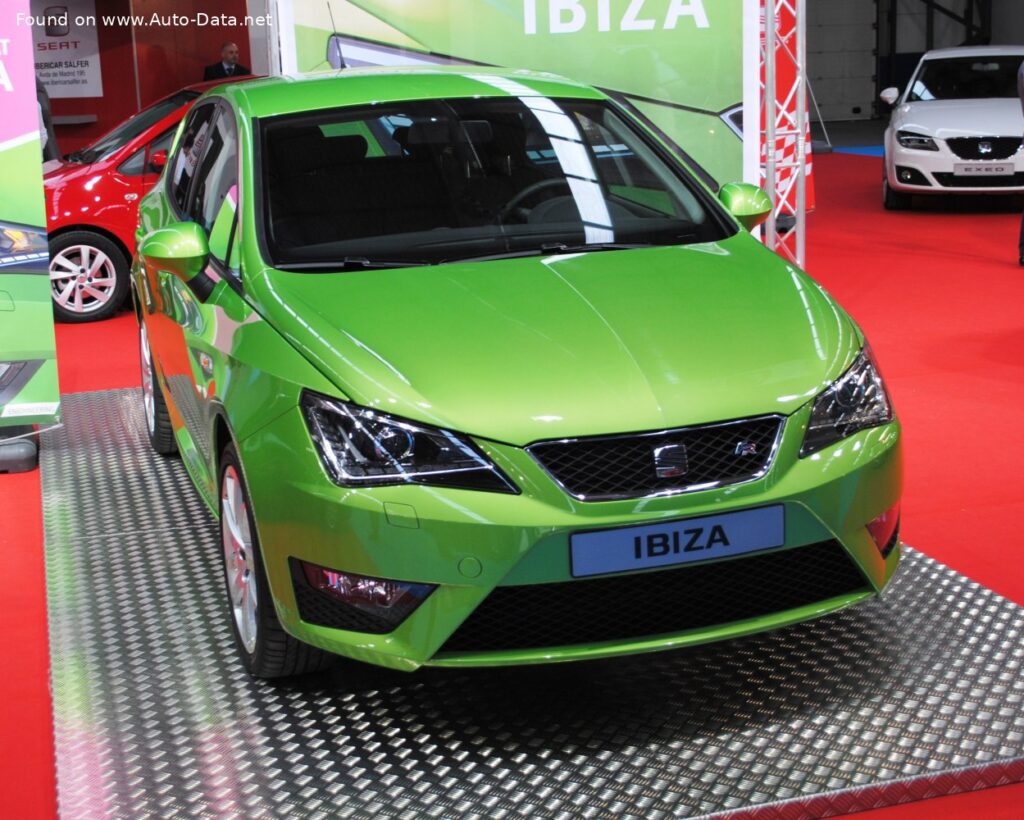
The Seat Ibiza IV (facelift 2012) maintained its sleek and sporty five-door hatchback body style, a practical choice for its target demographic. The 2012 facelift brought several aesthetic enhancements that sharpened its appearance. The front fascia received a more aggressive look with redesigned headlights, a revised grille, and a sportier bumper, bringing it in line with SEAT’s evolving design language, which emphasized angular lines and a dynamic stance. These changes gave the Ibiza a more mature yet still youthful appeal.
Inside, the Ibiza offered seating for five occupants, with a focus on ergonomics and user-friendly controls. While not luxurious, the cabin materials were durable and well-assembled, reflecting Volkswagen Group’s quality standards. Practicality was a strong suit, with a minimum trunk space of 10.31 cubic feet (292 liters), expandable by folding the rear seats, making it versatile for grocery runs or weekend trips.
In terms of features, the 2012 Ibiza included essential modern amenities for its time. Safety equipment typically comprised an Anti-lock Braking System (ABS), a standard feature that significantly enhances braking control during emergencies. The steering system utilized electric power steering with a rack and pinion setup, offering light and precise handling, particularly beneficial for urban maneuvering. The suspension system featured an independent McPherson strut design with coil springs and an anti-roll bar at the front, providing a good balance of comfort and handling. The rear suspension, described as having hydraulic elements, typically refers to a torsion beam axle with hydraulic shock absorbers, a common and effective setup for compact cars that balances ride comfort with cargo space and cost efficiency. Braking was handled by ventilated discs at the front and disc brakes at the rear, ensuring confident stopping power. Various tire and wheel options, ranging from 185/60 R15 to 215/40 R17, allowed for customization of both aesthetics and driving dynamics.
Technical Specifications
| Category | Specification |
|---|---|
| General Information | |
| Brand | Seat |
| Model | Ibiza |
| Generation | Ibiza IV (facelift 2012) |
| Type (Engine) | 1.2 TSI (85 Hp) |
| Start of Production | 2012 year |
| End of Production | 2015 year |
| Powertrain Architecture | Internal Combustion engine |
| Body Type | Hatchback |
| Seats | 5 |
| Doors | 5 |
| Performance Specifications | |
| Fuel Consumption (Economy) – Urban | 36.2 US mpg (6.5 l/100 km) |
| Fuel Consumption (Economy) – Extra Urban | 53.5 US mpg (4.4 l/100 km) |
| Fuel Consumption (Economy) – Combined | 46.1 US mpg (5.1 l/100 km) |
| CO2 Emissions | 119 g/km |
| Fuel Type | Petrol (Gasoline) |
| Acceleration 0 – 60 mph | 10.7 sec |
| Acceleration 0 – 100 km/h | 11.3 sec |
| Maximum Speed | 111.85 mph (180 km/h) |
| Emission Standard | Euro 5 |
| Weight-to-Power Ratio | 12.8 kg/Hp |
| Weight-to-Torque Ratio | 6.8 kg/Nm |
| Engine Specifications | |
| Power | 85 Hp @ 4800 rpm |
| Power per Liter | 71 Hp/l |
| Torque | 118.01 lb.-ft. @ 1500-3500 rpm (160 Nm) |
| Engine Layout | Front, Transverse |
| Engine Model/Code | CBZA |
| Engine Displacement | 1.2 liters (1197 cm3 / 73.05 cu. in.) |
| Number of Cylinders | 4 |
| Engine Configuration | Inline |
| Cylinder Bore | 2.8 in. (71 mm) |
| Piston Stroke | 2.98 in. (75.6 mm) |
| Compression Ratio | 10:1 |
| Number of Valves per Cylinder | 2 |
| Fuel Injection System | Direct Injection |
| Engine Aspiration | Turbocharger, Intercooler |
| Engine Oil Capacity | 3.8 US qt (3.6 l) |
| Coolant Capacity | 5.92 US qt (5.6 l) |
| Space, Volume and Weights | |
| Kerb Weight | 2403.04 lbs. (1090 kg) |
| Max. Weight | 3397.32 lbs. (1541 kg) |
| Max Load | 994.28 lbs. (451 kg) |
| Trunk (Boot) Space – Minimum | 10.31 cu. ft. (292 l) |
| Fuel Tank Capacity | 11.89 US gal (45 l) |
| Dimensions | |
| Length | 159.88 in. (4061 mm) |
| Width | 66.65 in. (1693 mm) |
| Height | 56.89 in. (1445 mm) |
| Wheelbase | 97.2 in. (2469 mm) |
| Front Track | 57.68 in. (1465 mm) |
| Rear (Back) Track | 57.36 in. (1457 mm) |
| Minimum Turning Circle (Turning Diameter) | 34.38 ft. (10.48 m) |
| Drivetrain, Brakes and Suspension Specifications | |
| Drivetrain Architecture | Front-wheel drive with Internal Combustion Engine |
| Drive Wheel | Front wheel drive |
| Number of Gears and Type of Gearbox | 5 gears, Manual transmission |
| Front Suspension | Independent, McPherson type with coil spring and anti-roll bar |
| Rear Suspension | Hydraulic elements (typically torsion beam with hydraulic dampers) |
| Front Brakes | Ventilated discs |
| Rear Brakes | Disc |
| Assisting Systems | ABS (Anti-lock braking system) |
| Steering Type | Steering rack and pinion |
| Power Steering | Electric Steering |
| Tires Size | 185/60 R15; 215/45 R16; 215/40 R17 |
| Wheel Rims Size | 6J x 15; 7J x 16; 7J x 17 |
Legacy and Market Impact of the Seat Ibiza IV (Facelift 2012)
The Seat Ibiza has consistently been one of SEAT’s best-selling models since its inception in 1984, and the fourth generation, particularly after its 2012 facelift, continued this legacy. In its primary European markets, the Ibiza competed fiercely in the highly competitive B-segment, facing off against formidable rivals such as the Volkswagen Polo (its platform mate), Ford Fiesta, Renault Clio, Peugeot 208, and Skoda Fabia. What set the Ibiza apart was its distinctive design language, which infused a sense of sportiness and flair often associated with Italian design, despite its Spanish origins and German engineering backbone.
The 2012 facelift, with its sharper aesthetics and refined interior, helped to keep the Ibiza fresh and appealing in a rapidly evolving market. The introduction and refinement of engines like the 1.2 TSI (85 Hp) were crucial. This engine, with its impressive balance of power and fuel efficiency, resonated with a broad spectrum of buyers who sought lower running costs without sacrificing modern driving characteristics. It demonstrated how smaller displacement, turbocharged engines could deliver performance comparable to larger naturally aspirated units while significantly reducing fuel consumption and CO2 emissions, aligning with increasing environmental consciousness and stricter regulations in Europe.
The Ibiza’s reputation was built on its dynamic handling, responsive steering, and a chassis that offered a more engaging driving experience than some of its more comfort-oriented competitors. It appealed to younger buyers and those who appreciated a car with character and a touch of Mediterranean passion. Its affordability, combined with the reliability and build quality derived from its Volkswagen Group parentage, made it a compelling value proposition.
Ultimately, the Seat Ibiza IV (facelift 2012) cemented the model’s position as a core pillar of the SEAT brand. It contributed significantly to SEAT’s sales volumes and helped project an image of a brand that offered stylish, practical, and fun-to-drive vehicles. While it may not have graced American roads, its impact on the European automotive landscape, particularly in demonstrating the viability of efficient turbocharged engines in the subcompact segment, is undeniable. It remains a significant chapter in the ongoing evolution of the modern hatchback.