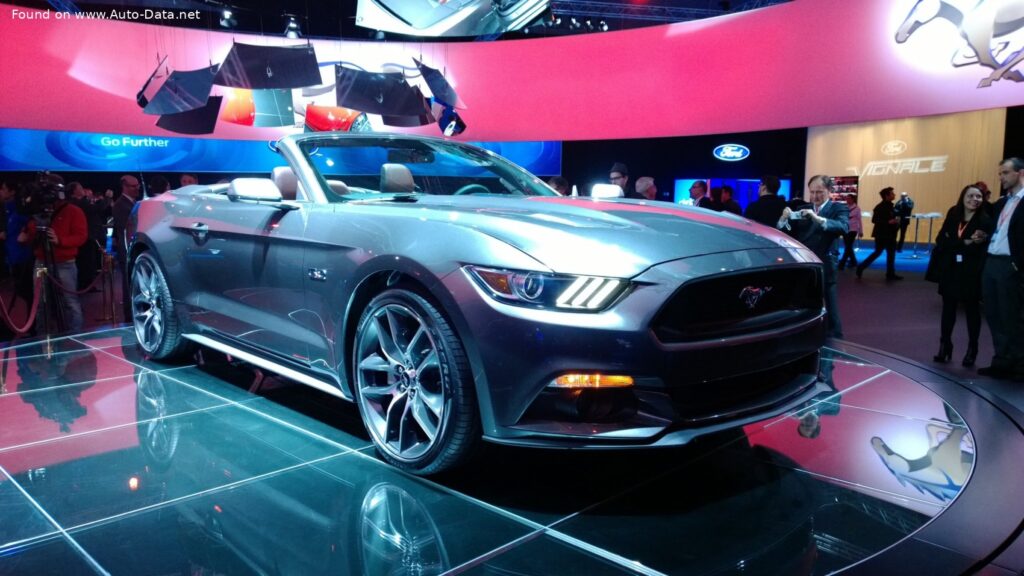
Ford Mustang Convertible VI 2.3 EcoBoost (309 Hp) Automatic
The Ford Mustang, an enduring icon of American automotive culture, entered its sixth generation (internal code S550) in 2015, marking a significant evolution for the storied pony car. This iteration was particularly notable as it was the first Mustang to be engineered as a truly global vehicle, designed to be sold and enjoyed in markets beyond North America, including Europe, Asia, and Australia. Among the diverse powertrain options offered, the Ford Mustang Convertible VI 2.3 EcoBoost (309 Hp) Automatic variant stood out, representing a modern approach to performance and efficiency within the classic Mustang lineage. Produced from 2015 to 2017, this model offered a compelling blend of open-air driving pleasure, contemporary technology, and a turbocharged four-cylinder engine that provided robust performance while addressing increasing global demands for fuel economy and lower emissions. It positioned the Mustang as a versatile sports convertible, appealing to a broader audience who desired the legendary styling and driving dynamics without necessarily opting for the traditional V8 powerplant.
Engine and Performance: The Ford Mustang Convertible VI 2.3 EcoBoost Drivetrain
At the heart of the Ford Mustang Convertible VI 2.3 EcoBoost (309 Hp) Automatic lies Ford’s acclaimed 2.3-liter EcoBoost engine. This powertrain architecture, an Internal Combustion Engine (ICE), is a front, longitudinal-mounted inline-four cylinder unit, meticulously engineered for both power and efficiency. With an engine displacement of 2264 cm3 (138.16 cu. in.), this turbocharged and intercooled gasoline engine delivers an impressive 309 horsepower at 5500 rpm. Its power-per-liter ratio stands at a remarkable 136.5 Hp/l, showcasing its advanced design.
Torque output is equally compelling, with 407 Nm (300.19 lb.-ft.) available across a broad rev range, specifically from 2500 to 4500 rpm. This wide torque band ensures responsive acceleration and strong pulling power, making the convertible an engaging drive both in urban settings and on the open highway. The engine features a DOHC (Dual Overhead Camshaft) valvetrain with four valves per cylinder, contributing to its efficient breathing and high-revving capability. Fuel is delivered via a direct injection system, which precisely controls fuel atomization and combustion, further enhancing both power output and fuel economy.
The engine’s internal specifications include a cylinder bore of 87.55 mm (3.45 in.) and a piston stroke of 94 mm (3.7 in.), with a compression ratio of 9.5:1. This configuration, combined with the turbocharger, allows for significant power density from a relatively small displacement. Power is sent to the rear wheels via a smooth-shifting 6-speed automatic transmission, reinforcing the Mustang’s traditional rear-wheel-drive sports car ethos. This combination ensures a dynamic driving experience, characteristic of the Mustang, while providing the convenience and refinement of an automatic gearbox.
In terms of fuel efficiency, the 2.3 EcoBoost engine offers a notable improvement over its V8 counterparts. The combined fuel consumption is rated at 9.8 l/100 km, which translates to approximately 24 US mpg. Urban driving yields about 11.8 l/100 km (19.9 US mpg), while extra-urban cruising can achieve 7.8 l/100 km (30.2 US mpg). These figures highlight the EcoBoost’s role in making the Mustang more accessible and practical for daily use, especially in markets with higher fuel prices or stricter emissions regulations. The fuel tank capacity of 58 liters (15.32 US gallons) provides a decent range for extended journeys.
Design and Features: Open-Air Style and Modern Amenities
The Ford Mustang Convertible VI maintains the aggressive, muscular styling that defines the Mustang brand, while incorporating modern design cues and aerodynamic enhancements. As a two-door cabriolet, it offers seating for four occupants, allowing for a shared open-air experience. The body type, with its retractable soft top, transforms the Mustang from a sleek coupe into an exhilarating convertible at the touch of a button, embodying the spirit of freedom and driving enjoyment.
Dimensionally, the S550 Convertible is a substantial vehicle, measuring 4783 mm (188.31 in.) in length, 1915 mm (75.39 in.) in width (2080 mm or 81.89 in. with mirrors folded), and 1394 mm (54.88 in.) in height. Its wheelbase extends to 2720 mm (107.09 in.), contributing to a stable ride and generous interior space for its class. The front track is 1582 mm (62.28 in.) and the rear track is 1648 mm (64.88 in.), providing a wide stance that enhances both aesthetics and handling. The vehicle’s drag coefficient (Cd) is 0.35, indicating a reasonable level of aerodynamic efficiency for a convertible of its size and shape.
Inside, the Mustang Convertible VI blends retro-inspired design elements with contemporary technology. While specific interior features are not detailed in the provided data, a modern car from 2015-2017 would typically include advanced infotainment systems, climate control, power-adjustable seating, and a suite of convenience features. Safety is addressed with standard features such as ABS (Anti-lock Braking System) for controlled stopping power, coupled with ventilated disc brakes on both the front and rear axles for robust performance. The steering system is a rack and pinion type, augmented by electric power steering, which offers precise control and customizable steering feel, enhancing the driving experience. The car rides on 235/55 R17 tires mounted on 17-inch wheel rims, providing a balance of grip and ride comfort.
Technical Specifications
| Category | Specification |
|---|---|
| General Information | |
| Brand | Ford |
| Model | Mustang |
| Generation | Mustang Convertible VI |
| Type (Engine) | 2.3 EcoBoost (309 Hp) Automatic |
| Start of Production | 2015 year |
| End of Production | 2017 year |
| Powertrain Architecture | Internal Combustion engine |
| Body type | Cabriolet |
| Seats | 4 |
| Doors | 2 |
| Performance Specs | |
| Fuel consumption (economy) – urban | 11.8 l/100 km (19.9 US mpg) |
| Fuel consumption (economy) – extra urban | 7.8 l/100 km (30.2 US mpg) |
| Fuel consumption (economy) – combined | 9.8 l/100 km (24 US mpg) |
| Fuel Type | Petrol (Gasoline) |
| Engine Specs | |
| Power | 309 Hp @ 5500 rpm |
| Power per liter | 136.5 Hp/l |
| Torque | 407 Nm @ 2500-4500 rpm (300.19 lb.-ft. @ 2500-4500 rpm) |
| Engine layout | Front, Longitudinal |
| Engine Model/Code | EcoBoost |
| Engine displacement | 2264 cm3 (138.16 cu. in.) |
| Number of cylinders | 4 |
| Engine configuration | Inline |
| Cylinder Bore | 87.55 mm (3.45 in.) |
| Piston Stroke | 94 mm (3.7 in.) |
| Compression ratio | 9.5:1 |
| Number of valves per cylinder | 4 |
| Fuel injection system | Direct injection |
| Engine aspiration | Turbocharger, Intercooler |
| Valvetrain | DOHC |
| Engine oil capacity | 5.4 l (5.71 US qt) |
| Coolant | 8.96 l (9.47 US qt) |
| Space, Volume and Weights | |
| Fuel tank capacity | 58 l (15.32 US gal) |
| Dimensions | |
| Length | 4783 mm (188.31 in.) |
| Width | 1915 mm (75.39 in.) |
| Width with mirrors folded | 2080 mm (81.89 in.) |
| Height | 1394 mm (54.88 in.) |
| Wheelbase | 2720 mm (107.09 in.) |
| Front track | 1582 mm (62.28 in.) |
| Rear (Back) track | 1648 mm (64.88 in.) |
| Drag coefficient (Cd) | 0.35 |
| Minimum turning circle (turning diameter) | 11.12 m (36.48 ft.) |
| Drivetrain, Brakes and Suspension Specs | |
| Drivetrain Architecture | The Internal combustion engine (ICE) drives the rear wheels of the vehicle. |
| Drive wheel | Rear wheel drive |
| Number of gears and type of gearbox | 6 gears, automatic transmission |
| Front brakes | Ventilated discs |
| Rear brakes | Ventilated discs |
| Assisting systems | ABS (Anti-lock braking system) |
| Steering type | Steering rack and pinion |
| Power steering | Electric Steering |
| Tires size | 235/55 R17 |
| Wheel rims size | 17 inches |
Legacy and Market Impact
The sixth-generation Ford Mustang, and particularly the Ford Mustang Convertible VI 2.3 EcoBoost (309 Hp) Automatic, represented a pivotal moment in the Mustang’s storied history. By embracing a global strategy, Ford transformed its quintessential American muscle car into a sophisticated sports car capable of competing on an international stage. The introduction of the 2.3-liter EcoBoost engine was central to this strategy, providing a more fuel-efficient and emissions-friendly alternative to the traditional V8, which was crucial for its success in markets like Europe and Asia, where fuel costs and displacement taxes can be significant deterrents to large-engine vehicles.
In its primary market, the United States, the EcoBoost Mustang Convertible offered a compelling proposition for buyers seeking the iconic Mustang style and open-air experience without the higher purchase price, insurance costs, or fuel consumption of the GT V8 models. It effectively broadened the Mustang’s appeal, attracting a new demographic who might have previously overlooked the car. While some purists initially questioned a four-cylinder Mustang, the EcoBoost’s strong performance figures and modern turbocharged character quickly won over many skeptics, proving that it could deliver genuine Mustang thrills.
Competitors for the Mustang Convertible VI 2.3 EcoBoost in the U.S. market included the Chevrolet Camaro Convertible and the Dodge Challenger (though the Challenger did not offer a convertible option in this generation, it was a direct competitor for the coupe). Globally, the EcoBoost Mustang found itself vying with a wider range of sports convertibles and coupes, such as the BMW 4 Series Convertible, Audi A5 Cabriolet, and even the Nissan 370Z Roadster, offering a unique blend of American heritage, modern performance, and relative value. Its reputation was built on its distinctive styling, engaging rear-wheel-drive dynamics, and the surprising punch of its turbocharged four-cylinder engine.
The legacy of this particular Mustang generation and powertrain lies in its role as a bridge between the old and new. It honored the Mustang’s past with its retro-futuristic design and focus on driving enjoyment, while simultaneously looking to the future with advanced engine technology and a global market vision. The 2.3 EcoBoost Convertible proved that a Mustang didn’t need a V8 to be a true Mustang, solidifying its place as a versatile and globally relevant sports car for the modern era. Its production run from 2015 to 2017 allowed it to establish a strong foothold in the market before subsequent updates and refinements were introduced, ensuring the Mustang’s continued relevance and appeal.