The Seat Ibiza IV (facelift 2012) 1.4 (85 Hp): A European Compact Stalwart
The Seat Ibiza IV (facelift 2012) represents a significant iteration of Seat’s popular subcompact car, a model series that has been a cornerstone of the Spanish automaker’s lineup since its inception in 1984. As a brand within the Volkswagen Group, Seat primarily caters to European and select international markets, and the Ibiza has consistently been one of its best-selling vehicles. This particular generation, the fourth (6J) series, received a comprehensive facelift in 2012, bringing refreshed styling, updated technology, and refined powertrains to maintain its competitive edge in the fiercely contested B-segment.
The 2012 facelift focused on modernizing the Ibiza’s aesthetic and enhancing its driving dynamics and interior quality. The 1.4 (85 Hp) variant, produced from 2012 to 2015, served as a practical and economical choice within the lineup, appealing to a broad demographic of European drivers seeking a versatile and efficient hatchback for urban commuting and occasional longer journeys. While never officially imported to the United States, the Ibiza’s role in Europe is analogous to popular American subcompacts, offering a blend of compact dimensions, sensible fuel economy, and a surprisingly engaging driving experience, often with a sportier flair than its Volkswagen Polo cousin.
Engine and Performance: The Heart of the Seat Ibiza IV (facelift 2012)
Under the hood of the Seat Ibiza IV (facelift 2012) 1.4 (85 Hp) lies a naturally aspirated 1.4-liter (1390 cm3 or 84.82 cu. in.) inline four-cylinder gasoline engine. This powerplant, identified by the engine code CGGB, was engineered for reliability and efficiency, common traits for Volkswagen Group’s smaller displacement engines of the era. Positioned transversely at the front, it delivered a modest but sufficient 85 horsepower at 5000 revolutions per minute (rpm), making it a capable performer for its segment.
Torque output stood at 132 Nm (97.36 lb.-ft.) peaking at 3800 rpm, providing adequate thrust for city driving and maintaining momentum on highways. Power was transmitted to the front wheels via a standard 5-speed manual transmission, a setup chosen for its direct engagement and efficiency. The vehicle’s relatively light curb weight of 2369.97 lbs. (1075 kg) contributed to its respectable performance figures. The 1.4 (85 Hp) Ibiza could accelerate from 0 to 60 mph in a calculated 11.2 seconds, with a top speed of approximately 109.98 mph (177 km/h). These figures placed it firmly in the mainstream of European compacts, prioritizing accessible performance and everyday usability over outright speed.
Fuel economy was a strong suit for this variant, with a combined cycle rating of 39.9 US mpg (5.9 l/100 km). Urban driving saw consumption at 29.4 US mpg (8 l/100 km), while extra-urban (highway) driving could achieve an impressive 50 US mpg (4.7 l/100 km). These efficiency numbers, coupled with CO2 emissions of 139 g/km, highlighted its environmental consciousness for its time, aligning with European mandates for lower emissions and fuel consumption.
Design and Features: Practicality Meets Spanish Flair
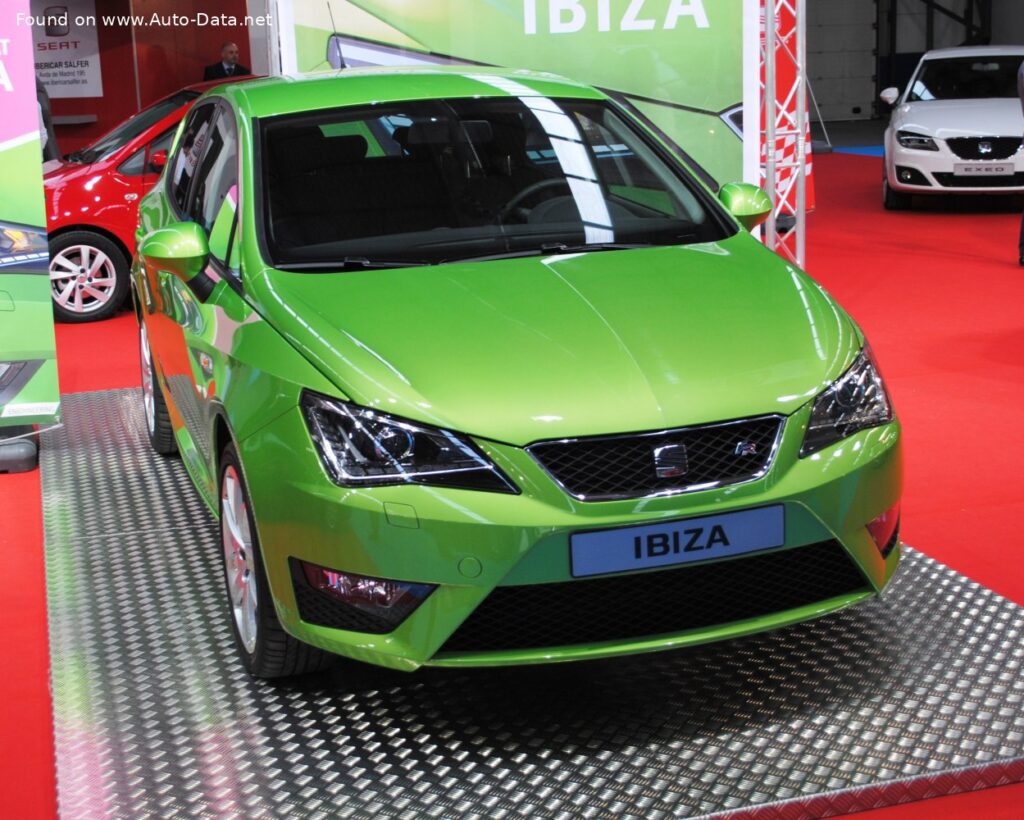
The 2012 facelift brought a sharper, more assertive look to the fourth-generation Ibiza. The 5-door hatchback body style offered a practical solution for European families and individuals, balancing compact exterior dimensions with a surprisingly spacious interior for five occupants. The refreshed front fascia featured redesigned headlights, a more angular grille, and updated bumper styling, giving the Ibiza a more contemporary and aggressive stance. The rear also received subtle updates to the taillights and bumper, maintaining a cohesive design language.
Inside, the Ibiza offered a functional and ergonomic cabin. While exact feature lists varied by trim, standard amenities for the era typically included air conditioning, power windows, and an audio system. Safety was a key consideration, with the Ibiza featuring an Anti-lock Braking System (ABS) as standard, along with multiple airbags and electronic stability control (ESC) on higher trims or as an option. The suspension system, comprising an independent McPherson strut setup with coil springs and an anti-roll bar at the front and a semi-independent coil spring arrangement at the rear, provided a comfortable yet agile ride, well-suited to varying European road conditions.
The Ibiza’s compact footprint, with a length of 159.88 inches (4061 mm) and a width of 66.65 inches (1693 mm), made it highly maneuverable in tight urban environments, further aided by a minimum turning circle of 34.38 feet (10.48 m). Despite its small size, the hatchback offered a usable 10.31 cu. ft. (292 liters) of trunk space, expandable by folding the rear seats, enhancing its practicality for shopping or weekend trips.
Technical Specifications: Seat Ibiza IV (facelift 2012) 1.4 (85 Hp)
| Category | Specification | US Equivalent |
|---|---|---|
| General Information | ||
| Brand | Seat | — |
| Model | Ibiza | — |
| Generation | Ibiza IV (facelift 2012) | — |
| Type (Engine) | 1.4 (85 Hp) | — |
| Start of Production | 2012 year | — |
| End of Production | 2015 year | — |
| Powertrain Architecture | Internal Combustion engine | — |
| Body type | Hatchback | — |
| Seats | 5 | — |
| Doors | 5 | — |
| Performance Specs | ||
| Fuel consumption (economy) – urban | 8 l/100 km | 29.4 US mpg |
| Fuel consumption (economy) – extra urban | 4.7 l/100 km | 50 US mpg |
| Fuel consumption (economy) – combined | 5.9 l/100 km | 39.9 US mpg |
| CO2 emissions | 139 g/km | — |
| Fuel Type | Petrol (Gasoline) | — |
| Acceleration 0 – 62 mph (0-100 km/h) | 11.8 sec | — |
| Acceleration 0 – 60 mph (Calculated) | 11.2 sec | — |
| Maximum speed | 177 km/h | 109.98 mph |
| Weight-to-power ratio | 12.6 kg/Hp | 79.1 Hp/tonne |
| Weight-to-torque ratio | 8.1 kg/Nm | 122.8 Nm/tonne |
| Engine Specs | ||
| Power | 85 Hp @ 5000 rpm | — |
| Power per liter | 61.2 Hp/l | — |
| Torque | 132 Nm @ 3800 rpm | 97.36 lb.-ft. @ 3800 rpm |
| Engine layout | Front, Transverse | — |
| Engine Model/Code | CGGB | — |
| Engine displacement | 1390 cm3 | 1.4 liters (84.82 cu. in.) |
| Number of cylinders | 4 | — |
| Engine configuration | Inline | — |
| Cylinder Bore | 76.5 mm | 3.01 in. |
| Piston Stroke | 75.6 mm | 2.98 in. |
| Compression ratio | 10.5:1 | — |
| Number of valves per cylinder | 4 | — |
| Fuel injection system | Multi-port manifold injection | — |
| Engine aspiration | Naturally aspirated engine | — |
| Engine oil capacity | 3.2 l | 3.38 US qt |
| Coolant | 5.6 l | 5.92 US qt |
| Space, Volume and Weights | ||
| Kerb Weight | 1075 kg | 2369.97 lbs. |
| Max. weight | 1526 kg | 3364.25 lbs. |
| Max load | 451 kg | 994.28 lbs. |
| Trunk (boot) space – minimum | 292 l | 10.31 cu. ft. |
| Fuel tank capacity | 45 l | 11.89 US gal |
| Dimensions | ||
| Length | 4061 mm | 159.88 in. |
| Width | 1693 mm | 66.65 in. |
| Height | 1445 mm | 56.89 in. |
| Wheelbase | 2469 mm | 97.2 in. |
| Front track | 1465 mm | 57.68 in. |
| Rear (Back) track | 1457 mm | 57.36 in. |
| Minimum turning circle (turning diameter) | 10.48 m | 34.38 ft. |
| Drivetrain, Brakes and Suspension Specs | ||
| Drivetrain Architecture | The Internal combustion engine (ICE) drives the front wheels of the vehicle. | — |
| Drive wheel | Front wheel drive | — |
| Number of gears and type of gearbox | 5 gears, manual transmission | — |
| Front suspension | Independent, type McPherson with coil spring and anti-roll bar | — |
| Rear suspension | Semi-independent, coil spring | — |
| Front brakes | Ventilated discs | — |
| Rear brakes | Drum | — |
| Assisting systems | ABS (Anti-lock braking system) | — |
| Steering type | Steering rack and pinion | — |
| Tires size | 175/70 R14; 185/60 R15; 215/45 R16; 215/40 R17 | — |
| Wheel rims size | 5.0J x 14; 6.0J x 15; 7.0J x 16; 7.0J x 17 | — |
Legacy and Market Impact in Europe
The Seat Ibiza has long been a key player in the European B-segment, consistently ranking among the top sellers in several countries. The Seat Ibiza IV (facelift 2012) 1.4 (85 Hp) specifically carved out a niche as a sensible, value-oriented option within its class. Its primary competitors included other European stalwarts such as the Volkswagen Polo (with which it shared its platform and many mechanical components), Ford Fiesta, Renault Clio, Opel Corsa, and Peugeot 208. What often set the Ibiza apart was its slightly more youthful and sporty image compared to its more conservative rivals, a characteristic Seat actively cultivated as its brand identity.
Its robust Volkswagen Group engineering provided a reputation for reliability and solid build quality, while its more expressive styling appealed to buyers looking for something a bit more dynamic than a Polo. The 1.4-liter engine, while not a performance leader, offered a proven balance of adequate power for daily driving and excellent fuel economy, making it a cost-effective choice for many European consumers facing high fuel prices and stringent emissions regulations. The combination of a practical 5-door hatchback body, a comfortable ride, and engaging handling ensured its broad appeal.
The Ibiza IV, including the facelifted model, maintained Seat’s position as a vibrant, design-led brand within the Volkswagen Group, particularly in markets like Spain, Germany, and the UK. Its historical significance lies in its continuous evolution, showcasing how a compact car can adapt to changing market demands for efficiency, technology, and style, all while retaining a distinct brand personality. The 1.4 (85 Hp) variant embodies the practical, everyday workhorse of the lineup, contributing significantly to the model’s enduring success and solidifying the Ibiza’s legacy as one of Europe’s most beloved subcompacts.