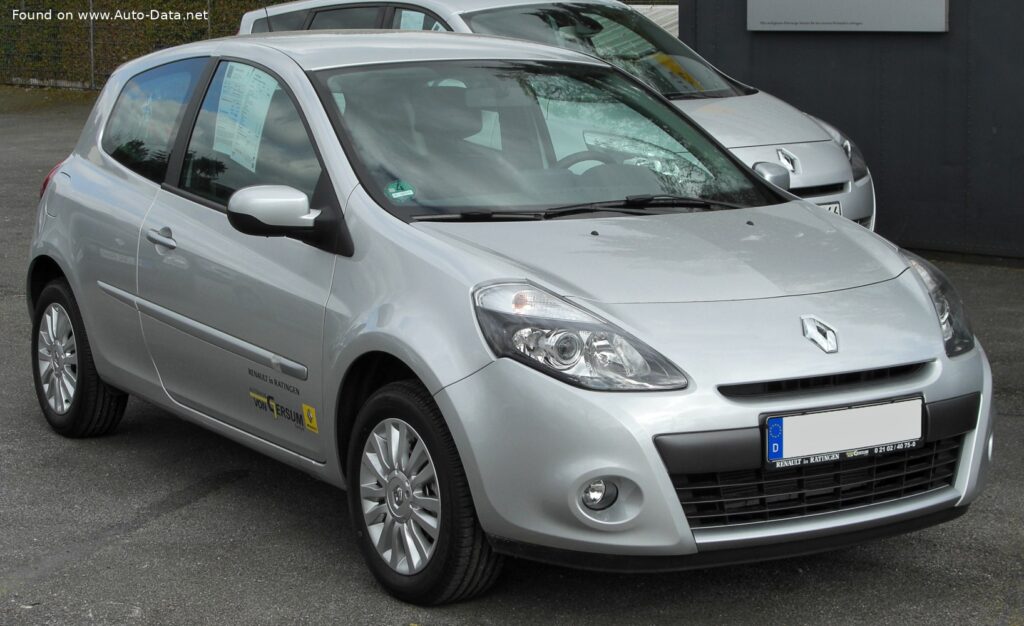
The Renault Clio III (Phase II, 2009) 3-door 1.2 16V (78 Hp) Quickshift: A European Supermini Standard
The Renault Clio III (Phase II, 2009) 3-door 1.2 16V (78 Hp) Quickshift represents a significant iteration of Renault’s highly successful supermini, a segment fiercely contested in the European automotive market. Launched in May 2009 as part of the Clio’s third generation (Phase II facelift), this particular model combined a compact, three-door hatchback body style with a small-displacement, fuel-efficient gasoline engine and an automated manual transmission. While the Renault Clio has never been officially sold in the United States, it has consistently been one of Europe’s best-selling cars, renowned for its blend of practicality, style, and accessible technology. This 2009 model aimed to further refine the Clio’s appeal, offering enhanced efficiency and updated aesthetics to maintain its competitive edge against rivals across the continent.
Positioned as an ideal urban commuter and a versatile small family car, the Clio III (Phase II) continued the legacy of its predecessors by providing a comfortable ride, nimble handling, and a thoughtfully designed interior within a compact footprint. This specific 1.2-liter 16-valve variant, paired with the Quickshift automated manual gearbox, emphasized ease of driving in congested city environments and aimed for optimal fuel economy, a crucial factor for European buyers facing high fuel prices and stringent emissions regulations.
Engine and Performance of the Renault Clio III (Phase II, 2009) 3-door 1.2 16V (78 Hp) Quickshift
At the heart of this particular Renault Clio III (Phase II, 2009) 3-door 1.2 16V (78 Hp) Quickshift model was Renault’s D4F 764 engine, a naturally aspirated 1.2-liter (1149 cm3 or 70.12 cu. in.) inline four-cylinder gasoline unit. This engine featured a Double Overhead Camshaft (DOHC) valvetrain with four valves per cylinder, a configuration designed for efficient breathing and responsiveness. It produced a modest but adequate 78 horsepower at 5500 rpm, delivering a power output of approximately 67.9 Hp per liter. Peak torque stood at 108 Newton-meters (79.66 lb.-ft.) at 4250 rpm, providing sufficient thrust for city driving and maintaining momentum on extra-urban roads. The multi-port manifold injection system ensured precise fuel delivery, contributing to both performance and efficiency.
Power was sent to the front wheels via a 5-speed Quickshift automated manual transmission. This type of gearbox, distinct from a conventional automatic with a torque converter, used an electronically controlled clutch and gear selection mechanism. While offering the convenience of two-pedal driving, it typically provided a more direct feel and often better fuel economy than traditional automatics of the era, albeit sometimes with noticeable shifts.
In terms of performance, the Renault Clio III (Phase II, 2009) 3-door 1.2 16V (78 Hp) Quickshift was engineered for practicality rather than outright speed. It accelerated from 0 to 60 mph in a calculated 14.2 seconds, with a top speed of 101.28 mph (163 km/h). These figures placed it firmly in the realm of efficient urban transport. Fuel economy was a strong suit, with a combined NEDC rating of 5.6 liters per 100 kilometers, translating to an impressive 42 US mpg. Urban consumption was rated at 7.1 l/100 km (33.1 US mpg), and extra-urban at 4.7 l/100 km (50 US mpg). CO2 emissions were rated at 133 g/km, meeting the Euro 4 emission standard, which was competitive for its time. The car’s kerb weight of 2403.04 lbs (1090 kg) contributed to its nimble feel and efficiency.
Design and Features
The Clio III (Phase II) showcased a refined design language, building upon the well-received aesthetics of the pre-facelift model. The 3-door hatchback body offered a sporty and compact appearance, ideal for navigating tight city streets and parking spaces. Its dimensions measured 158.74 inches (4032 mm) in length, 67.72 inches (1720 mm) in width (79.72 inches or 2025 mm including mirrors), and 58.94 inches (1497 mm) in height, with a wheelbase of 101.38 inches (2575 mm). These proportions contributed to a stable stance and a surprisingly spacious interior for its class.
Inside, the Renault Clio III (Phase II, 2009) 3-door 1.2 16V (78 Hp) Quickshift provided seating for five occupants. Renault was known for creating comfortable and ergonomic interiors, and the Clio III was no exception, offering a pleasant environment for both driver and passengers. The trunk space was practical, ranging from 10.17 cubic feet (288 liters) with all seats in place, expanding to a generous 36.66 cubic feet (1038 liters) with the rear seats folded down, enhancing its utility for shopping or weekend trips.
Key chassis and safety features included an independent McPherson strut front suspension with coil springs and an anti-roll bar, providing a good balance of comfort and handling. The rear suspension utilized a coil spring torsion beam setup, a common and cost-effective solution for compact cars that also maximizes interior space. Braking was handled by ventilated discs at the front (260×22 mm) and drum brakes at the rear (203 mm), augmented by an Anti-lock Braking System (ABS) for enhanced stopping power and control. The steering system was a rack and pinion type with electric power steering, offering light and precise control, particularly beneficial for urban maneuvering. Various tire and wheel options were available, ranging from 15-inch to 16-inch sizes, impacting both aesthetics and ride characteristics.
Technical Specifications
| Feature | Specification |
|---|---|
| Brand | Renault |
| Model | Clio III (Phase II, 2009) 3-door |
| Type (Engine) | 1.2 16V (78 Hp) Quickshift |
| Production Start | May, 2009 |
| Production End | January, 2011 |
| Body Type | Hatchback |
| Doors | 3 |
| Seats | 5 |
| Fuel Type | Petrol (Gasoline) |
| Engine Displacement | 1149 cm3 (70.12 cu. in.) |
| Power | 78 Hp @ 5500 rpm |
| Torque | 108 Nm (79.66 lb.-ft.) @ 4250 rpm |
| Engine Layout | Front, Transverse |
| Cylinders | 4, Inline |
| Valves per Cylinder | 4 |
| Fuel Injection | Multi-port manifold injection |
| Engine Aspiration | Naturally aspirated |
| Valvetrain | DOHC |
| Compression Ratio | 10.6:1 |
| 0-60 mph Acceleration | 14.2 sec |
| Maximum Speed | 101.28 mph (163 km/h) |
| Fuel Economy (Combined) | 5.6 l/100 km (42 US mpg) |
| CO2 Emissions | 133 g/km (Euro 4) |
| Transmission Type | 5-speed automatic transmission Quickshift |
| Drive Wheel | Front-wheel drive |
| Kerb Weight | 2403.04 lbs (1090 kg) |
| Maximum Weight | 3483.3 lbs (1580 kg) |
| Fuel Tank Capacity | 14.53 US gal (55 l) |
| Trunk Space (Min/Max) | 10.17 / 36.66 cu. ft. (288 / 1038 l) |
| Length | 158.74 in (4032 mm) |
| Width | 67.72 in (1720 mm) |
| Height | 58.94 in (1497 mm) |
| Wheelbase | 101.38 in (2575 mm) |
| Ground Clearance | 4.72 in (120 mm) |
| Turning Circle | 33.79 – 37.07 ft (10.3 – 11.3 m) |
| Front Suspension | Independent McPherson with coil spring and anti-roll bar |
| Rear Suspension | Coil spring, Torsion beam |
| Front Brakes | Ventilated discs, 260×22 mm |
| Rear Brakes | Drum, 203 mm |
| Assisting Systems | ABS (Anti-lock braking system) |
| Steering Type | Steering rack and pinion, Electric Power Steering |
Legacy and Market Impact
The Renault Clio, throughout its generations, has consistently been a cornerstone of the European supermini segment, and the Clio III (Phase II) was instrumental in maintaining this strong market position. The Renault Clio III (Phase II, 2009) 3-door 1.2 16V (78 Hp) Quickshift variant, specifically, played a vital role in offering an accessible, economical, and user-friendly option for a wide demographic of buyers. Its success was built on a reputation for reliability, attractive styling, and strong safety credentials, having achieved a five-star Euro NCAP safety rating (for the Clio III generation as a whole).
In its primary European market, the Clio III Phase II competed fiercely with established rivals such as the Ford Fiesta, Peugeot 207, Volkswagen Polo, and Opel Corsa. What set the Clio apart was often its sophisticated ride quality for a small car, comfortable seating, and a generally upscale feel compared to some of its more utilitarian competitors. The 1.2-liter engine, while not powerful, was perfectly suited for the daily grind of city life, offering low running costs and a relaxed driving experience, particularly when paired with the Quickshift transmission. This automated manual gearbox, though sometimes criticized for its shift characteristics by drivers accustomed to traditional automatics, offered a compelling balance of convenience and fuel efficiency that resonated with many European consumers.
The Clio III Phase II also benefited from Renault’s extensive dealer network and brand recognition across Europe. It continued to be perceived as a chic and practical choice, embodying the French brand’s expertise in designing small, yet characterful, vehicles. The 3-door variant, in particular, appealed to younger buyers or those without regular rear passengers who preferred its sportier silhouette over the more practical 5-door model. Its ability to combine a relatively compact exterior with a surprisingly versatile interior, including a decent trunk capacity, further cemented its appeal as a well-rounded contender.
Ultimately, the 2009 Renault Clio III (Phase II) 3-door 1.2 16V (78 Hp) Quickshift was more than just an entry-level model; it was a testament to Renault’s commitment to delivering efficient, safe, and enjoyable compact cars tailored to the specific demands of the European market. Its legacy is one of continued success in a highly competitive segment, proving that thoughtful engineering and a focus on core consumer needs can lead to enduring popularity.