Introduction to the Renault Clio III (Phase II, 2009) 3-door
The Renault Clio III (Phase II, 2009) 3-door 1.4 16V (98 Hp) represents a significant iteration within the third generation of Renault’s highly successful supermini, the Clio. Unveiled in 2009, this Phase II update brought subtle but impactful refinements to a model that had already garnered critical acclaim, including the prestigious European Car of the Year award in 2006. As a cornerstone of the European B-segment, the Clio III was designed to offer a compelling blend of compact dimensions, practical interior space, impressive safety features for its class, and an engaging driving experience. This particular variant, with its 1.4-liter, 16-valve engine, was positioned as a well-balanced option, providing sufficient power for urban and highway driving while maintaining a focus on fuel efficiency. Primarily sold in European and other international markets, the Clio has never been officially imported to the United States, making it a distinctive example of European automotive engineering and market preferences.
Engine & Performance: The 1.4 16V Powertrain in the Renault Clio III (Phase II, 2009) 3-door
At the heart of this particular Renault Clio III (Phase II, 2009) 3-door lies Renault’s well-regarded K4J engine, a naturally aspirated 1.4-liter (1390 cm³ or 84.82 cu. in.) inline-four gasoline unit. This 16-valve engine, employing a multi-port manifold injection system and a Single Overhead Camshaft (SOHC) valvetrain, was engineered for smooth operation and accessible power delivery throughout its rev range. It produces a respectable 98 horsepower at 5700 rpm, translating to a power-per-liter ratio of 70.5 horsepower per liter, which was competitive for its class at the time. Torque output stands at 127 Nm (93.67 lb.-ft.) at 4250 rpm, providing adequate pulling power for daily driving scenarios.
The powertrain architecture is a conventional front-engine, transverse layout, driving the front wheels through a 5-speed manual transmission. This setup contributes to the Clio’s agile handling and efficient packaging. In terms of outright performance, the 1.4 16V Clio III Phase II is capable of accelerating from 0 to 60 mph in an estimated 10.5 seconds (0-100 km/h in 11 seconds) and reaching a maximum speed of 113.71 mph (183 km/h). While not a performance hot hatch, these figures underscore its capability as a brisk and responsive commuter car.
Fuel economy was a key consideration for European buyers, and this Clio variant delivered competitive numbers. The combined fuel consumption is rated at 6.6 liters per 100 km, which translates to an impressive 35.6 US miles per gallon. Urban driving yields approximately 8.7 l/100 km (27 US mpg), while extra-urban (highway) driving improves to 5.4 l/100 km (43.6 US mpg). These figures highlight the engine’s balance between performance and economic operation, a crucial factor in the supermini segment.
Design & Features of the Renault Clio III (Phase II, 2009) 3-door
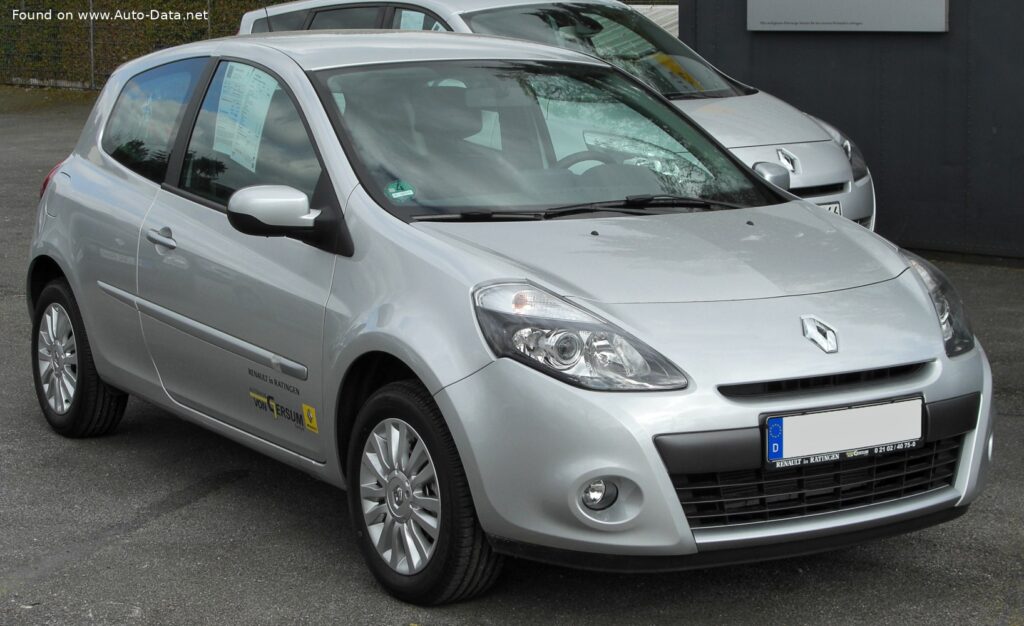
The Renault Clio III (Phase II, 2009) 3-door maintains the fundamental design language of the third-generation Clio while incorporating subtle updates that refreshed its appearance and enhanced its appeal. As a 3-door hatchback, it presented a sportier silhouette compared to its 5-door sibling, appealing to younger buyers or those prioritizing style over rear-door access. Its dimensions—158.74 inches (4032 mm) in length, 67.72 inches (1720 mm) in width (79.72 inches or 2025 mm including mirrors), and 58.94 inches (1497 mm) in height—made it perfectly suited for maneuvering and parking in congested European cities.
The Phase II update typically brought revised front fascias, including new headlights, grilles, and bumpers, giving the car a more modern and assertive look. The rear also saw minor tweaks to the taillight clusters and bumper design. Inside, the Clio III was praised for its robust build quality and thoughtful ergonomics. Despite its compact exterior, the cabin offered comfortable seating for five, though the 3-door configuration naturally made rear access a bit tighter. The trunk space was practical, ranging from 10.17 cubic feet (288 liters) with the rear seats up, expandable to a generous 36.66 cubic feet (1038 liters) with the rear seats folded down, making it versatile for groceries, luggage, or larger items.
Safety features for the Clio III were advanced for its segment at the time, contributing to its strong Euro NCAP crash test ratings. Standard equipment included an Anti-lock Braking System (ABS), and often a suite of airbags (front, side, and curtain airbags were commonly available depending on trim). The vehicle featured ventilated disc brakes at the front and reliable drum brakes at the rear, coupled with a responsive electric power steering system and a steering rack and pinion setup, ensuring confident handling and braking performance. The front suspension utilized spring struts, while the rear featured coil springs, providing a comfortable yet controlled ride characteristic of European hatchbacks.
Technical Specifications
| Category | Specification | US Equivalent / Notes |
|---|---|---|
| Brand | Renault | |
| Model | Clio | |
| Generation | Clio III (Phase II, 2009) 3-door | |
| Type (Engine) | 1.4 16V (98 Hp) | |
| Start of Production | 2009 year | |
| End of Production | 2012 year | |
| Powertrain Architecture | Internal Combustion engine | Front-wheel drive |
| Body type | Hatchback | |
| Seats | 5 | |
| Doors | 3 | |
| Fuel Type | Petrol (Gasoline) | |
| Fuel consumption (economy) – urban | 8.7 l/100 km | 27 US mpg |
| Fuel consumption (economy) – extra urban | 5.4 l/100 km | 43.6 US mpg |
| Fuel consumption (economy) – combined | 6.6 l/100 km | 35.6 US mpg |
| Acceleration 0 – 60 mph | 10.5 sec | |
| Acceleration 0 – 100 km/h | 11 sec | |
| Maximum speed | 183 km/h | 113.71 mph |
| Power | 98 Hp @ 5700 rpm. | |
| Power per liter | 70.5 Hp/l | |
| Torque | 127 Nm @ 4250 rpm. | 93.67 lb.-ft. @ 4250 rpm. |
| Engine layout | Front, Transverse | |
| Engine Model/Code | K4J | |
| Engine displacement | 1390 cm³ | 1.4 liters / 84.82 cu. in. |
| Number of cylinders | 4 | Inline configuration |
| Cylinder Bore | 79.5 mm | 3.13 in. |
| Piston Stroke | 70 mm | 2.76 in. |
| Compression ratio | 10:1 | |
| Number of valves per cylinder | 4 | Total 16 valves |
| Fuel injection system | Multi-port manifold injection | |
| Engine aspiration | Naturally aspirated engine | |
| Valvetrain | SOHC | Single Overhead Camshaft |
| Engine oil capacity | 5 l | 5.28 US qt |
| Coolant capacity | 5.5 l | 5.81 US qt |
| Kerb Weight | 1145 kg | 2524.29 lbs. |
| Max. weight | 1635 kg | 3604.56 lbs. |
| Max load | 490 kg | 1080.27 lbs. |
| Trunk (boot) space – minimum | 288 l | 10.17 cu. ft. |
| Trunk (boot) space – maximum | 1038 l | 36.66 cu. ft. |
| Fuel tank capacity | 55 l | 14.53 US gal |
| Length | 4032 mm | 158.74 in. |
| Width | 1720 mm | 67.72 in. |
| Width including mirrors | 2025 mm | 79.72 in. |
| Height | 1497 mm | 58.94 in. |
| Wheelbase | 2575 mm | 101.38 in. |
| Front track | 1472 mm | 57.95 in. |
| Rear (Back) track | 1470 mm | 57.87 in. |
| Front overhang | 830 mm | 32.68 in. |
| Rear overhang | 626 mm | 24.65 in. |
| Minimum turning circle | 10.7 m | 35.1 ft. |
| Drivetrain Architecture | Front wheel drive | Internal Combustion engine drives front wheels |
| Number of gears and type of gearbox | 5 gears, manual transmission | |
| Front suspension | Spring Strut | |
| Rear suspension | Coil spring | |
| Front brakes | Ventilated discs | |
| Rear brakes | Drum | |
| Assisting systems | ABS (Anti-lock braking system) | |
| Steering type | Steering rack and pinion | |
| Power steering | Electric Steering | |
| Tires size | 185/60 R15 | |
| Wheel rims size | 6J x 15 |
Legacy & Market Impact of the Renault Clio III (Phase II, 2009) 3-door
The Renault Clio III, particularly in its Phase II iteration, solidified the model’s reputation as a leader in the fiercely competitive European supermini segment. Since its inception in 1990, the Clio has consistently been one of Europe’s best-selling cars, and the third generation, produced from 2005 to 2012, continued this trend with its blend of style, practicality, and safety. The 2009 Phase II update ensured the Clio remained fresh against newer rivals, maintaining its strong appeal to a broad demographic, from first-time drivers to small families seeking an economical and reliable vehicle.
In its primary markets, the Clio III 3-door 1.4 16V competed directly with other European stalwarts such as the Ford Fiesta, Volkswagen Polo, Opel/Vauxhall Corsa, and Peugeot 207. What set the Clio apart was often its distinctive French styling, a comfortable ride quality that sometimes prioritized suppleness over ultimate sportiness (though it remained agile), and its strong emphasis on passive and active safety features. Its five-star Euro NCAP safety rating was a significant selling point, underscoring Renault’s commitment to occupant protection.
The 1.4 16V engine variant was a popular choice, occupying a sweet spot in the lineup. It offered more power than the entry-level 1.2-liter engines, making it more capable on highways, without incurring the higher running costs or purchase price of the larger 1.6-liter gasoline or diesel options. This balance of performance and economy made it a pragmatic choice for many European consumers. The 3-door body style, while slightly less practical for rear passenger access than the 5-door, often appealed to buyers looking for a sportier aesthetic and a more compact feel.
The legacy of the Renault Clio III is one of continued success and evolution for the Clio nameplate. It built upon the foundations laid by its predecessors, demonstrating Renault’s ability to produce a small car that felt premium and substantial. While never sold in the U.S. market, its impact on the European automotive landscape was profound, influencing design trends and setting benchmarks for safety and interior quality in the supermini class. The Clio III’s robust engineering and enduring popularity paved the way for future generations of the model, ensuring the Clio remains a household name across Europe and beyond.