The Peugeot 207 CC 1.6 VTi (120 Hp) Automatic: A European Compact Convertible Icon
The Peugeot 207 CC 1.6 VTi (120 Hp) Automatic represents a significant chapter in the compact coupe-cabriolet segment, a niche particularly popular in Europe during the 2000s. Launched in 2006, the 207 CC was the successor to the highly successful 206 CC, which pioneered the affordable retractable hardtop in the mass market. As part of the broader Peugeot 207 lineup, this specific variant, with its 1.6-liter VTi engine and automatic transmission, offered a blend of open-air motoring, practical urban usability, and a touch of French style. While never officially sold in the United States, the Peugeot 207 CC 1.6 VTi (120 Hp) Automatic carved out a strong identity in its primary European markets, appealing to consumers seeking a versatile vehicle that could transform from a secure coupe to a sun-loving convertible at the touch of a button.
Engine and Performance of the Peugeot 207 CC 1.6 VTi (120 Hp) Automatic
At the heart of the Peugeot 207 CC 1.6 VTi (120 Hp) Automatic lies a 1.6-liter VTi (Variable Valve Lift and Timing Injection) gasoline engine, a naturally aspirated inline-four-cylinder unit. This engine, designated with the internal code 5FW EP6, was part of the “Prince” engine family, a collaboration between PSA Peugeot Citroën and BMW. Known for its efficiency and refined operation, the 1.6 VTi delivered a respectable 120 horsepower at 6000 rpm, providing adequate power for its segment. Peak torque stood at 118.01 lb.-ft. (160 Nm) at 4250 rpm, ensuring a responsive feel in city driving and sufficient grunt for highway cruising.
Power was channeled to the front wheels via a 4-speed automatic transmission. While a 4-speed automatic might seem somewhat dated by contemporary standards, even in 2006, it offered a smooth and effortless driving experience, perfectly suited to the relaxed nature of a compact convertible. Performance figures for this configuration included an acceleration time of 12.6 seconds from 0 to 62 mph (0-100 km/h), or 12 seconds from 0 to 60 mph. The top speed reached 121.17 mph (195 km/h), making it capable of comfortable highway travel within European speed limits. Despite its convertible nature, the engine’s design, featuring DOHC-VVT (Double Overhead Camshaft with Variable Valve Timing) and multi-port manifold injection, contributed to a combined fuel economy of approximately 32.7 US mpg (7.2 l/100 km) and CO2 emissions of 173 g/km, meeting Euro 4 emission standards.
Design and Features
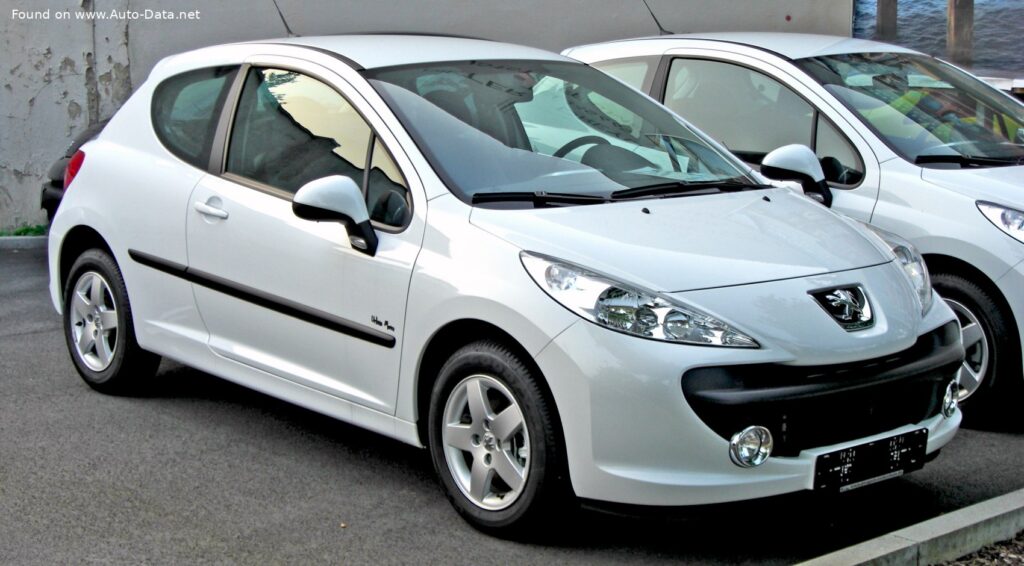
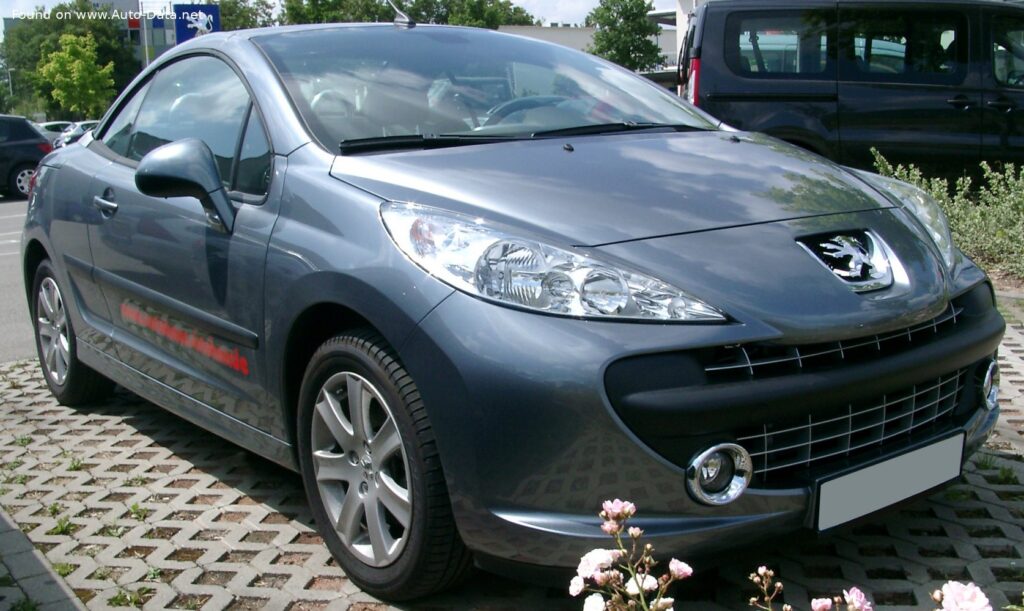
The Peugeot 207 CC inherited the distinctive styling cues of the 207 hatchback, adapting them to its unique coupe-cabriolet body type. The design successfully integrated the retractable hardtop mechanism into a compact two-door, four-seat package. With the roof up, the 207 CC presented a sleek and sporty coupe profile, characterized by its flowing lines and Peugeot’s signature large grille. When the electro-hydraulic roof was stowed, it transformed into an attractive open-top convertible, ideal for sunny drives. The roof operation was fully automatic, a significant convenience feature for the time.
Measuring 158.94 inches (4037 mm) in length and 68.82 inches (1748 mm) in width, the 207 CC maintained a compact footprint, making it agile in urban environments. The interior, though designed for four occupants, offered more comfortable seating for two adults and two smaller passengers, especially when the roof was down and trunk space was at a premium. Safety features included an Anti-lock Braking System (ABS) as standard, along with disc brakes on all four wheels (ventilated discs at the front) for confident stopping power. The car rode on 195/55 R16 tires and 16-inch wheel rims, providing a balance of ride comfort and handling. The trunk space varied significantly depending on the roof position: 6.6 cu. ft. (187 liters) with the roof down, expanding to a more practical 15.86 cu. ft. (449 liters) with the roof up, highlighting the inherent compromise of a retractable hardtop design.
Technical Specifications: Peugeot 207 CC 1.6 VTi (120 Hp) Automatic
| General Information | |
|---|---|
| Brand | Peugeot |
| Model | 207 |
| Generation | 207 CC |
| Type (Engine) | 1.6 VTi (120 Hp) Automatic |
| Start of Production | 2006 year |
| End of Production | 2009 year |
| Powertrain Architecture | Internal Combustion engine |
| Body Type | Coupe – Cabriolet |
| Seats | 4 |
| Doors | 2 |
| Performance Specifications | |
| Fuel Consumption (Urban) | 10 l/100 km (23.5 US mpg) |
| Fuel Consumption (Extra Urban) | 5.7 l/100 km (41.3 US mpg) |
| Fuel Consumption (Combined) | 7.2 l/100 km (32.7 US mpg) |
| CO2 Emissions | 173 g/km |
| Fuel Type | Petrol (Gasoline) |
| Acceleration 0-62 mph (0-100 km/h) | 12.6 sec |
| Acceleration 0-60 mph (Calculated) | 12 sec |
| Maximum Speed | 195 km/h (121.17 mph) |
| Emission Standard | Euro 4 |
| Weight-to-Power Ratio | 11.6 kg/Hp (86.3 Hp/tonne) |
| Weight-to-Torque Ratio | 8.7 kg/Nm (115 Nm/tonne) |
| Engine Specifications | |
| Power | 120 Hp @ 6000 rpm |
| Power per Liter | 75.1 Hp/l |
| Torque | 160 Nm @ 4250 rpm (118.01 lb.-ft. @ 4250 rpm) |
| Engine Layout | Front, Transverse |
| Engine Model/Code | 5FW EP6 |
| Engine Displacement | 1598 cm³ (97.52 cu. in.) |
| Number of Cylinders | 4 |
| Engine Configuration | Inline |
| Cylinder Bore | 77 mm (3.03 in.) |
| Piston Stroke | 85.8 mm (3.38 in.) |
| Compression Ratio | 11:1 |
| Number of Valves per Cylinder | 4 |
| Fuel Injection System | Multi-port manifold injection |
| Engine Aspiration | Naturally aspirated engine |
| Valvetrain | DOHC-VVT |
| Engine Oil Capacity | 4.25 l (4.49 US qt) |
| Engine Oil Specification | Not Specified |
| Coolant Capacity | 5.4 l (5.71 US qt) |
| Space, Volume and Weights | |
| Kerb Weight | 1391 kg (3066.63 lbs.) |
| Max. Weight | 1765 kg (3891.16 lbs.) |
| Max Load | 374 kg (824.53 lbs.) |
| Trunk (Boot) Space – Minimum | 187 l (6.6 cu. ft.) |
| Trunk (Boot) Space – Maximum | 449 l (15.86 cu. ft.) |
| Fuel Tank Capacity | 50 l (13.21 US gal) |
| Permitted Trailer Load with Brakes (12%) | 1060 kg (2336.9 lbs.) |
| Permitted Trailer Load without Brakes | 600 kg (1322.77 lbs.) |
| Dimensions | |
| Length | 4037 mm (158.94 in.) |
| Width | 1748 mm (68.82 in.) |
| Width with Mirrors Folded | 1818 mm (71.57 in.) |
| Width Including Mirrors | 1972 mm (77.64 in.) |
| Height | 1397 mm (55 in.) |
| Wheelbase | 2540 mm (100 in.) |
| Front Track | 1469 mm (57.83 in.) |
| Rear (Back) Track | 1470 mm (57.87 in.) |
| Drag Coefficient (Cd) | 0.31 |
| Minimum Turning Circle (Turning Diameter) | 10.8 m (35.43 ft.) |
| Drivetrain, Brakes and Suspension Specifications | |
| Drivetrain Architecture | The Internal combustion engine (ICE) drives the front wheels of the vehicle. |
| Drive Wheel | Front wheel drive |
| Number of Gears and Type of Gearbox | 4 gears, automatic transmission |
| Front Suspension | Coil spring |
| Rear Suspension | Coil spring |
| Front Brakes | Ventilated discs |
| Rear Brakes | Disc |
| Assisting Systems | ABS (Anti-lock braking system) |
| Steering Type | Steering rack and pinion |
| Tires Size | 195/55 R16 |
| Wheel Rims Size | 16 |
Legacy and Market Impact of the Peugeot 207 CC
The Peugeot 207 CC, particularly the Peugeot 207 CC 1.6 VTi (120 Hp) Automatic variant, continued Peugeot’s strong tradition in the coupe-cabriolet market, building on the success of its groundbreaking predecessor, the 206 CC. This segment, offering the versatility of a hardtop coupe with the thrill of a convertible, resonated strongly with European consumers who often faced variable weather conditions but still desired open-air motoring. The 207 CC was positioned as an accessible and stylish option for those who wanted a convertible without the compromises of a fabric roof or the higher price tag of premium models.
In its primary markets, the 207 CC faced competition from other compact retractable hardtops such as the Opel Tigra TwinTop, Nissan Micra C+C, and the Mitsubishi Colt CZC. What set the 207 CC apart was its more mature styling compared to some quirky rivals, its relatively comfortable ride, and the established reputation of Peugeot’s CC line. The 1.6 VTi engine, being part of the “Prince” family, also lent it a degree of technical sophistication and efficiency that was appreciated. While the 4-speed automatic transmission was perhaps its weakest link in terms of modern performance, it perfectly aligned with the car’s role as a relaxed cruiser rather than a performance machine.
The 207 CC played a crucial role in solidifying Peugeot’s image as a leader in innovative and stylish compact cars. Its production run from 2006 to 2009 saw it maintain a strong presence in European sales charts, appealing particularly to younger buyers and those seeking a second, fun-to-drive vehicle. Its absence from the U.S. market is largely due to Peugeot’s withdrawal from North America decades prior, as well as the generally smaller demand for compact convertibles in the American automotive landscape, which tends to favor larger, more powerful vehicles. Nevertheless, the Peugeot 207 CC remains a testament to European automotive design and engineering, offering a unique blend of practicality, style, and open-top enjoyment that defined a specific era of motoring.